Why Outdated Policies Create Legal Risk
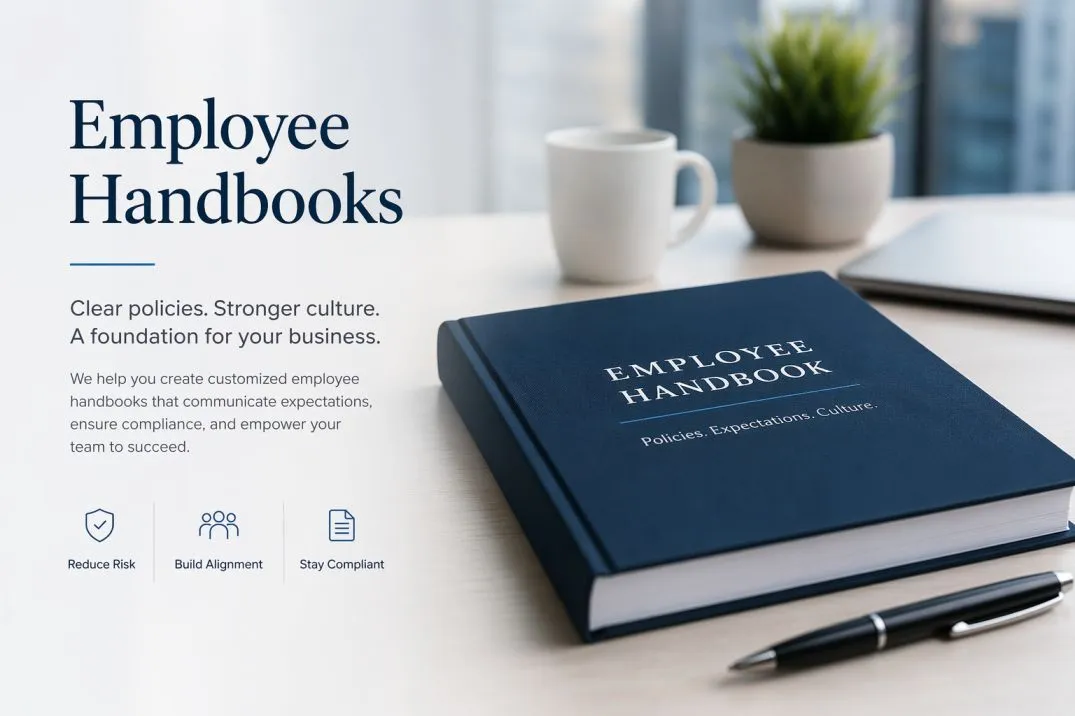
A structured employee handbook service ensures that policies are not just written, but aligned with how the organization actually operates.
Most employee handbooks are a legal liability masquerading as a compliance document. They were written years ago, updated in layers by adding new policies without removing contradictory old ones, and reviewed by someone whose primary qualification was that they had time to do it. The result is a document that is internally inconsistent, legally outdated, and operationally useless — and that can be used against the organization in litigation because it makes promises the organization does not keep and establishes standards the organization does not enforce.
Over time, corporate policies and employee policies are layered without coordination, creating contradictions that expose the organization to unnecessary risk.
The sedimentary layering problem is real. An organization adds a social media policy in 2014. Adds a remote work addendum in 2020. Adds a COVID protocol in 2021. Never removes the contradictory provisions from 2009. The document becomes a palimpsest of organizational history rather than a functional guide to how the organization actually operates. Employees do not read it. Supervisors do not follow it. And when something goes wrong, everyone discovers simultaneously that the handbook says something nobody knew it said.
What a Modern Employee Handbook Must Do
A well-designed employee handbook serves three distinct functions simultaneously — and most handbooks fail at all three. Understanding what the document is supposed to accomplish is the starting point for building one that actually works.
Human resource policies should reflect both legal requirements and operational reality, not just compliance templates copied from another organization.
A legally compliant handbook establishes the organization's policies in writing, demonstrates that employees were informed of those policies, and creates a documented basis for disciplinary action when policies are violated. It is the organization's first line of defense in employment litigation.
A handbook communicates what the organization values, how it expects people to treat each other, and what employees can expect from the organization in return. The tone and content of a handbook send a clear signal about whether the organization respects its employees — and employees notice.
A well-designed handbook gives employees the information they need to navigate the organization — how to request leave, how to report a concern, what to do when they have a conflict with a coworker. It reduces the number of questions HR has to answer individually and ensures consistency across the organization.
How to Fix an Outdated Employee Handbook
An outdated employee handbook creates legal risk, management inconsistency, and confusion across the organization. Fixing an outdated employee handbook requires more than editing old language. An effective employee handbook review aligns handbook policies with current employment law, daily operations, and supervisor expectations so the document protects the organization instead of creating avoidable exposure.
For small businesses, nonprofits, and growing organizations, employee handbook updates should focus on practical compliance, policy clarity, and operational alignment rather than copying generic templates that do not fit the workplace.
- Audit current policies against employment law requirements: Review the handbook for alignment with applicable federal and state requirements, including the FLSA, ADA, FMLA, and relevant Texas employment law standards.
- Align handbook policies with actual operations: Employee handbook policies should reflect how work is truly performed. Policies that conflict with daily practice are often ignored, and ignored policies create liability.
- Remove outdated or overly punitive language: An outdated employee handbook often contains rigid, legacy language that signals distrust, creates inconsistent enforcement, and increases employee relations risk.
- Clarify supervisor expectations and policy enforcement: Supervisors need clear guidance on attendance, leave, discipline, reporting responsibilities, and documentation standards so the handbook can be applied consistently.
- Build a recurring handbook review process: Employee handbook review should not happen only after a problem arises. A defined review cycle helps keep policies current as laws, business practices, and workforce needs change.
- Train managers on handbook content: A compliant employee handbook is only useful if leaders understand it. Supervisor training helps translate policy language into consistent day-to-day practice.
Employee Handbook Consulting: Our Development Process
Building a handbook that actually works requires understanding how the organization operates, not just what the law requires. A generic template filled in with your organization's name is not a handbook — it is a liability with a cover page. Our development process is built around the specific context of your organization.
We build employee handbook policies and procedures that are clear, enforceable, and aligned with how work is actually performed across the organization.
Review of existing policies, current practices, applicable federal and Texas state law requirements, and the organization's specific operational context — including workforce composition, industry requirements, and culture.
Development of a logical, navigable policy structure that covers all required areas without creating unnecessary complexity. Elimination of contradictory, outdated, or legally problematic provisions from existing documentation.
Drafting of all policies in plain language that employees can actually understand, with legal accuracy and organizational specificity. Review cycles with leadership to ensure alignment with organizational values and operational realities.
Guidance on rollout strategy, employee acknowledgment processes, supervisor training on key policy provisions, and documentation practices to ensure the handbook is actually used.
Why Most Employee Handbook Updates Fail
Most employee handbook updates fail because organizations approach the process as a one-time compliance task instead of a structured system improvement. An employee handbook is not just a document. It is a set of policies that guide how work is performed, how decisions are made, and how risk is managed.
When handbook updates are treated as a checkbox exercise, the result is a document that may appear compliant but does not hold up under real-world use. The most common employee handbook mistakes show up quickly — through inconsistent enforcement, employee confusion, and increased legal exposure.
- Copying generic employee handbook templates: Templates found online rarely align with your organization's operations, workforce structure, or applicable state and federal employment laws.
- Using AI-generated employee handbook content without review: AI can assist with drafting, but unreviewed content often includes incorrect policies, missing legal requirements, or language that does not match your organization’s practices.
- Treating the handbook as a one-time update: An employee handbook that is not reviewed regularly becomes outdated as employment laws, internal policies, and operational realities change.
- Failing to align policies with real-world practices: When handbook policies do not reflect how work actually happens, employees and supervisors default to informal processes that create inconsistency and risk.
- Skipping supervisor training and accountability: Managers are responsible for applying handbook policies. Without training, enforcement becomes inconsistent — and inconsistent enforcement is a primary driver of employee claims and disputes.
Policy Modernization Case Study
A startup used an AI tool to generate its employee handbook, believing that a polished-looking document was equivalent to a legally sound one. The handbook contained multiple factual errors about Texas employment law, including incorrect information about at-will employment, overtime exemptions, and leave entitlements. It also contained internally contradictory provisions — the progressive discipline policy conflicted with the at-will employment disclaimer in ways that created implied contract exposure. The organization had distributed the handbook to all employees and obtained signed acknowledgments before anyone with HR expertise reviewed it.
We conducted a comprehensive review of the existing handbook and identified all legally problematic provisions. The engagement included:
- Identification of 14 provisions containing factual errors about applicable law or creating unintended legal obligations
- Complete rewrite of the handbook from scratch, using the organization's existing policies as a starting point but rebuilding the document with legal accuracy and internal consistency
- Development of a revised acknowledgment process that protected the organization's at-will status while clearly communicating the handbook's terms
- Supervisor training on the key provisions most likely to be tested in practice — discipline, leave, and accommodation
- Annual review protocol to ensure the handbook stays current as laws change
The organization replaced its legally problematic handbook with a document that is accurate, consistent, and operationally useful. The revised acknowledgment process was distributed to all employees, and the organization now has a documented record of informed consent. The supervisor training significantly improved consistency in policy application — which had been a source of employee complaints under the previous handbook.
Related Services
Frequently Asked Questions
How often should an employee handbook be updated?
At minimum, annually. Any time a significant law changes, a new policy is adopted, or an HR incident reveals a gap, the handbook should be reviewed and updated.
What makes an employee handbook legally compliant in Texas?
A compliant Texas handbook addresses at-will employment, anti-harassment, leave policies under state and federal law, and wage-and-hour practices consistent with the FLSA and Texas Labor Code.
Can I use an AI-generated employee handbook?
You can, but I would not recommend it. AI-generated handbooks routinely contain legally incorrect provisions and generic language that does not reflect your organization's actual policies. The liability risk is significant.
What is the difference between an employee handbook and an HR policy manual?
A handbook is an employee-facing document that communicates expectations and rights. A policy manual is an internal operational reference. Both should be current, consistent, and aligned.
What is employee handbook consulting?
Employee handbook consulting involves designing or updating employee handbook policies and procedures to ensure legal compliance, internal consistency, and practical usability.
What does an employee handbook service include?
An employee handbook service typically includes policy review, legal alignment, drafting, formatting, and guidance on implementation and employee acknowledgment processes.
What are corporate policies and why do they matter?
Corporate policies define expectations for behavior, compliance, and operations. Poorly written policies can create legal exposure and inconsistent enforcement across the organization.
What should be included in employee policies?
Employee policies should cover workplace conduct, attendance, leave, discipline, compliance requirements, and procedures for reporting issues or concerns.
How often should human resource policies be updated?
Human resource policies should be reviewed at least annually or whenever significant legal or operational changes occur.
Your Handbook Should Protect You, Not Expose You.
If your handbook was last reviewed more than two years ago — or was generated by an AI tool without expert review — you have compliance exposure you may not know about. Let's fix it.