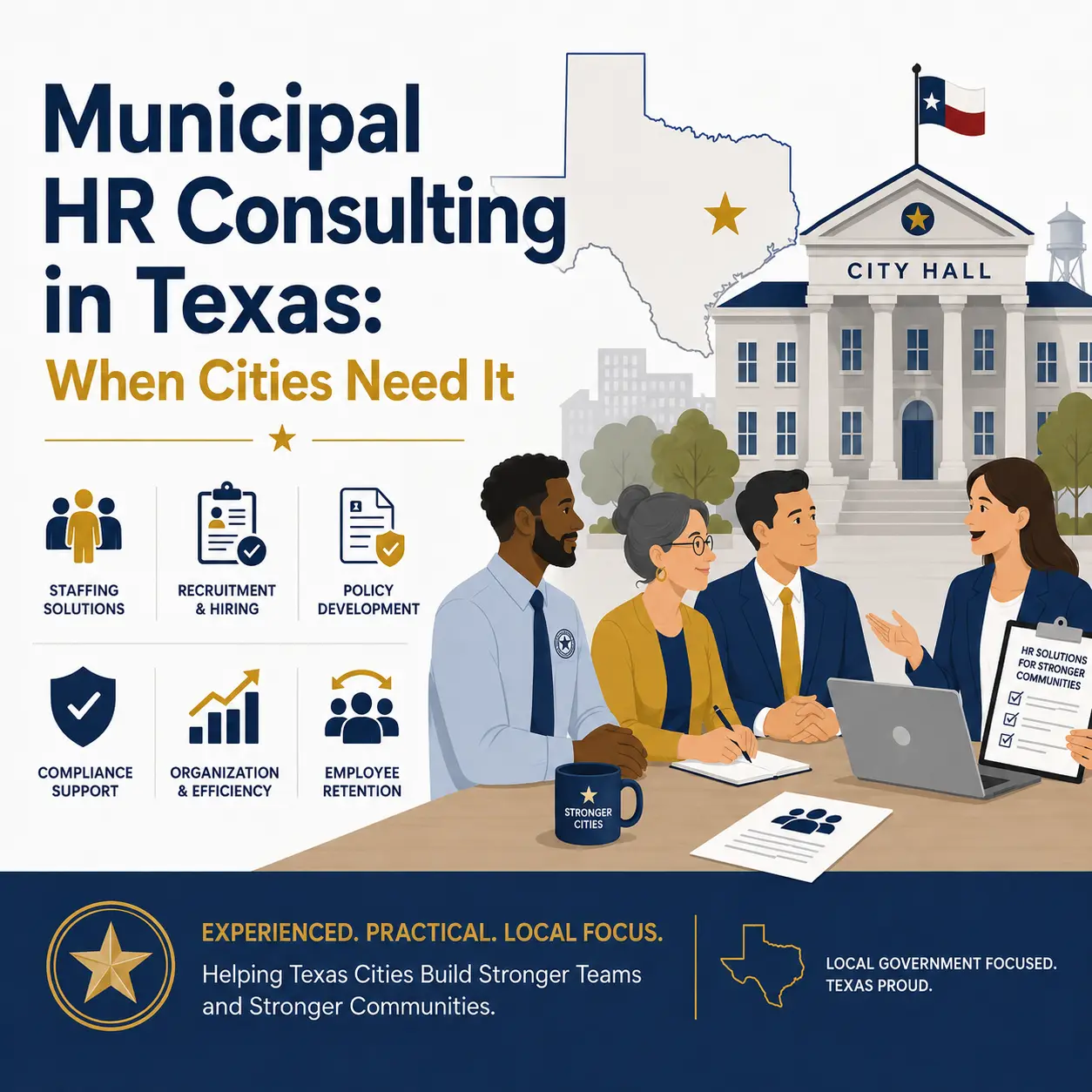
A Texas city needs HR consulting when the way it handles people has outgrown the way it is staffed to handle them — not when it crosses an employee-count line. The honest test is a readiness question: can the city make an employment decision, document it, and defend it consistently, without depending on one person's memory or improvisation? This guide gives you a named maturity model to locate your city on, the measurable triggers that actually predict trouble, and a scored ten-question diagnostic that tells you whether you're administratively manageable, in need of system repair, or ready for dedicated strategic capacity.
Cities ask the wrong question about HR. They ask, "Are we big enough to need this yet?" — as if HR readiness were a function of headcount. It isn't. I've watched a 28-employee city with a police department, safety-sensitive public-works crews, and three grant-funded positions carry more real HR exposure than a 90-employee organization of office staff. Size is the number everyone reaches for because it's easy to count. Complexity, exposure, and projected growth are harder to count and far more predictive.
If you've already decided to bring someone in and you're comparing firms, start with the companion procurement guide — services, scope, deliverables, and a selection scorecard. This page is for the decision that comes first: whether, and how much.
Why Listen to Me on This
I'm Dr. Thomas W. Faulkner, founder of Faulkner HR Solutions. My experience runs through municipal government and behavioral-health operations, not just corporate HR — environments where a personnel file is a public record and the supervisor making a call at 6 a.m. during an ice storm is a working foreman, not a trained manager. I hold a DBA in Organizational Leadership, the SPHR credential, and a Lean Six Sigma Black Belt, and I wrote Designed to Fail because I kept seeing the same thing: organizations engineer the conditions for people problems upstream, then blame the people downstream.
That's why the model below isn't about size. It's about whether the city's HR system has caught up to what the city is actually asking it to do.
The Municipal HR Maturity Model
Every Texas city sits at one of five stages. The goal is not to rush to the top — a small city has no business building a full HR department. The goal is for the stage of your HR system to match the complexity and exposure of your workforce. Trouble shows up when those two fall out of alignment: a city operating at Stage 1 while carrying Stage 3 exposure is the single most common pattern I'm called into.
| Stage | How HR Actually Happens | Where It Breaks |
|---|---|---|
| 1. Informal Handling | HR happens by whoever is nearest the problem. No standard, no written process, decisions made from memory and instinct. | The first contested termination, harassment complaint, or records request the city can't cleanly answer. |
| 2. Administratively Assigned HR | HR duties are bolted onto a city secretary, administrator, or finance clerk who is capable but untrained in HR and already full. | Volume and complexity outrun the person's time; consistency slips between departments; documentation becomes an afterthought. |
| 3. Outside Strategic Support | The city keeps its assigned administrator but layers in senior HR judgment — fractional or project-based — to build systems and handle the hard calls. | Nothing, if scoped right. This is the correct stage for most small and mid-sized Texas cities. |
| 4. Dedicated HR Capacity | A real HR generalist or coordinator role exists and owns the function day to day. | When the role is created before the systems exist, so one person inherits a mess with no framework to run it. |
| 5. Full Departmental Infrastructure | An HR department with specialists, governance, and mature systems — appropriate for larger cities. | When infrastructure grows faster than the discipline to use it; process replaces judgment. |
HR consulting is the right move when your workforce complexity sits a stage or more above your HR system. A Stage 1 or Stage 2 city carrying Stage 3 exposure doesn't need to hire an HR director — it usually needs Stage 3 outside support to build the systems its assigned administrator can then run. That is the most cost-effective correction available to a Texas city, and it's the one most cities skip on the way to over-hiring or under-reacting.
The Measurable Triggers That Actually Predict Trouble
Forget "how many employees." These are the variables that reliably tell me a city's HR system is about to be tested beyond its stage. None of them is decisive alone; three or four together almost always mean the city has crossed into needing outside structure.
- Federal coverage thresholds crossed. Hitting 15 employees (Title VII, ADA), 20 (ADEA), or 50 (FMLA) changes your legal obligations overnight — and most cities don't notice the day they cross the line.
- Number of supervisors making independent people decisions. Every supervisor without a shared standard is a separate, improvised HR system. The more of them, the more inconsistency the city has to defend.
- Department variety. A city with public works, utilities, police or fire, code enforcement, and administration is running five different work realities. Uniform policy applied to non-uniform work produces grievances.
- Safety-sensitive roles. On-call crews, heavy equipment, water and wastewater operators — these raise the stakes of every documentation and discipline decision.
- Recurring complaints under different names. When the same grievance keeps arriving with a new employee attached, you don't have an employee problem. You have a design problem.
- Turnover concentrated in one department. A citywide average can look fine while one critical department quietly destabilizes. Concentration matters more than the average.
- Records exposure. If a Public Information Act request would force you to scramble — or to disclose something that should have been separated — your records system is already behind your obligations.
- Administrator time spent reacting to personnel matters. When the city secretary or administrator is spending real hours firefighting people issues instead of running the city, the informal model has already failed; it just hasn't sent the bill yet.
The 10-Question Municipal HR Readiness Diagnostic
Answer each question honestly for your city. Count one point for every "yes." The result bands below tell you which stage of support fits — and they're written in plain terms so you can score this on paper if you prefer. This is a directional self-assessment, not a substitute for a formal review, but it is the same first cut I make when a city calls.
Score one point for each statement that is true of your city:
What Your Score Means
- 0–3 — Administratively Manageable. Your HR system is roughly aligned with your complexity. Keep it that way with periodic policy updates and a supervisor decision guide. A one-time tune-up beats an ongoing engagement here. Run the free Municipal HR Risk Audit Checklist to confirm.
- 4–6 — System Repair Needed. Your workforce complexity has moved a stage above your HR system. This is the Stage 3 sweet spot: outside strategic support to rebuild policies, documentation, and supervisor consistency — without hiring a full-time HR director. This is the most common — and most fixable — position a Texas city is in.
- 7–10 — Dedicated Strategic Capacity Needed. The informal model has failed and is now generating risk faster than the city can absorb it. You need a sequenced repair and, likely, a plan to build dedicated HR capacity — starting with the systems, then the role, in that order.
A high-scoring city's instinct is to post an HR director job and hope the hire fixes everything. Build the systems first. Dropping one person into a Stage 1 mess with no framework is how good HR hires burn out and quit inside a year — leaving the city worse off, and back at the top of this list.
Why Headcount Is the Wrong Threshold
I'll say it plainly because the whole industry sells against it: headcount alone is a poor threshold for municipal HR readiness. It's popular because it's easy — a number anyone can pull from payroll. But it consistently misreads the two cities that matter most.
It over-reacts for the simple city: 70 employees, all administrative, one location, low turnover, no safety-sensitive work. That city can run well at Stage 2 for a long time. And it under-reacts for the complex city: 30 employees spread across public works, water, police, and a couple of grant-funded roles, with a records obligation and a handful of untrained supervisors. That city is carrying Stage 3 exposure and needs help now, regardless of what the payroll count says.
Complexity, exposure, and projected growth are the real thresholds. The diagnostic above measures those instead of counting heads — which is exactly why it puts some small cities ahead of much larger ones.
Frequently Asked Questions
A Texas city needs HR consulting when its workforce complexity has outgrown its HR system — when the city can no longer make, document, and defend employment decisions consistently without improvising. The clearest signals are recurring complaints under different names, turnover concentrated in one department, records exposure, and an administrator spending real time firefighting personnel issues. Size is a poor trigger; complexity and exposure are reliable ones.
Most small and mid-sized Texas cities are better served by outside strategic support (Stage 3) than by a full-time HR director. Build the systems — policy, documentation, supervisor standards — with fractional or project help first. Add a dedicated role only once the workload and complexity genuinely justify it, and once there's a framework for that person to run. Hiring the role before the systems exist is how good HR hires burn out.
A municipal HR readiness assessment locates a city on an HR maturity model, measures the triggers that predict exposure — supervisor count, department variety, safety-sensitive roles, records obligations, turnover concentration, and administrator load — and recommends the level of support that fits. The ten-question diagnostic on this page is a directional version; a formal readiness diagnostic examines actual files, policies, and practices.
No. Headcount over-reacts for simple cities and under-reacts for complex ones. A 30-employee city with police, safety-sensitive crews, and grant-funded roles can carry more HR exposure than a 90-employee office. Complexity, exposure, and projected growth are stronger indicators, which is why a readiness diagnostic weighs those instead of counting employees.
If you scored in the 4–10 range, the next step isn't a generic consultation — it's a structured read of where your city actually stands. The municipal people-systems audit turns this self-assessment into a documented readiness diagnostic with a recommended level of support and a corrective-action plan you own.
Final Take
The question was never "are we big enough." It's "has our HR system kept up with what we're asking it to do." Cities that ask it that way spend less, hire more deliberately, and stop paying for the same people problem twice. Find your stage, measure your triggers, and match the support to the exposure — not to the headcount on the payroll report.
Disclaimer: This diagnostic is intended for educational and planning purposes and does not constitute legal advice. Always consult qualified legal and HR professionals for guidance specific to your city.