Most leadership advice sounds useful until something breaks.
Then the usual guidance about staying positive and inspiring others gets tested against deadlines, performance gaps, and decisions nobody wants to make.
Leadership is not a personality trait. Leadership is a set of observable leadership behavior patterns that show up when work stalls, expectations are unclear, and pressure increases. If those behaviors are not defined, those behaviors cannot be coached.
That is where many organizations create their own leadership problem. They ask managers and employees to show leadership, but never define what leadership behavior should look like in the workplace.
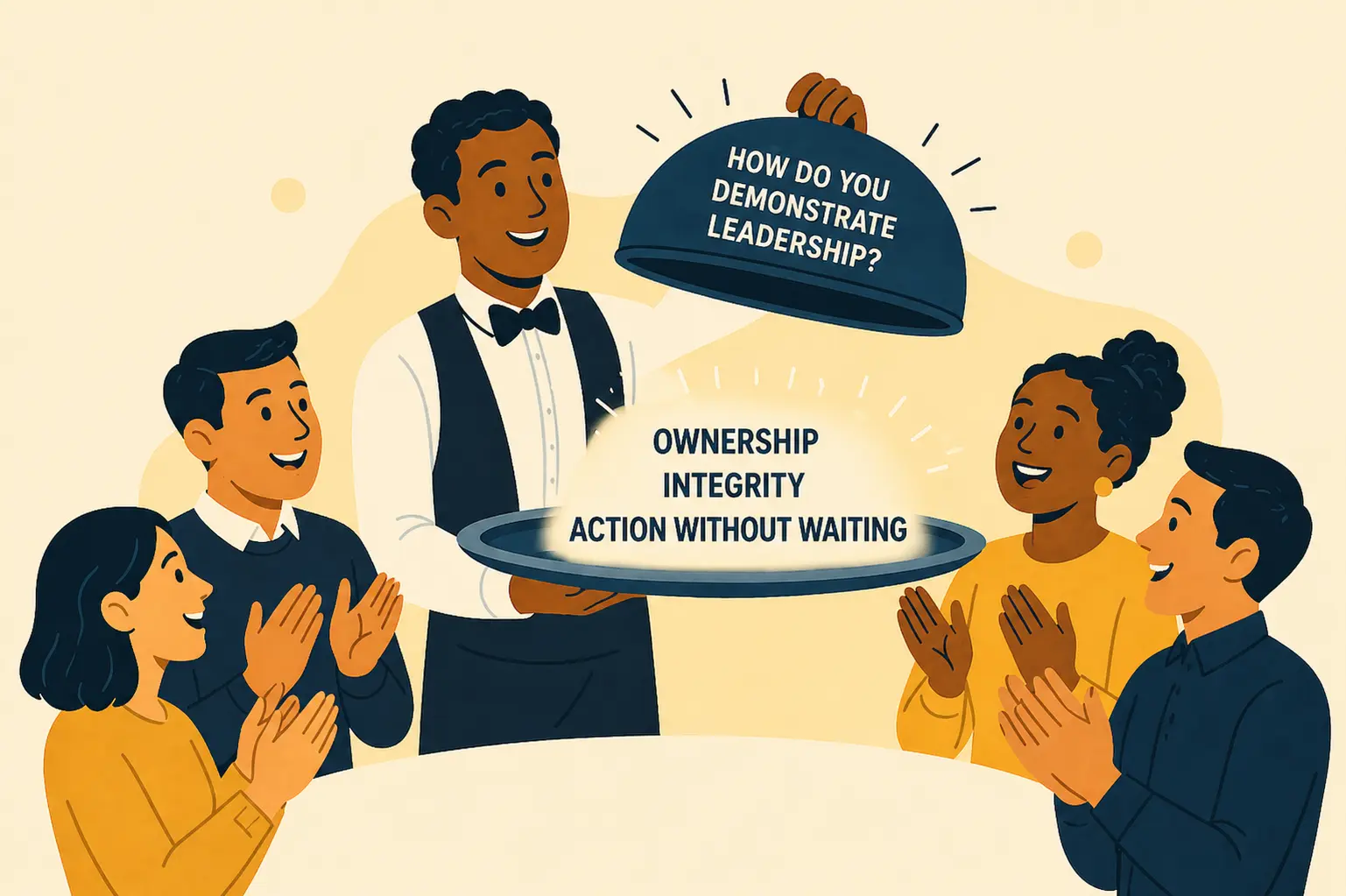
Quick Answer: How Do You Demonstrate Leadership?
How do you demonstrate leadership? You demonstrate leadership by taking ownership, clarifying expectations, and addressing problems before they escalate. It also means improving broken processes, supporting your team's performance, communicating clearly under pressure, and making decisions when others stall.
Leadership is not about title, charisma, or personality. Leadership is behavior that moves work forward when conditions are unclear.
Simple version: Leadership is demonstrated when someone creates clarity, accepts responsibility, improves the work, and helps others perform better.
What Demonstrating Leadership Actually Means
Demonstrating leadership means making responsibility visible. In practical terms, leadership behavior includes the actions people can see, evaluate, coach, and reinforce.
That matters because leadership in the workplace is often misunderstood from the start. Organizations treat leadership like charisma, seniority, confidence, or personality. Those traits may influence how people communicate, but those traits do not prove leadership.
Leadership is demonstrated through behavior under real conditions. Those conditions usually involve unclear direction, competing priorities, conflict, missed expectations, or pressure.
Observable Leadership vs. Theoretical Leadership
Leadership is not what someone says they would do. Leadership is what someone actually does when direction is unclear, expectations are not defined, or work begins to stall.
If leadership cannot be observed, it cannot be developed. That is why organizations need to define leadership behavior examples instead of relying on vague expectations like “step up†or “be a leader.â€
Behavior Under Pressure
Anyone can appear steady when the work is smooth. Leadership under pressure is different. Leadership becomes visible when deadlines are missed, employees are confused, performance drops, or conflict begins building.
Leadership under pressure requires more than a calm tone. It requires clarity, communication, decision-making in the workplace, and the willingness to address what others are avoiding.
Ownership vs. Authority
Authority gives permission. Leadership creates direction.
A person without formal authority can still define next steps, clarify expectations, support a struggling teammate, or identify a broken process. That is why employees can demonstrate leadership without authority.
For organizations trying to make leadership repeatable, the distinction between leadership vs authority matters. Authority belongs to a role. Leadership belongs to behavior.
Organizations that want to build repeatable leadership capacity may benefit from structured leadership development consulting or practical leadership coaching services that connect leadership expectations to real work.
7 Ways to Demonstrate Leadership at Work
The best ways to demonstrate leadership are not complicated. They are practical and tied to results. Here are seven that employees and managers can use at work.
1. Take Ownership Without Being Asked
Work stalls when responsibility is unclear. Leadership begins when someone decides the work will not stay stuck.
Example: A task sits untouched because no one owns the next step. One person steps in, confirms the deliverable, assigns responsibility, and sets a deadline.
That is leadership.
Taking ownership does not mean taking over everything. It means refusing to let ambiguity become the operating system.
2. Clarify Expectations When Others Are Confused
Confusion slows performance. Leaders remove confusion.
Example: A team receives vague direction from leadership. Instead of guessing, someone clarifies roles, deliverables, timelines, and decision points.
That is leadership.
Role clarity in organizations is not administrative housekeeping but rather the foundation for accountability, performance, and confidence.
3. Address Problems Early
Most workplace issues become larger because people wait too long to address them. Leadership accountability means addressing problems while the problem is still manageable.
Example: A performance issue appears during the week. Instead of saving the concern for an annual review, a supervisor addresses the concern immediately and resets expectations.
That is leadership.
Leadership does not avoid difficult conversations. Leadership creates the conditions where difficult conversations become clearer, fairer, and less dramatic.
4. Improve Broken Processes
Working around problems is not leadership. Fixing the pattern is leadership.
Example: A recurring workflow failure keeps delaying customer follow-up. Someone identifies the handoff gap, updates the process, and prevents the same failure from repeating.
That is leadership.
Many organizations mistake individual effort for leadership. Effort matters, but leadership performance impact is stronger when people improve the system that creates repeated problems.
When process issues are creating performance drag, stronger HR process improvement strategies can help leaders move from temporary workarounds to better systems.
5. Support Team Performance
Leadership is not individual performance alone. Leadership includes helping other people perform better.
Example: A teammate struggles with a new responsibility. Instead of criticizing them or stepping over them, someone provides clarification, support, and feedback so the work improves.
That is leadership.
Supporting team performance does not mean lowering standards. It means helping people meet the standard with better clarity, resources, and follow-through.
6. Communicate Clearly Under Pressure
Pressure exposes communication gaps. Leaders close those gaps.
Example: A deadline is at risk. Instead of going silent, someone communicates the status, the risk, the next step, and the decision needed.
That is leadership.
Showing leadership skills under pressure often comes down to disciplined communication. People do not need panic. People need facts, options, ownership, and next steps.
7. Make Decisions When Others Hesitate
Indecision stops progress. Leaders move work forward.
Example: Several options exist, but nobody chooses. Someone evaluates the situation, makes a decision, explains the rationale, and owns the outcome.
That is leadership.
Decision-making in the workplace does not require perfect information. It requires reasonable judgment, clear accountability, and the willingness to move forward when delay has become the bigger risk.
Real Workplace Examples of Leadership in Action
Leadership is easy to describe from a stage. It is harder to recognize when you are standing inside the mess.
Real leadership shows up when the schedule is breaking, the team is frustrated, the supervisor is avoiding the conversation, the process is failing again, and everyone is quietly waiting for someone else to define what happens next.
That is where leadership becomes observable. Not inspirational. Observable.
Example 1: When Flexibility Becomes Avoidance
A frontline supervisor believed leadership meant giving employees freedom. On paper, that sounds reasonable. Nobody wants to be the rigid supervisor who treats grown adults like children.
But in practice, the team began setting its own schedule. Call-ins became inconsistent. Coverage became unpredictable. Expectations shifted depending on the day. The supervisor was not trying to create chaos. He was trying to be fair, flexible, and supportive.
That is the uncomfortable lesson: weak leadership does not always come from bad intent. Sometimes weak leadership comes from undefined authority.
The supervisor avoided hard conversations because the organization had not given him a stable leadership framework. Expectations were not defined. Authority was inconsistent. Leadership parity did not exist across supervisors. One supervisor enforced expectations. Another softened them. Another avoided them entirely.
Once inconsistency becomes the pattern, the team stops following direction because direction feels negotiable.
"You cannot coach what you have not defined." - Dr. Thomas W. Faulkner, SPHR
Here is the leadership lesson for the reader: if you are trying to demonstrate leadership at work, do not confuse kindness with vagueness. You can be humane and still be clear. You can be flexible and still define expectations. You can support employees and still hold the line.
Leadership is not letting people operate without structure. Leadership is building enough structure that people know how to succeed inside it.
Example 2: When a Rural Municipality Had to Stabilize Critical Work
In one rural municipality workforce stabilization engagement, the issue was not abstract leadership theory. Experienced water and wastewater operators had left in a short window. Newer employees were trying to carry critical work. Field supervisors were absorbing the operational gap while also trying to train staff, maintain service continuity, and protect regulatory compliance.
That is not a motivational poster problem. That is an operational risk problem.
The leadership move was not to tell supervisors to “step up.†That would have been lazy consulting and even lazier leadership. The work required competency mapping, clearer licensing pathways, better delegation, on-the-job training structure, redesigned hiring and onboarding, and certification incentives tied to real workforce needs.
That engagement produced a 60%+ reduction in voluntary turnover among critical operator roles, a 45% decrease in overtime costs tied to staffing shortages, and 100% TCEQ staffing and reporting compliance with zero regulatory findings.
The leadership lesson is simple: leadership under pressure requires more than personal effort. When work is technical, regulated, and high stakes, leaders have to build systems that reduce dependency on heroics.
If you are leading inside a strained operation, ask yourself this: are you actually demonstrating leadership, or are you just personally absorbing the failure of a broken system?
Example 3: When Nonprofit Leaders Were Carrying HR by Default
In a nonprofit leadership capacity restoration engagement, program leaders were spending significant time on HR administration they were never trained or resourced to manage. Hiring practices were inconsistent. Performance management varied by department. Leadership burnout was becoming a retention risk.
This is common in mission-driven organizations. Passion fills the gap until passion becomes exhaustion.
The leadership failure was not that program leaders lacked commitment. The failure was that responsibility had spread without structure. Everyone was helping, but no one had a clean ownership model.
The fix required responsibility clarification through a RACI matrix, standardized hiring processes, structured interview guides, evaluation criteria, and coaching for program directors on feedback, conflict resolution, and delegation.
The result was 10 hours per week reclaimed per program leader, a 30% reduction in staff turnover, and standardized hiring across program departments.
That is what leadership looks like when it becomes operational instead of performative.
If you want to demonstrate leadership without authority, start here: clarify the work nobody owns. Define the handoff that keeps failing. Name the decision that keeps getting delayed. Leadership often begins where ambiguity has been allowed to live rent-free.
Example 4: When Supervisory Inconsistency Became the Real Turnover Driver
In another engagement, turnover was being driven by inconsistent supervisory practices. Newer employees were leaving while long-tenured employees operated under a different set of informal protections. Standards were not being applied evenly.
That kind of inconsistency destroys trust fast.
Employees do not need perfect leaders. They need leaders who are consistent enough to be believed.
The intervention required a supervisor capability assessment, leadership coaching, accountability metrics tied to retention and satisfaction, and manager onboarding so new supervisors did not learn the old culture by osmosis.
The outcome was a 75% reduction in voluntary turnover attributed to supervisory practices and a 40-point increase in employee satisfaction scores related to management fairness and trust.
The leadership lesson: if your team believes accountability depends on tenure, personality, favoritism, or who complains the loudest, leadership has already lost credibility.
Showing leadership skills means applying standards consistently even when the conversation is inconvenient.
Example 5: When Leadership Transition Exposed the Missing Structure
Founder-led and personality-driven organizations often look stable until the central person steps back. Then the truth becomes visible: the organization was not operating from a leadership system. It was operating around a person.
In a mental health service provider engagement, clinical leaders were highly skilled in their clinical roles but suddenly responsible for leading multidisciplinary teams without enough structure, preparation, or role clarity. Clinical staff burnout increased. Supervision practices became inconsistent. Regulatory documentation exposure became a real concern.
The fix required leadership structure design, clarified reporting lines, applied management training, workforce stability planning, retention incentives, professional development pathways, and better coordination between administrative and clinical teams.
The outcome included a 50% reduction in clinical staff turnover in key roles, zero major findings in the next regulatory audit, and improved coordination between administrative and clinical teams.
The leadership lesson is direct: if leadership only works when one person is present, you do not have leadership capacity. You have dependency.
Real leadership builds continuity beyond the individual.
What These Examples Teach About Demonstrating Leadership
These examples are different, but the pattern is the same.
Leadership was not demonstrated through charisma. Leadership was demonstrated through structure, clarity, decision-making, accountability, and the willingness to address the real problem instead of the convenient one.
That is the part many organizations miss. They want leaders to be confident, but they do not define authority. They want accountability, but they tolerate inconsistency. They want better communication, but they leave roles unclear. They want employees to take initiative, but punish them when initiative crosses an invisible line.
So when we ask how do you demonstrate leadership, the better question is this:
What are you making clearer, stronger, more consistent, or more functional because you were involved?
That is the test.
When conflict is already affecting performance, use stronger methods for handling workplace conflict between employees instead of letting tension become the team culture. When the issue is deeper than conflict, connect the leadership problem to structure through organizational development consulting services, HR process improvement strategies, or practical leadership development consulting.
Situations Where You Can Demonstrate Leadership
If someone asks, how can you show leadership in a regular job, the answer is simple: look for moments where clarity, ownership, and decision-making are missing.
Leadership is not limited to executive meetings or formal management roles. Leadership appears in specific workplace moments:
- During team conflict
- During unclear direction
- During missed deadlines
- During change initiatives
- During process breakdowns
- During customer service failures
- During performance conversations
- During staffing pressure
- During operational confusion
These are the moments where leadership is required. These are also the moments where weak leadership systems become visible.
Organizations navigating transition should connect leadership expectations to change management in HR so managers and employees understand how to lead through disruption rather than react to it.
What Demonstrating Leadership Is Not
Most leadership advice fails because it focuses on the wrong things.
Leadership is not:
- Charisma
- Seniority
- Being the loudest voice in the room
- Holding a title
- Avoiding difficult conversations
- Being liked by everyone
- Taking over every decision
- Calling flexibility leadership when expectations are unclear
Those behaviors can create the appearance of leadership without producing leadership performance impact.
Real leadership creates clarity, movement, accountability, and better conditions for performance.
Why Most Employees Struggle to Demonstrate Leadership
Most employees do not struggle to demonstrate leadership because they lack motivation.
They struggle because they are operating inside systems that punish clarity, blur authority, and leave expectations open to interpretation.
From the outside, it looks like hesitation. From the inside, it feels like risk.
You see the issue. You know what should happen next. But you pause.
Not because you lack initiative, but because you are asking yourself:
- Is this actually my responsibility?
- Am I allowed to make this call?
- Will this be backed—or corrected later?
- Does this standard apply to everyone, or just me?
That hesitation is not a personality flaw. That hesitation is a signal.
It is a signal that the system has not defined leadership clearly enough to act with confidence.
Organizations routinely fail to define the basic conditions required for leadership to exist in the workplace:
- Role clarity: Where responsibility actually starts and stops
- Decision authority: What you can decide without asking for permission
- Accountability structure: What happens when expectations are not met
- Escalation standards: When to act versus when to elevate
- Manager expectations: What leadership behavior looks like at each level
- Leadership behavior examples: Observable actions, not vague traits like “be proactiveâ€
- Performance follow-through: Whether standards are consistently enforced or selectively applied
When those elements are missing, the pattern is predictable:
- Employees hesitate because the line is unclear
- Supervisors avoid difficult conversations because expectations are not grounded
- Decisions get delayed because authority is ambiguous
- Accountability becomes inconsistent depending on the person involved
Inconsistent leadership produces inconsistent performance. Every time.
This is why most leadership development efforts fail to produce lasting change.
They focus on confidence, communication, and inspiration while ignoring the conditions that determine whether someone can act on those skills in real time.
Inspiration works in the room. It does not survive contact with unclear expectations, weak authority, and inconsistent accountability.
If you are trying to build leadership in your organization, the question is not whether your people are capable.
The question is whether your environment allows them to act without second-guessing every decision.
Leadership is not unlocked by motivation. Leadership is unlocked by clarity.
Organizations that want leadership behavior to become consistent, coachable, and repeatable need to define the structure behind it. That is where organizational development consulting services become critical—because leadership only sticks when the system supports it.
Benefits of Leadership in the Workplace
When leadership is demonstrated consistently, organizations usually experience practical operational gains.
Strong leadership in the workplace can improve:
- Faster decision-making
- Clearer expectations
- Reduced conflict escalation
- Improved accountability
- Stronger team performance
- Better employee confidence
- More consistent manager behavior
- Cleaner communication under pressure
- Improved follow-through on priorities
Leadership is not a soft concept. Leadership is operational infrastructure.
How Organizations Build Leadership Behavior
Most organizations invest in inspiration. Fewer invest in structure.
Leadership is not built through motivation alone. Leadership becomes repeatable when organizations define the behaviors they expect and reinforce those behaviors through systems.
Organizations build leadership behavior through:
- Defined expectations: Employees need to know what leadership looks like in their actual work.
- Consistent accountability: Leadership standards must be applied across teams instead of depending on manager preference.
- Aligned authority: People cannot be held accountable for decisions they are not allowed to make.
- Structured feedback systems: Leadership behavior must be discussed, coached, and reinforced.
- Real workplace application: Leadership development must connect to real decisions, conflicts, deadlines, and performance issues.
Without these conditions, leadership training does not stick. With these conditions, leadership becomes repeatable.
Faulkner HR Solutions helps organizations build leadership systems that connect expectations, behavior, authority, and accountability. If leadership in your organization looks like confusion, inconsistency, or avoided conversations, the problem may not be the people. The problem may be the structure around the people.
When Leadership Breaks Down, It’s Usually Not a People Problem
Most organizations do not struggle with leadership because employees lack motivation. They struggle because leadership expectations are not defined, authority is inconsistent, and accountability varies by manager.
That is where leadership becomes unpredictable. One team performs well. Another struggles with the same expectations. The difference is not effort. The difference is structure.
If leadership in your organization depends on personality, experience, or who is willing to step in, the system is creating inconsistency.
That is where structured leadership development consulting becomes necessary. The focus is not theory. The focus is defining leadership behavior, aligning authority, and building accountability systems that hold under pressure.
When leadership expectations are clear, leadership becomes repeatable. When leadership becomes repeatable, performance stabilizes.
Final Thought: Stop Buying Inspiration Without Structure
If leadership in your organization looks like confusion, inconsistency, or avoided conversations, it is not automatically a people problem. It may be a structure problem.
And structure can be fixed.
If you are burned out from spending thousands on inspirational coaches who spoon-feed motivation with no teeth for action, stop buying inspiration and start building systems.
Book a consultation with Faulkner HR Solutions to build leadership expectations, accountability systems, and practical manager behavior that can hold up under real workplace pressure.
FAQs
You demonstrate leadership without authority by taking ownership, clarifying expectations, supporting team performance, identifying problems early, and moving work forward without waiting for a formal title.
Examples of leadership at work include addressing problems early, improving broken processes, clarifying expectations, helping teammates perform better, communicating clearly under pressure, and making decisions when others hesitate.
You can show leadership at work by creating clarity, taking responsibility for outcomes, improving communication, making timely decisions, and helping the team move forward when direction is unclear.
Yes. Authority is formal permission attached to a role. Leadership is behavior that creates direction, accountability, clarity, and progress. A person can have authority without demonstrating leadership, and a person can demonstrate leadership without authority.
Yes. Leadership can be learned when organizations define observable leadership behavior, coach those behaviors consistently, and build systems that support decision-making, accountability, and role clarity.