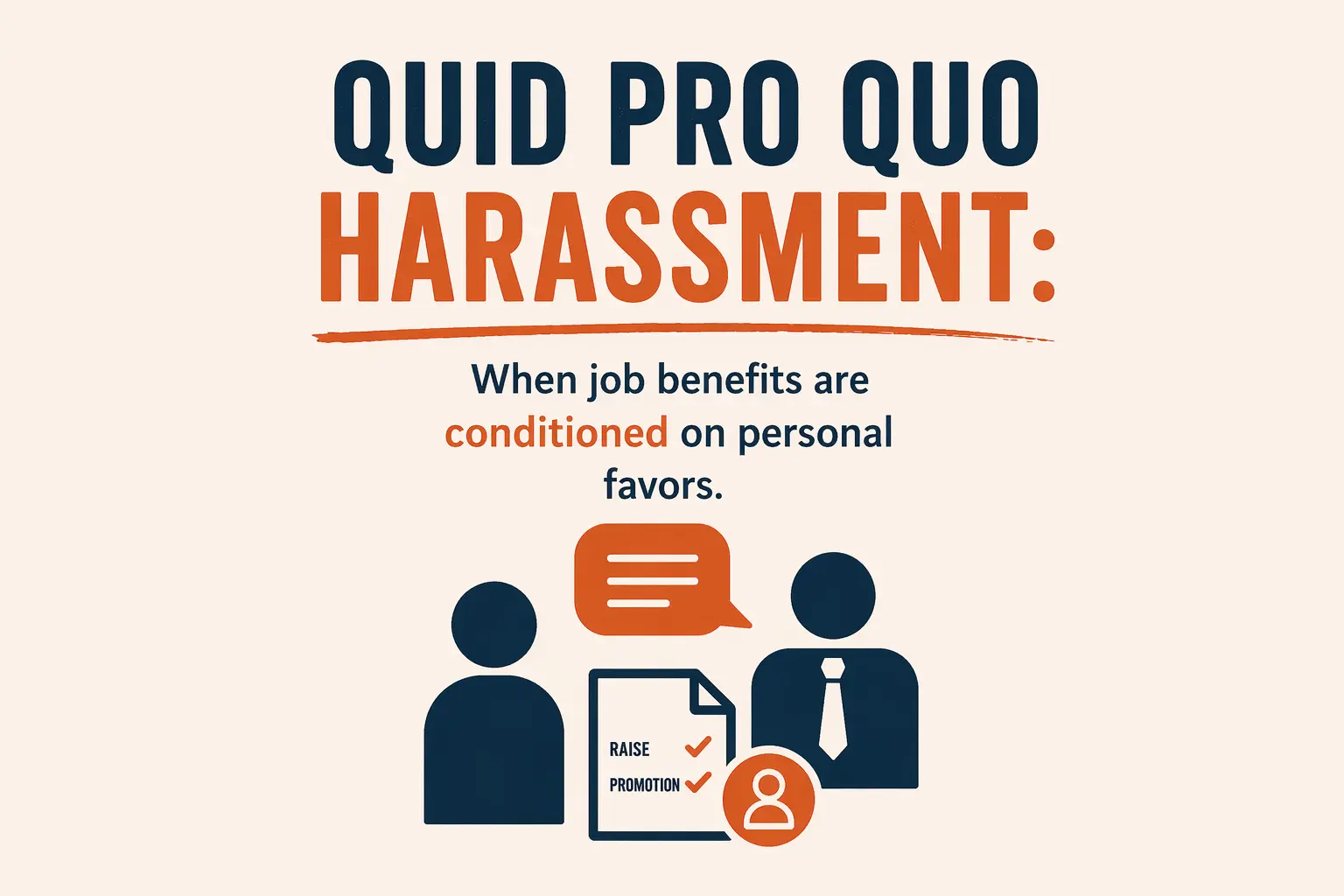
Quid pro quo harassment is a form of workplace harassment in which a person with authority ties employment benefits or consequences to an employee’s response to unwelcome conduct. This often includes quid pro quo sexual harassment and differs from a hostile work environment, which involves ongoing behavior rather than a direct exchange.
Quid pro quo is Latin for this for that. In ordinary life, it can describe any exchange where one thing is offered in return for another. In the workplace, though, quid pro quo harassment becomes a legal and organizational problem when a person with authority ties an employment benefit or consequence to an employee’s response to unwelcome conduct.
This is one of the most direct forms of workplace harassment risk because the issue is not just inappropriate behavior. The issue is the use of power over hiring, pay, promotions, scheduling, assignments, discipline, or continued employment. Many organizations assume a written policy is enough protection. It is not. If decision authority is vague, documentation is weak, and reporting options are limited, the organization is far more exposed than leadership realizes.
Why Listen to Me?
I'm Dr. Thomas Faulkner, founder of Faulkner HR Solutions. My work helps Texas organizations strengthen HR compliance, management accountability, and workforce systems so employment decisions are clearer, more defensible, and less vulnerable to preventable risk.
I hold a Doctorate in Business Administration, the SPHR credential, and a Lean Six Sigma Black Belt. In real-world consulting work, I routinely see organizations that believe they are protected because a handbook exists. In practice, exposure usually appears where authority is informal, oversight is thin, and leaders cannot prove how decisions were made.
What Does Quid Pro Quo Mean?
The basic quid pro quo meaning is an exchange: one thing is given in return for another. By itself, that concept is not inherently improper. It shows up all the time in normal business and personal situations.
- Business agreement: a service is exchanged for payment.
- Negotiation: support is exchanged for support.
- Trade: one person helps with something in return for help on something else.
The problem begins when the exchange involves pressure, coercion, or authority in a way that affects employment. That is when quid pro quo stops being a neutral phrase and becomes a compliance and liability issue.
What Is Quid Pro Quo Harassment?
Quid pro quo harassment is a form of workplace harassment in which a person with authority ties job-related benefits or consequences to an employee’s response to unwelcome conduct. In simple terms, the employee is put in a position where something about employment depends on how they respond.
That “something” may involve:
- Hiring decisions
- Promotions or raises
- Work schedules or assignments
- Performance evaluations
- Termination, demotion, or reduced hours
The risk is not just inappropriate conduct. The risk is the link between unwanted conduct and a tangible employment outcome controlled by someone with authority.
That is why this issue matters so much for employer liability. It is also why stronger leadership development and tighter decision controls are so important in practice.
Quid Pro Quo Sexual Harassment
Quid pro quo sexual harassment is the most commonly recognized form of this issue. It occurs when a person in authority ties sexual advances, requests, or conduct to employment outcomes such as promotions, pay, continued employment, favorable assignments, or protection from negative consequences.
This is where employer exposure becomes especially serious because the connection between authority and employment consequences is direct. While quid pro quo harassment can involve other forms of coercive pressure, many claims center on sexual harassment tied to job-related decisions.
Organizations often make the mistake of treating this as a conduct-only issue. It is not. It is a power-and-decision issue. Once sexual conduct is connected to employment outcomes, the organization is no longer dealing with a vague professionalism concern. It is dealing with a concrete compliance and liability problem.
Difference Between Quid Pro Quo and Hostile Work Environment
The difference between quid pro quo and hostile work environment harassment is one of the most common points of confusion for employers, but the distinction directly affects how claims are evaluated, investigated, and defended.
These two concepts are related but not interchangeable. Employers often confuse them, which creates sloppy investigations and weak risk assessment.
| Quid Pro Quo Harassment | Hostile Work Environment |
|---|---|
| Direct “this for that” exchange | Ongoing behavior that creates an intimidating or abusive workplace |
| Typically involves a supervisor or decision-maker | Can involve coworkers, clients, or vendors |
| Requires a tangible employment action | Does not require a direct exchange |
| Can arise from a single incident | Usually depends on conduct that is severe or pervasive |
One common organizational mistake is assuming that if quid pro quo is hard to prove, the risk disappears. It often does not. The same conduct may still support a hostile work environment concern. That is why effective HR compliance consulting depends on good analysis, not just labels.
Why Quid Pro Quo Harassment Happens
Leaders often assume this only happens in obviously toxic workplaces. In reality, it often happens in organizations where authority is poorly structured and oversight is weak. The misconduct may be personal, but the exposure is systemic.
1. Undefined Authority
Managers and supervisors operate with too much unchecked discretion. When decision boundaries are not clear, abuse of authority becomes easier.
2. Informal Decision-Making
Promotions, raises, scheduling, and opportunities are handled through informal judgment rather than written criteria. That creates room for favoritism, pressure, and poor defensibility.
3. Weak Documentation
Employment actions are taken without a reliable record of why they occurred. When the organization cannot explain a decision clearly, it is left defending outcomes after the fact.
4. No Safe Reporting Path
Employees are forced to report concerns through the same authority structure that may be causing the problem. That makes reporting less likely and organizational risk much higher.
Quid pro quo harassment is often less a random event than a predictable risk that appears when authority operates without structure.
Quid Pro Quo Harassment Examples
These situations do not always appear as dramatic or explicit demands. They often surface in more subtle but still very risky forms.
- A manager suggests that spending time together outside of work could help an employee’s advancement.
- An employee’s schedule changes or hours are reduced after rejecting personal attention.
- A promised raise or promotion disappears without clear, documented reasoning.
- A performance review suddenly drops in a way that cannot be supported through prior records.
In each case, the central issue is not just awkward conduct or poor judgment. The issue is that a person with power over employment is using or appearing to use that power in connection with unwelcome behavior.
How Quid Pro Quo Harassment Is Proven
From a legal and investigative standpoint, the question usually becomes whether the unwelcome conduct can be linked to a tangible employment decision. That does not always require direct written proof, though direct evidence certainly strengthens a case.
Typically, the analysis involves showing that:
- The individual had authority over employment decisions.
- Unwelcome conduct occurred, whether explicit or implied.
- A job-related action followed.
- The timing, context, or pattern connects the conduct and the action.
Emails, messages, and witness statements can help, but many cases are built through timing, inconsistency, and the employer’s inability to explain why an employment decision happened when it did.
Where Organizations Get This Wrong
Many businesses do not lose harassment matters because leadership intended harm. They lose because the organization cannot prove control, consistency, or defensible decision-making.
“Nothing happened, so we are fine”
Even if a specific threat was not fully carried out, the same conduct may still create serious exposure under a hostile work environment theory.
“We didn’t know about it”
When a supervisor is involved, employer liability concerns can still be significant. Lack of awareness is not a reliable shield.
“We have a policy”
A written policy is not protection if leaders do not enforce it, if reporting pathways are weak, or if actual decisions contradict the policy in practice.
Most organizations do not lose these cases because of intent. They lose because they cannot show that authority was structured, decisions were documented, and reporting channels were credible.
Why This Gets Organizations Sued
Most organizations do not fail because they lack a harassment policy. They fail because they cannot prove how employment decisions were made.
When a promotion, termination, or schedule change happens without documented reasoning, any allegation of quid pro quo harassment becomes harder to defend, even when leadership believes the action was legitimate.
In practice, the absence of structure creates the appearance of intent. That is what turns a bad fact pattern into a serious legal and organizational problem.
How to Prevent Quid Pro Quo Risk
This is not solved by annual training alone. It is reduced through better structure.
Define Decision Authority
Clarify who can make decisions involving pay, scheduling, promotions, hiring, discipline, and termination. High-impact employment actions should not float informally.
Standardize Criteria
Use written standards for employment decisions whenever possible. The more objective the process, the easier it is to defend and the harder it is to abuse.
Require Documentation
If it affects employment, it should be documented. Clear records help prove consistency and reduce after-the-fact confusion.
Create Alternate Reporting Channels
Employees should never be forced to report a concern only through the person who holds power over them. Multiple reporting paths reduce fear and improve organizational response.
Audit Decision Patterns
Review how promotions, discipline, terminations, and schedule changes are being applied across teams. Patterns often reveal risk before a formal complaint does.
Quick Risk Check: Are You Exposed?
Answer these honestly:
- Do managers make pay, scheduling, or promotion decisions without documented rationale?
- Can employees report concerns without going through their direct supervisor?
- Are promotions tied to written, consistent criteria?
- Is discipline applied consistently across employees and leaders?
If the answer to any of those is no, the organization may not have a current harassment complaint, but it does have the conditions that make one more likely.
The Reality Most Organizations Miss
Quid pro quo harassment is not only about misconduct in the abstract. It is about control over employment decisions. When authority is unclear, documentation is weak, and oversight is inconsistent, risk is not theoretical. It is built into the system.
How Faulkner HR Solutions Helps
Most organizations do not identify this exposure until a complaint forces the issue. A structured compliance and risk review can identify where authority is unclear, where decisions are inconsistent, where documentation breaks down, and where policies fail in practice.
Faulkner HR Solutions helps organizations evaluate those risks before they become legal, financial, or cultural problems. That includes stronger HR compliance consulting, better managerial decision systems, and more defensible employment practices.
Book a strategy call if your organization needs stronger reporting pathways, cleaner employment decision controls, or a structured compliance review.
Frequently Asked Questions
Quid pro quo means “this for that,” referring to an exchange where one thing is offered in return for another.
It is when a person with authority ties job benefits or job consequences to an employee’s response to unwelcome conduct.
Quid pro quo sexual harassment occurs when a person in authority ties sexual advances, requests, or conduct to employment outcomes such as promotions, pay, or continued employment.
Quid pro quo harassment involves a direct exchange tied to employment decisions, while a hostile work environment involves ongoing conduct that creates an intimidating or abusive workplace.
Yes. It typically involves a real employment decision such as hiring, firing, promotion, pay, scheduling, or other tangible work consequences.
Yes. A single incident can qualify if it involves a clear link between unwelcome conduct and a tangible employment action.
It may not meet every standard for quid pro quo harassment, but it can still support a hostile work environment concern and create serious organizational risk.
Related HR Questions, Answered
Direct answers from our HR FAQ library for Texas employers: