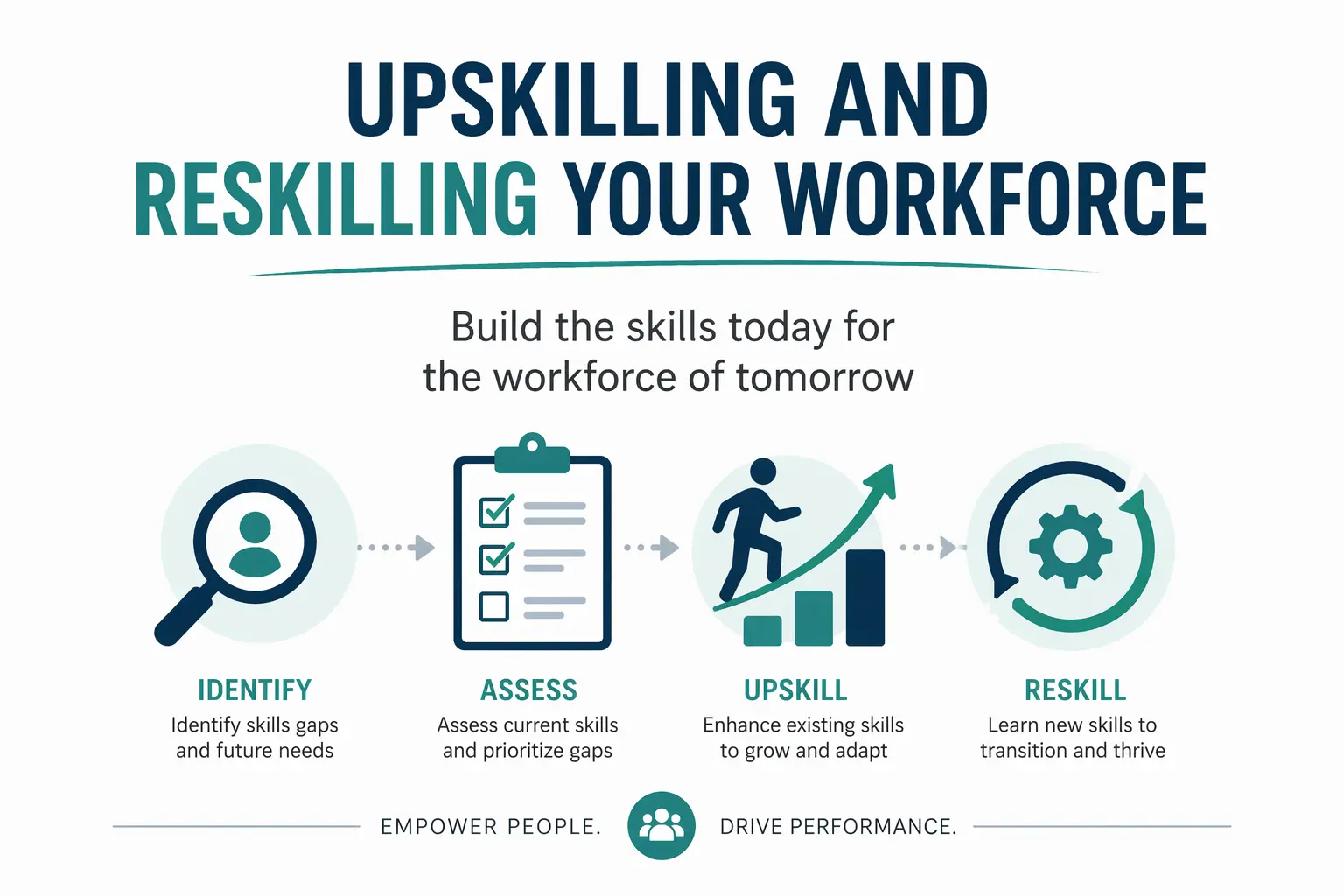
Upskilling employees means improving skills within a current role, while reskilling employees prepares them for new roles as business needs change. Effective workforce development requires more than training. It requires structured systems that connect skill gaps, role expectations, manager accountability, and measurable business outcomes.
Every organization says it wants to upskill employees and reskill the workforce, but too many treat those goals like a workshop schedule instead of an operating system. A few generic courses get rolled out, attendance gets tracked, and someone declares progress. Meanwhile, the actual skills gap stays open, managers keep complaining about capability, and turnover keeps eating away at the people the organization claims it wants to retain.
The problem is usually not lack of good intent. The problem is that many workforce training programs are built as isolated activity rather than as structured systems tied to role demands, manager behavior, and measurable outcomes. Upskilling and reskilling only matter when they change what people can reliably do on the job.
Why Listen to Me?
I'm Dr. Thomas Faulkner, founder of Faulkner HR Solutions. My work focuses on helping organizations strengthen workforce capability, leadership accountability, and performance systems through practical HR and organizational design. That includes workforce development efforts that go beyond training theater and produce measurable results.
I hold a Doctorate in Business Administration, the SPHR credential, and a Lean Six Sigma Black Belt. My approach to learning and development is grounded in system design, practical application, and performance accountability. If a program cannot be connected to role performance, manager reinforcement, and business outcomes, it is not a serious development strategy.
What Upskilling and Reskilling Actually Mean
Upskilling employees means building stronger or broader capability inside a current role. Reskilling the workforce means preparing employees to move into different responsibilities or entirely different roles as organizational needs shift.
Those two ideas are related, but they are not identical. Upskilling deepens current contribution. Reskilling supports transition and adaptability. Both matter if the organization wants to build a continuous learning workplace that does more than talk about agility.
Upskilling and reskilling are not one-time learning events. They are workforce systems that require role clarity, reinforcement, accountability, and measurement.
Organizations often use these terms as if they automatically describe sophisticated employee development strategies. They do not. Without design discipline, they become nice-sounding labels attached to shallow training calendars.
Why Most Workforce Training Programs Fail
Traditional workforce training programs often fail because they prioritize content delivery over capability building. A learning portal is launched. A workshop gets booked. Employees complete modules. Leadership feels productive. Then almost nothing changes in day-to-day performance because the actual structure around the learning never changed.
The Most Common Failure Points
- Lack of alignment: Training content is not tied closely enough to actual role demands or business priorities.
- No accountability: Employees attend training, but nobody tracks whether new skills are applied on the job.
- One-size-fits-all design: Generic learning paths ignore the real differences between roles, readiness levels, and skill gaps.
- Weak manager involvement: Managers are expected to support development without being equipped or held accountable to do it.
- No meaningful measurement: If impact is not tracked, the organization cannot tell what worked, what failed, or what should change.
When those gaps exist, training becomes performance theater. It looks active. It may even look expensive. But it does not reliably produce stronger capability, better results, or higher retention.
Organizations that fail to build structured upskilling and reskilling systems increase the risk of turnover, skill obsolescence, internal stagnation, and weaker operational performance.
What Upskilling and Reskilling Actually Fix
Organizations rarely invest in upskilling and reskilling because everything is working well. They invest when capability gaps start affecting performance, consistency, or growth.
- Employees struggling to perform at expected levels despite experience or tenure
- Managers spending excessive time correcting mistakes instead of driving results
- High turnover in critical roles where onboarding never fully sticks
- Skill gaps slowing down operations or limiting growth capacity
- Internal promotion pipelines breaking down due to lack of readiness
- Training programs that exist but do not change behavior
If those issues exist, the problem is not a lack of training content. The problem is that workforce capability has not been intentionally designed.
How to Build an Effective Upskilling Program for Employees
If the goal is real workforce capability, the solution is not more random development activity. The solution is a repeatable system that identifies gaps, targets learning to the right roles, reinforces application, and measures impact. For Texas organizations, this often becomes urgent when growth outpaces internal capability or when turnover exposes weak training systems.
1. How to Conduct a Skills Gap Analysis for Workforce Development
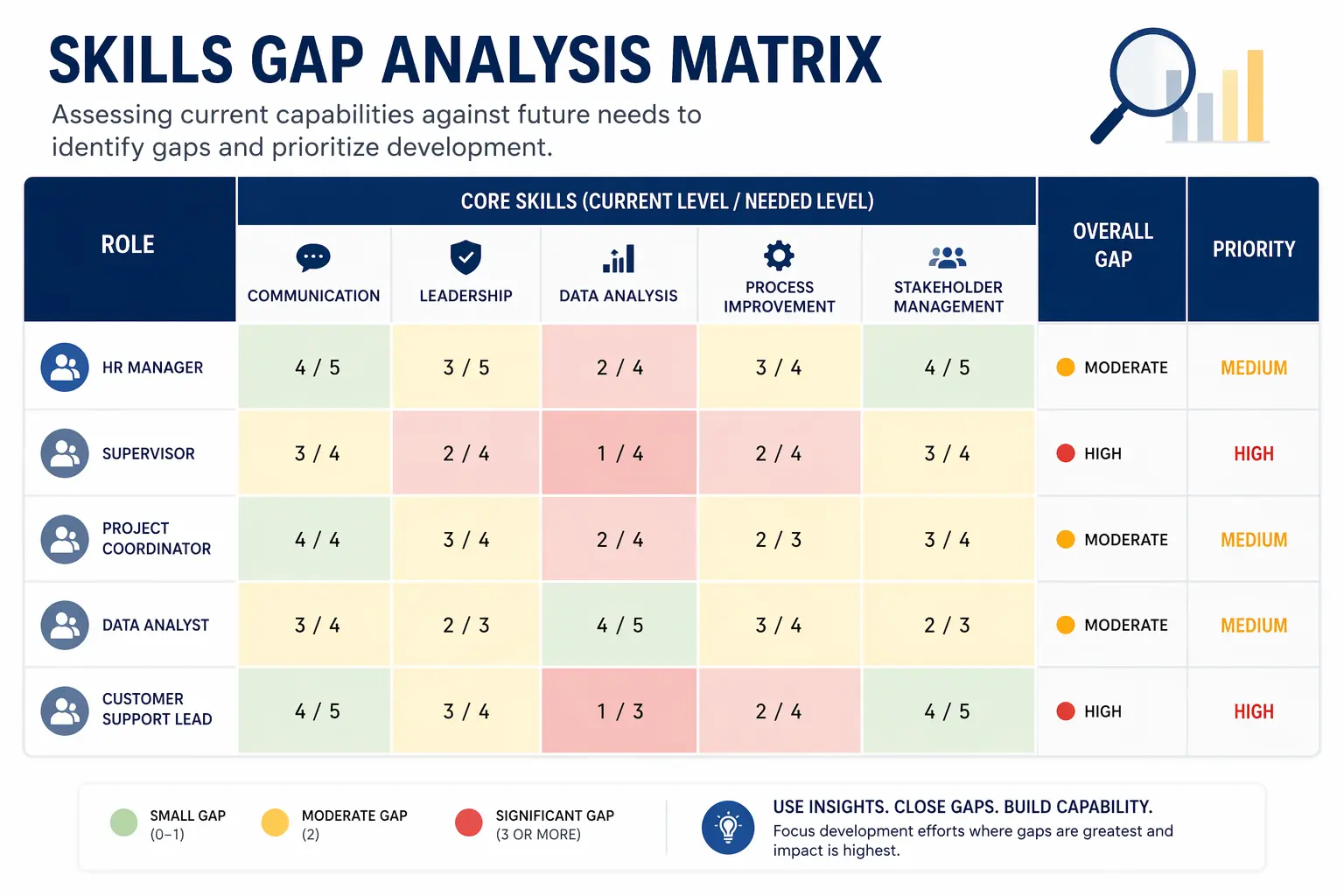
Before designing anything, identify what the workforce can do now and what the organization actually needs people to do next. That means gathering information from multiple sources including performance data, manager input, employee self-assessment, operational trends, and future business strategy.
A good skills gap analysis does not just identify weaknesses. It prioritizes them based on urgency, relevance, and business impact. That keeps development resources focused on the gaps that matter most. If your organization needs a deeper walkthrough, start with this guide on how to conduct a skills gap analysis.
2. Build Role-Specific Learning Paths
Generic training will always underperform compared with learning paths tied to real roles and real work. Development should be structured differently for frontline staff, supervisors, technical specialists, and emerging leaders. Those paths should mix formal instruction, applied practice, coaching, stretch assignments, and repetition over time.
Each path should have clear milestones, expected outcomes, and reinforcement points. If a learning path has no visible progression and no link to demonstrated capability, it is just organized content.
3. Make Managers Development Coaches
Managers are the bridge between learning and application. Without them, most employee development strategies break down the moment the employee leaves the training environment and returns to the real workflow.
That means managers need tools, expectations, and accountability. They should know what skill is being developed, how to observe it, how to coach it, and how to reinforce it under normal job pressure. Development should not be treated as HR’s side project. It should be part of managerial responsibility.
4. Measure Progress and Adjust Continuously
Measurement is what turns development from optimism into strategy. Define key performance indicators tied to both learning progress and business outcomes. That may include productivity gains, quality improvements, reduced error rates, time-to-competence, retention changes, or stronger customer-facing outcomes.
Then review the data regularly. Continuous adjustment matters because workforce needs shift. Learning systems that are not reviewed become stale almost as fast as the skills they were designed to build.
Strong workforce development systems connect four things clearly: the skill gap, the role requirement, the manager’s reinforcement responsibility, and the outcome that proves the effort worked.
Advantages of Upskilling Employees
The advantages of upskilling employees go well beyond training completion. When done well, upskilling strengthens day-to-day performance, improves adaptability, and reduces the need to solve every capability problem through outside hiring.
- Stronger internal capability: employees perform more effectively in current roles instead of plateauing at a basic level.
- Better retention: employees are more likely to stay where growth and development feel real rather than performative.
- Faster adaptation: organizations respond more effectively to shifting demands, technology changes, and new service requirements.
- Improved promotion readiness: upskilling creates a stronger internal bench for future leadership and specialized roles.
- Lower external hiring pressure: organizations can solve more capability needs internally instead of relying on constant recruitment.
- Clearer business alignment: development becomes tied to real workforce needs instead of disconnected learning activity.
The real advantage is not that employees attend more training. The real advantage is that the organization becomes more capable, more stable, and more prepared for change.
Real-World Application: Building Workforce Capability Through System Design
A practical workforce development effort starts by rejecting the assumption that more training volume means more readiness. One Texas municipality facing capability strain in critical service areas improved outcomes by first identifying the actual gaps rather than guessing at them. Frontline input and supervisory feedback showed that the issue was not simply knowledge deficiency. The issue was uneven capability in a few high-impact areas that affected operations directly.
From there, development was built around role-specific learning, applied practice, managerial reinforcement, and tracked outcomes. That design principle matters more than the specific organization. What worked was not the existence of training. What worked was the structure around the training.
That is the broader lesson for any organization trying to close a skills gap. Training becomes credible when it is tied to operational outcomes instead of existing as a side initiative with no real accountability.
Common Mistakes to Avoid
Even organizations with strong intentions can sabotage their own development efforts. The most common mistakes are predictable.
- Skipping the assessment: Training without a skills diagnosis is guesswork.
- Assuming everyone needs the same thing: Uniform content creates weak relevance and low engagement.
- Leaving managers out: Skills will not stick if supervisors do not reinforce them.
- Relying too heavily on e-learning alone: Knowledge exposure is not the same thing as applied capability.
- Ignoring reinforcement: Skills decay quickly when they are not practiced and observed.
- Failing to measure impact: If outcomes are not tracked, improvement becomes impossible to prove.
The fastest way to weaken a workforce development effort is to treat learning as an HR event instead of an operational expectation.
Implementation Checklist for Building a Workforce Development System
Before launching an upskilling or reskilling initiative, make sure the structure is ready.
- Complete a skills gap analysis tied to current and future business needs.
- Create role-specific learning paths with visible milestones and varied development methods.
- Define manager expectations for coaching, reinforcement, and follow-up.
- Set measurable KPIs tied to both skill growth and business outcomes.
- Establish data collection and review points to monitor effectiveness.
- Communicate clearly with employees about what is expected and why it matters.
- Build feedback loops so the system can be refined as needs change.
When External Support Makes Sense
Some organizations do not lack commitment. They lack the internal bandwidth or system design expertise to build a strong workforce development model from scratch. In those cases, external support can speed up the work and reduce trial-and-error waste.
That support is most useful when it helps the organization create scalable learning paths, accountability systems, role-specific development structures, and meaningful measurement. If your team needs help building something more rigorous than generic training, our workforce development consulting, leadership development consulting, and training and development outsourcing support may be the right fit.
Conclusion: Build Capability, Not Just Activity
Upskilling and reskilling matter because workforce capability matters. But capability does not grow from good intentions or full calendars. It grows from design discipline, managerial reinforcement, practical application, and measurement that proves whether the effort is working.
If your organization is serious about closing skill gaps, improving adaptability, and retaining stronger performers, the answer is not more disconnected training. The answer is a better system.
Book a strategy call if your organization needs a more structured approach to upskilling, reskilling, and workforce capability design.
Further Reading from Faulkner HR Solutions
Frequently Asked Questions
Upskilling develops stronger capability inside an employee’s current role. Reskilling prepares an employee to move into a different role or set of responsibilities as business needs change.
The advantages of upskilling employees include stronger performance, faster adaptation to change, improved retention, better internal mobility, reduced hiring pressure, and clearer readiness for future business needs.
An effective upskilling program for employees starts with a skills gap analysis, followed by role-specific learning paths, manager reinforcement, measurable milestones, and tracking tied to business outcomes.
Measure progress through indicators tied to both skill development and business impact, such as time-to-competence, productivity improvement, quality gains, reduced errors, stronger retention, or other role-relevant outcomes.
Managers are the people most responsible for translating learning into behavior. They reinforce expectations, observe application, coach improvement, and help make the new skill real in daily work.
Organizations should invest in reskilling employees when roles are changing, technology is reshaping work, internal mobility is needed, or current workforce capability no longer matches future business demands.
Related HR Questions, Answered
Direct answers from our HR FAQ library for Texas employers: