What This Process Solves
This guide explains how to conduct a skills gap analysis step by step so you can identify missing competencies, assess current workforce capability, and prioritize the right training response. Most organizations do not have a training problem. Most organizations have a diagnosis problem. Leaders see inconsistent performance, assume more training will solve it, and then wonder why capability does not improve.
A good skills gap analysis fixes that mistake by comparing what a role requires against what employees can currently do. That difference matters because targeted development starts with evidence, not guesswork. If your organization is dealing with weak bench strength, uneven management capability, unclear role expectations, or training spend that never seems to move performance, this process is one of the best places to start.
What Is a Skills Gap Analysis?
A skills gap analysis is a structured process used to compare current employee capability against the skills, competencies, and behaviors required for success in a role. In practice, that means defining what the role demands, conducting a workforce skills assessment, identifying the gaps between expectation and reality, and then using that information to prioritize development actions.
Done well, a skills gap analysis helps an organization stop treating training like a default answer. It shows whether the real issue is knowledge, practice, process clarity, supervision, role design, or a combination of factors. That is why a strong competency gap analysis is more useful than a vague list of training requests. It separates assumptions from measurable needs.
Organizations often confuse a skills gap analysis with a training wish list. They are not the same. A real analysis defines required competency first, then measures current capability, then prioritizes what matters most.
Skills Gap Analysis Template
Below is a simple skills gap analysis template you can copy into Excel or Google Sheets. If you want the page to rank for template intent and actually help a reader, the page needs to provide something usable, not just mention the phrase once in passing.
A practical skills gap analysis template should include the role, the competency being measured, the required proficiency level, the current proficiency level, the size of the gap, the business impact of that gap, the recommended action, the owner, and the review date.
- Role
- Competency
- Required proficiency
- Current proficiency
- Gap level
- Business impact
- Recommended action
- Owner
- Review date
Keep the template simple enough that leaders will actually use it. A bloated worksheet usually dies after the first review cycle.
Step-by-Step Instructions
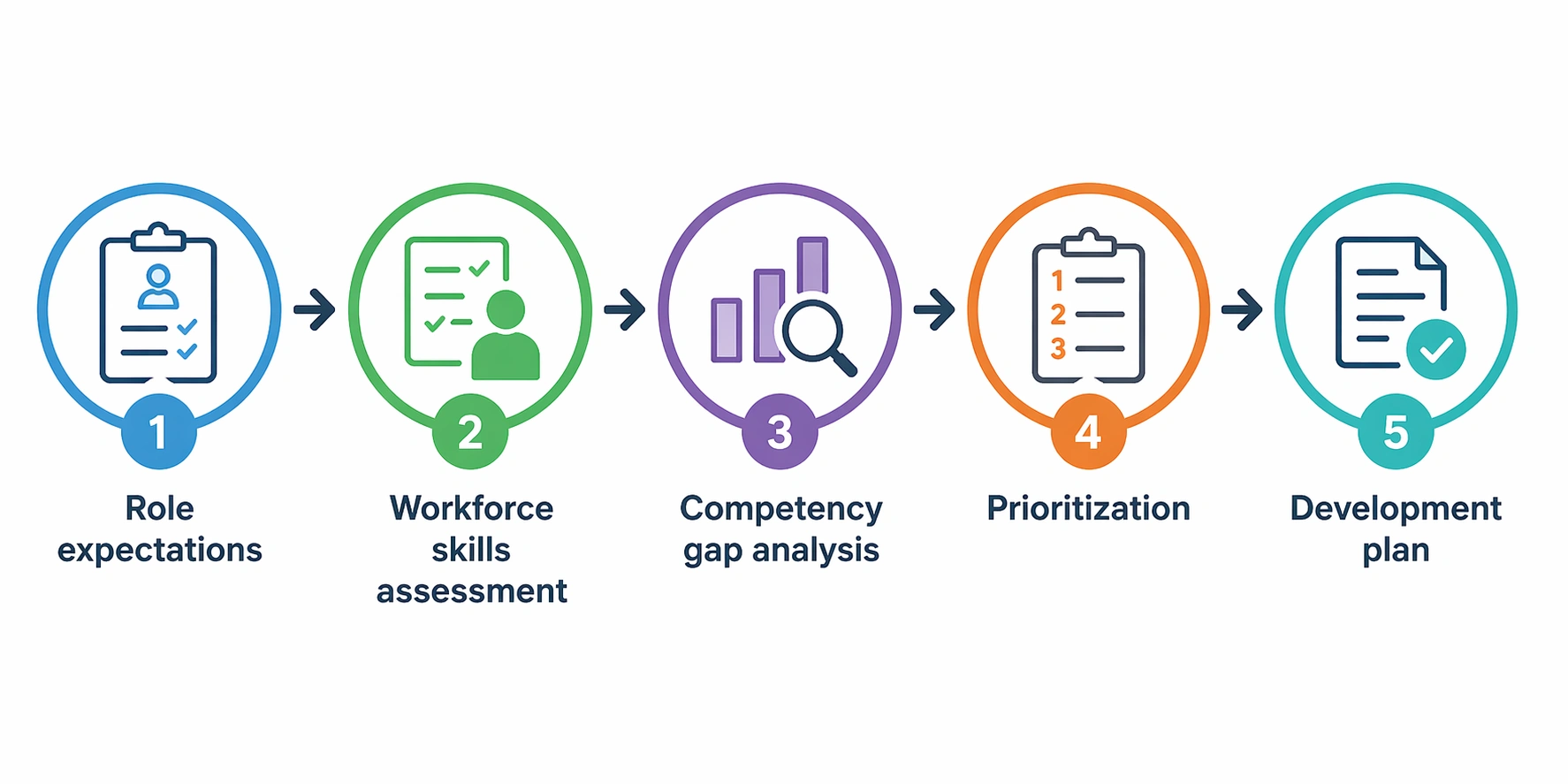
Define Role Expectations and Competencies
The first step in how to conduct a skills gap analysis is to define what success looks like in the role. That means documenting the competencies, behaviors, and outputs required to perform effectively. Without this baseline, the rest of the process becomes subjective.
Use job descriptions, performance standards, manager input, and examples from strong performers to define the role clearly. Focus on operational reality rather than idealized language. Your competency definitions should be precise enough that two different reviewers would understand them the same way.
This is the baseline for every later workforce skills assessment and competency gap analysis decision.
Conduct a Workforce Skills Assessment
Once role expectations are defined, assess current capability using role-aligned evidence. This is where the workforce skills assessment and employee skills assessment come into play. Look for measurable signals such as work quality, observation, throughput, error rates, manager evaluation, and knowledge checks.
The goal is not to create a perfect measurement system. The goal is to build a credible picture of current performance. A stronger assessment is usually a blended one, where no single input controls the result.
Too many organizations rely on self-ratings alone, which are easy to collect but rarely precise enough to support targeted decisions.
Run the Competency Gap Analysis
Compare required proficiency to current proficiency for each critical competency. This is the point where the analysis becomes useful. You are no longer asking whether someone seems ready. You are measuring where the role requires more than the current level of capability supports.
Document the size of the gap and describe what that gap is causing. A one-point gap in a low-impact skill is not the same as a one-point gap in a compliance-critical or manager-facing skill. Context matters.
This step is what turns a workforce skills assessment into a true competency gap analysis instead of a vague conversation about development.
Prioritize the Most Important Gaps
Not every gap deserves equal attention. Prioritize the ones that affect compliance, team stability, service quality, leadership effectiveness, workflow reliability, or growth capacity. That is the difference between a useful analysis and a long list no one acts on.
This is where the work starts to overlap with a training needs analysis. Once gaps are ranked by importance, the organization can make disciplined decisions about where to invest time, money, and leadership attention first.
If you skip prioritization, you usually end up with training overload and weak follow-through.
Build a Training Needs Analysis and Development Plan
Once the gaps are prioritized, convert them into a training needs analysis and development plan. This is where many organizations go wrong. They identify a real issue, then respond with generic training. That wastes money because generic training rarely maps tightly enough to the gap.
A stronger approach is to match the intervention to the problem. Some gaps call for structured training. Others call for coaching, job aids, workflow changes, guided practice, observation, or stronger supervisory reinforcement.
Good development planning is specific, measurable, and tied directly to the skill deficiency identified earlier in the process.
Monitor Progress and Reassess
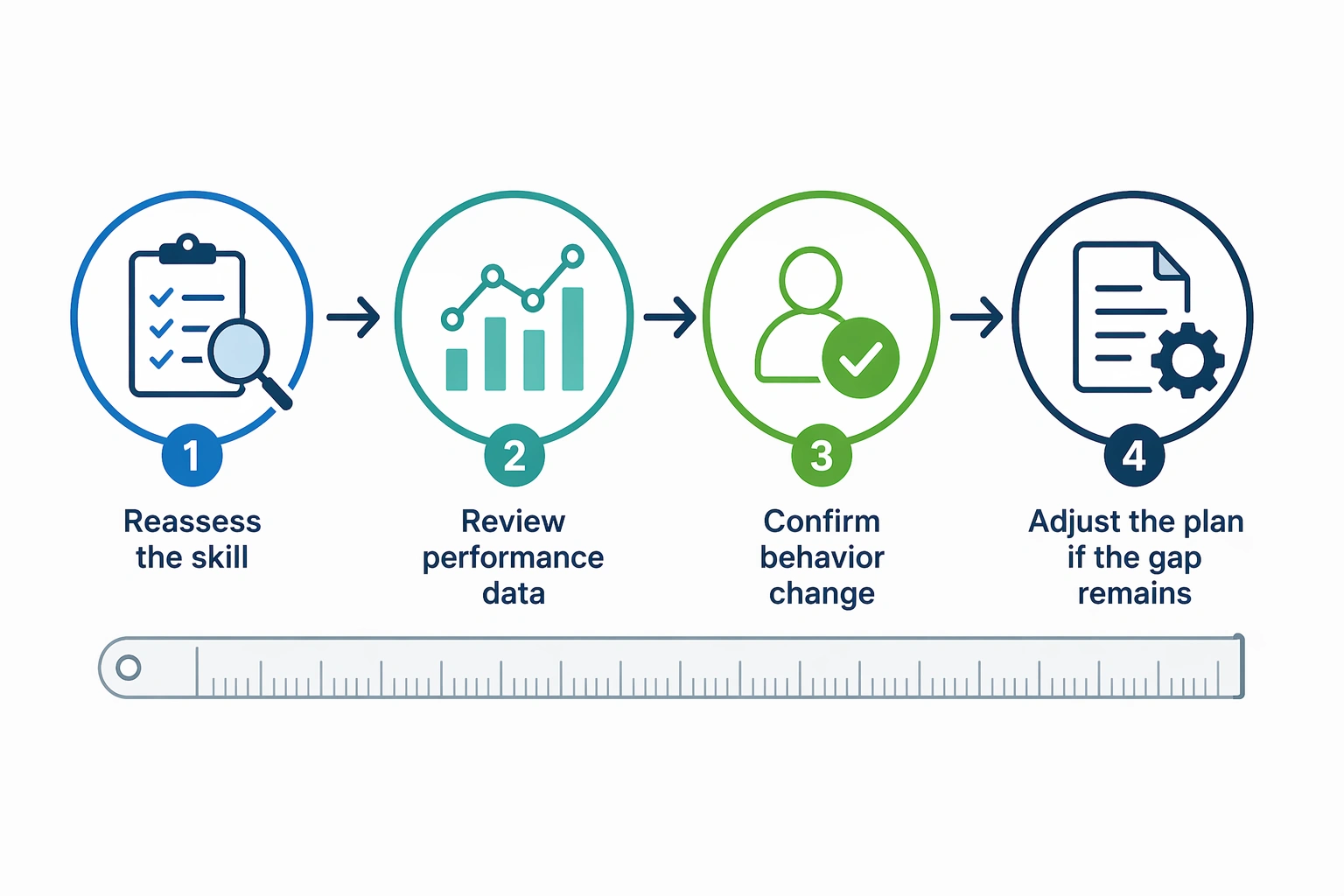
Skills gap analysis is not a one-time event. Workforce needs evolve, and training effectiveness varies over time. Establish ongoing monitoring mechanisms to track skill development progress and adjust the plan accordingly.
Use post-training assessments, performance reviews, output data, manager feedback, and employee feedback to gauge improvement and identify emerging gaps. The goal is not just to prove training happened. The goal is to determine whether capability improved.
If the gap remains, the issue may not have been training at all. The issue may be role clarity, supervision, process design, or structural friction.
How to Run an Employee Skills Assessment
An employee skills assessment is the role-specific application of the broader workforce skills assessment. Instead of asking what the organization is missing, you are asking where an individual employee is strong, where the employee is underprepared, and which capability gaps matter most for success in the role.
To do that well, assess employees against defined competency expectations rather than broad labels like leadership or communication. Break broad categories into observable behaviors and outputs. Those can be observed and rated. Generic labels cannot.
That matters because an employee skills assessment should tell you what to do next. It should not just confirm that someone needs development. It should specify what type of development is needed and what improved performance would look like afterward.
Competency Gap Analysis Example
Imagine an organization is preparing frontline supervisors to manage a larger team after growth. Leadership assumes supervisors need more training, but that statement is too broad to be useful. A competency gap analysis narrows the issue into something actionable.
- Competency: Coaching underperformance
- Required level: 4 out of 5
- Current level: 2 out of 5
- Operational effect: Problems linger and standards vary by shift
- Recommended action: Supervisor coaching workshop plus structured practice
That is the value of competency gap analysis. Instead of saying that supervisors need leadership training, the organization now knows which skill is weak, what operational problem it creates, and what development action makes sense first.
Skills Gap Analysis vs. Training Needs Analysis
These terms are related, but they are not interchangeable. A skills gap analysis identifies the difference between current capability and required capability. A training needs analysis uses that information to determine what development response makes the most sense.
- Skills gap analysis: What is missing?
- Training needs analysis: What should be done about it?
If you skip the analysis and go straight to training, the organization may solve the wrong problem with the wrong intervention.
How to Measure Training Results
A training intervention only matters if capability improves in a way the organization can see. That is why post-analysis monitoring matters so much. The purpose of measurement is not just to prove the training happened. The purpose is to determine whether the targeted skill improved and whether that improvement affected performance, risk, or workflow reliability.
Skills Gap Analysis Checklist
- Define the roles being assessed
- Clarify required competencies for each role
- Use concrete rating criteria
- Choose evidence sources beyond self-ratings
- Document the specific gaps by role and skill
- Rank the gaps by business impact
- Assign targeted development actions
- Set owners and review dates
- Reassess to confirm improvement
When the process is done well, skills gap analysis improves more than training decisions. It improves role clarity, prioritization, managerial consistency, and workforce planning discipline. When the process is done poorly, it turns into generic learning activity with no clear tie to capability or results.
For practical insights on related topics, explore these resources: workforce development consulting in Texas, organizational development consulting, leadership development consulting services, New Manager Training That Actually Works, HR Onboarding Best Practices, and Employee Documentation Best Practices for Legal Defense.
Frequently Asked Questions
Skills gap analysis identifies the difference between current capability and required competency. Training needs analysis uses that information to decide which learning or development actions should be used to close the gap.
Most organizations should conduct a skills gap analysis at least annually and more often when roles change, growth accelerates, or performance problems emerge.
A practical template should include the role, competency, required proficiency, current proficiency, gap level, business impact, recommended action, owner, and review date.
Use role-aligned criteria and multiple evidence sources such as manager observations, work samples, quality data, productivity data, and knowledge checks instead of relying only on self-ratings.
Common mistakes include vague competency definitions, self-rating-only assessments, failure to prioritize gaps by impact, and generic training that is not tied to measurable business outcomes.
Most organizations do not need more learning activity. Most organizations need a better method for identifying which capabilities are missing, why those gaps matter, and what intervention actually fits the problem. That is what a skills gap analysis is for. When the process is disciplined, it produces better development decisions, stronger workforce planning, and more credible use of training resources.