Most employee performance goals fail because they sound reasonable but do not define success. “Improve communication,” “be more productive,” and “take more initiative” are not performance goals. They are vague expectations pretending to be management tools. Strong employee performance goals identify the result, define the measurement, set the timeline, and give managers a fair basis for coaching, evaluation, development, and accountability.
Employee performance goals examples are specific, measurable objectives that define what successful work looks like in a role. They can focus on productivity, quality, customer service, teamwork, leadership, attendance, communication, compliance, or professional development.
What Are Employee Performance Goals?
Employee performance goals are role-based objectives that define the results, behaviors, or improvements an employee is expected to achieve during a performance period. Effective goals clarify what needs to happen, how progress will be measured, and when the outcome should be reviewed.
Work performance goals should not be disconnected from daily responsibilities. The best goals are tied to role expectations, department priorities, customer needs, workflow quality, compliance obligations, and measurable business outcomes.
If a manager cannot explain how a goal will be measured, the goal is not ready for an evaluation form.
Employee Performance Goals Examples
The strongest employee performance goals examples are specific enough to guide behavior and measurable enough to support fair evaluation. The goal does not need to be complicated. The goal needs to be clear.
| Goal Type | Employee Performance Goal Example | How to Measure It |
|---|---|---|
| Productivity | Complete 95% of assigned tasks by the established deadline during the next quarter. | Task completion rate and deadline tracking |
| Quality | Reduce report errors by 20% within 90 days by using the department review checklist before submission. | Error rate before and after implementation |
| Customer Service | Respond to customer inquiries within one business day for the next quarter while maintaining a satisfaction score of 90% or higher. | Response time and customer satisfaction score |
| Communication | Provide weekly status updates every Friday that identify completed work, barriers, and next steps. | Weekly update completion and manager review |
| Teamwork | Participate in weekly team meetings and contribute at least one relevant update, concern, or recommendation each week. | Meeting participation and documented contributions |
| Professional Development | Complete one job-related training course by the end of Q2 and apply one learning outcome to current work processes. | Training completion and applied improvement |
| Compliance | Complete required documentation within 24 hours of each client, customer, or operational interaction for the next 60 days. | Documentation timeliness and audit results |
| Attendance | Maintain reliable attendance for the next 90 days with no unexcused absences or avoidable late arrivals. | Attendance record |
| Leadership | Conduct monthly one-on-one meetings with each direct report and document progress, barriers, and follow-up actions. | Completed meeting notes and follow-up tracking |
| Process Improvement | Identify one recurring workflow issue and submit a documented improvement recommendation by the end of the quarter. | Submitted recommendation and implementation status |
Copy-and-Use Employee Performance Goals
Use these measurable employee goals as starting points. Adjust the percentage, timeline, department name, quality standard, or review cadence to match the role.
- Increase task completion rate to 95% within the next 90 days.
- Reduce customer response time to less than 24 hours by the end of Q2.
- Complete all assigned monthly reports by the established deadline for three consecutive months.
- Reduce data entry errors by 15% within 60 days.
- Submit complete and accurate documentation within one business day of each required event.
- Complete one job-related certification, course, or training program by Q3.
- Provide one process improvement recommendation during each quarterly review period.
- Maintain a customer satisfaction score of at least 90% for the next quarter.
- Resolve 85% of assigned support tickets within the department standard timeline.
- Attend all required team meetings and provide at least one relevant update per meeting.
- Improve project handoff accuracy by using the department checklist for every assigned handoff over the next 60 days.
- Complete assigned onboarding or cross-training activities by the agreed deadline.
- Reduce rework caused by avoidable errors by 20% over the next quarter.
- Document all follow-up actions after customer, client, or internal stakeholder meetings within 24 hours.
- Meet weekly production targets for eight consecutive weeks while maintaining quality standards.
Performance Objectives Examples by Role
Performance objectives examples should reflect the employee's actual responsibilities. A strong objective for an administrative employee may look different from a strong objective for a supervisor, technician, program manager, or customer service representative.
Administrative Employee Performance Objectives Examples
- Process 98% of assigned records accurately by the weekly deadline for the next quarter.
- Respond to internal information requests within one business day for the next 60 days.
- Maintain organized digital files with no more than two documentation corrections per monthly audit.
- Prepare meeting agendas and supporting materials at least 24 hours before each scheduled meeting.
Customer Service Performance Objectives Examples
- Resolve 85% of customer issues during the first interaction by the end of Q3.
- Maintain an average customer satisfaction score of 90% or higher during the next review period.
- Reduce average response time from 48 hours to 24 hours within 60 days.
- Document customer issues, actions taken, and follow-up needs in the tracking system by the end of each workday.
Supervisor Performance Objectives Examples
- Complete documented monthly check-ins with each direct report for the next six months.
- Ensure 100% of employee evaluations are completed by the required deadline.
- Reduce preventable scheduling gaps by 20% over the next quarter.
- Address documented performance concerns within five business days of identification.
Operations Employee Performance Objectives Examples
- Complete assigned work orders within the department standard timeline 90% of the time.
- Reduce avoidable rework by following the pre-task checklist on every assigned job for the next 90 days.
- Report equipment, safety, or workflow issues within one business day of identification.
- Maintain compliance with required safety procedures during all observed field or operational activities.
Measurable Employee Goals: How to Make Goals Trackable
Measurable employee goals rely on clear benchmarks such as percentages, timelines, completion rates, response times, quality standards, or observable behaviors. If the goal cannot be tracked, reviewed, or documented, the manager will struggle to use it fairly during an employee evaluation.
A measurable goal answers four questions:
- What result should happen? Define the expected outcome.
- How will progress be measured? Identify the metric, record, or observable behavior.
- When should progress be reviewed? Set a deadline or review cadence.
- Why does the goal matter? Connect the goal to the role, team, customer, or organization.
Never write a performance goal that depends entirely on opinion. Use evidence, records, examples, metrics, or documented behavior.
Weak vs. Strong Work Performance Goals
Weak work performance goals create confusion because they sound positive but fail to define the expected action. Strong goals convert broad expectations into observable and measurable performance standards.
| Weak Goal | Strong Performance Goal |
|---|---|
| Improve communication. | Provide a written project status update every Friday for the next 90 days that includes completed work, barriers, and next steps. |
| Be more productive. | Complete 95% of assigned tasks by the established deadline during the next quarter. |
| Improve customer service. | Respond to customer inquiries within one business day while maintaining a satisfaction score of 90% or higher for the next quarter. |
| Show more initiative. | Submit one documented process improvement recommendation during each quarterly review period. |
| Be a better team player. | Attend weekly team meetings and contribute at least one relevant update, barrier, or support offer during each meeting. |
| Improve documentation. | Complete required documentation within 24 hours of each required event with no more than two corrections per monthly audit. |
How to Write SMART Employee Performance Goals
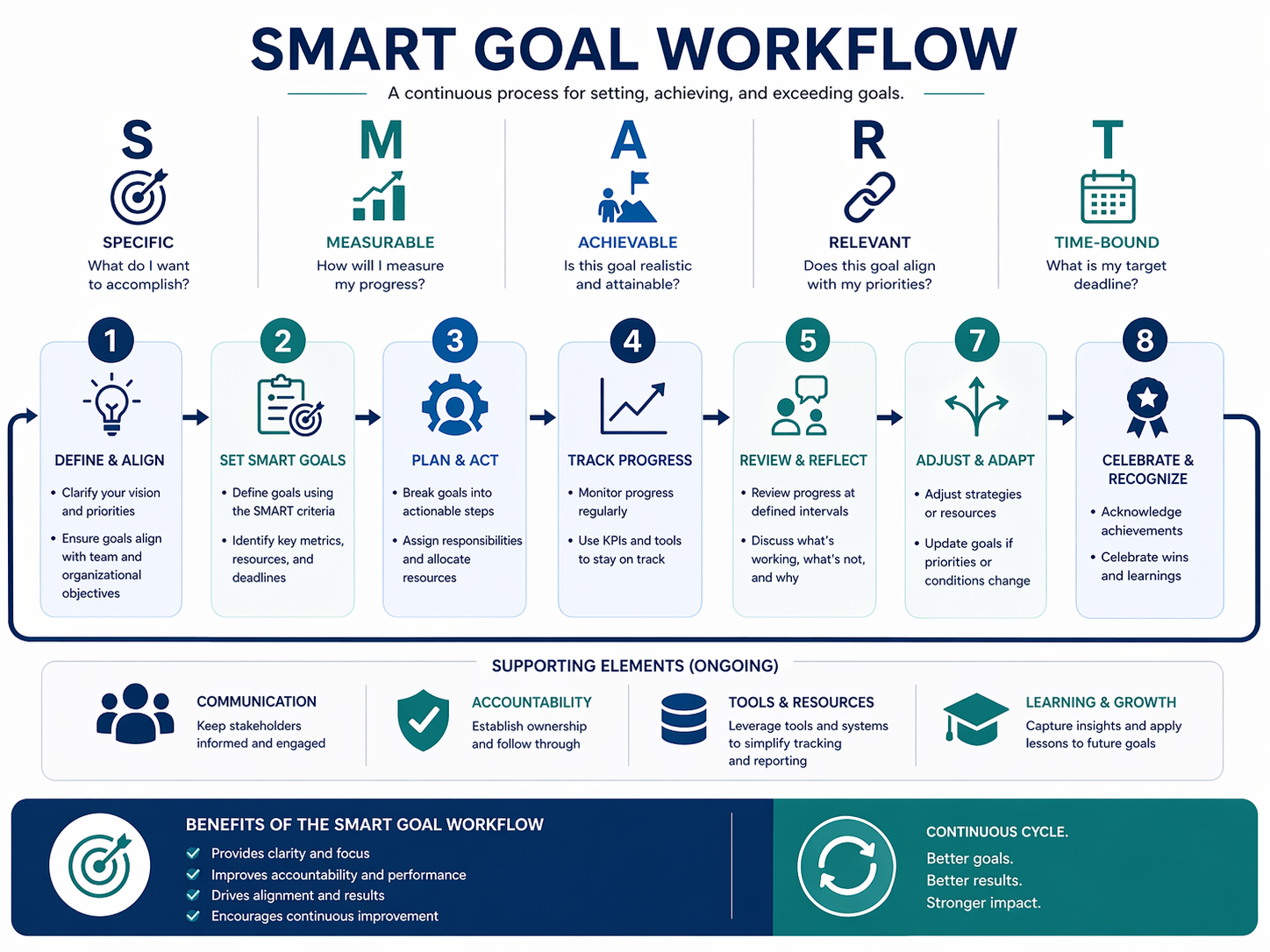
SMART goals are specific, measurable, achievable, relevant, and time-bound. The SMART framework helps managers move from vague performance expectations to clear employee evaluation goals.
Specific: Define the Expected Result
A specific goal identifies the work result, behavior, or improvement expected. “Improve work quality” is not specific. “Reduce monthly report errors by 20%” gives the employee and manager a defined target.
Measurable: Identify the Evidence
A measurable goal includes a metric, deadline, tracking method, or observable behavior. Measurement protects the employee from unclear expectations and protects the organization from evaluation decisions based on memory or preference.
Achievable: Match the Goal to Reality
A goal should challenge the employee without ignoring staffing, workload, authority, training, or resource constraints. Unrealistic goals create frustration and weak documentation.
Relevant: Connect the Goal to the Role
Relevant goals support the employee's actual job duties, team priorities, customer needs, compliance requirements, or operational outcomes. A goal that does not connect to the role is hard to defend during an evaluation.
Time-Bound: Set the Review Point
A time-bound goal identifies when progress will be reviewed. Without a deadline or review cadence, goals drift until the annual evaluation becomes a surprise. That is not performance management. That is administrative archaeology.
Employee Evaluation Goals for Performance Reviews
Employee evaluation goals should create a clear line between expectations, evidence, and decisions. A performance review should not be the first time an employee hears that a goal mattered. Goals should be documented, reviewed, and adjusted throughout the performance period.
Strong employee evaluation goals help managers answer three questions:
- Did the employee understand what was expected?
- Was progress reviewed before the evaluation?
- Is the evaluation based on documented evidence instead of general impressions?
Examples of Employee Evaluation Goals
- Meet or exceed 90% of assigned productivity targets during the review period.
- Maintain documentation accuracy of 95% or higher during quarterly audits.
- Complete all required training by the assigned deadline.
- Demonstrate consistent follow-through by completing agreed action items before the next check-in.
- Improve customer response time from 48 hours to 24 hours by the next quarterly review.
- Reduce avoidable rework by 20% before the next performance evaluation.
- Participate in monthly coaching conversations and complete documented follow-up actions.
If a performance issue was not discussed during the review period, it should not suddenly appear as a major evaluation finding without prior documentation.
Five Steps to Setting Performance Goals That Work
Start with the Role, Not the Form
Before writing goals, define what the role is responsible for producing. Review the job description, workflow responsibilities, performance problems, customer expectations, and department priorities. The goal should reflect real work, not generic language copied from last year's form.
Choose the Right Type of Goal
Some goals measure output. Some measure quality. Some measure behavior, growth, or compliance. Match the goal type to the performance need. A struggling employee may need a documentation accuracy goal. A high-potential employee may need a development goal tied to leadership readiness.
Define the Measurement Before the Goal Is Final
Do not finalize a goal until the measurement is clear. Managers should know exactly what record, report, observation, checklist, system, or documented example will be used to assess progress.
Set a Review Cadence
Goals only work when managers review them. Monthly or quarterly check-ins create accountability, allow barriers to be addressed, and prevent the annual evaluation from becoming a memory contest.
Document Progress and Use It Fairly
Documented progress turns goals into usable management infrastructure. Notes from check-ins, examples of completed work, missed deadlines, coaching conversations, and completed training all help managers evaluate performance fairly and consistently.
Real-World Application: From Vague Reviews to Measurable Goals
A mid-sized nonprofit moved away from task-based annual reviews and implemented measurable performance goals for program managers. The organization replaced vague expectations with outcome-based goals, quarterly check-ins, documented developmental goals, and clearer evaluation criteria.
The improvement did not come from writing prettier goals. The improvement came from creating a system where employees understood expectations, managers reviewed progress consistently, and evaluations were connected to documented performance evidence.
Employee Performance Goals Checklist
Use this checklist before adding a goal to an evaluation form, performance improvement plan, development plan, or quarterly review document.
- The goal is connected to the employee's actual role.
- The goal identifies a specific outcome, behavior, or improvement.
- The goal includes a measurable standard.
- The goal has a deadline or review cadence.
- The goal is realistic based on workload, training, resources, and authority.
- The goal supports a department, customer, compliance, quality, or business need.
- The manager and employee understand how progress will be documented.
- The goal can be reviewed before the final evaluation.
- The goal avoids vague language such as “better,” “more,” or “improve” without a defined measure.
- The goal can support coaching, recognition, development, or accountability decisions.
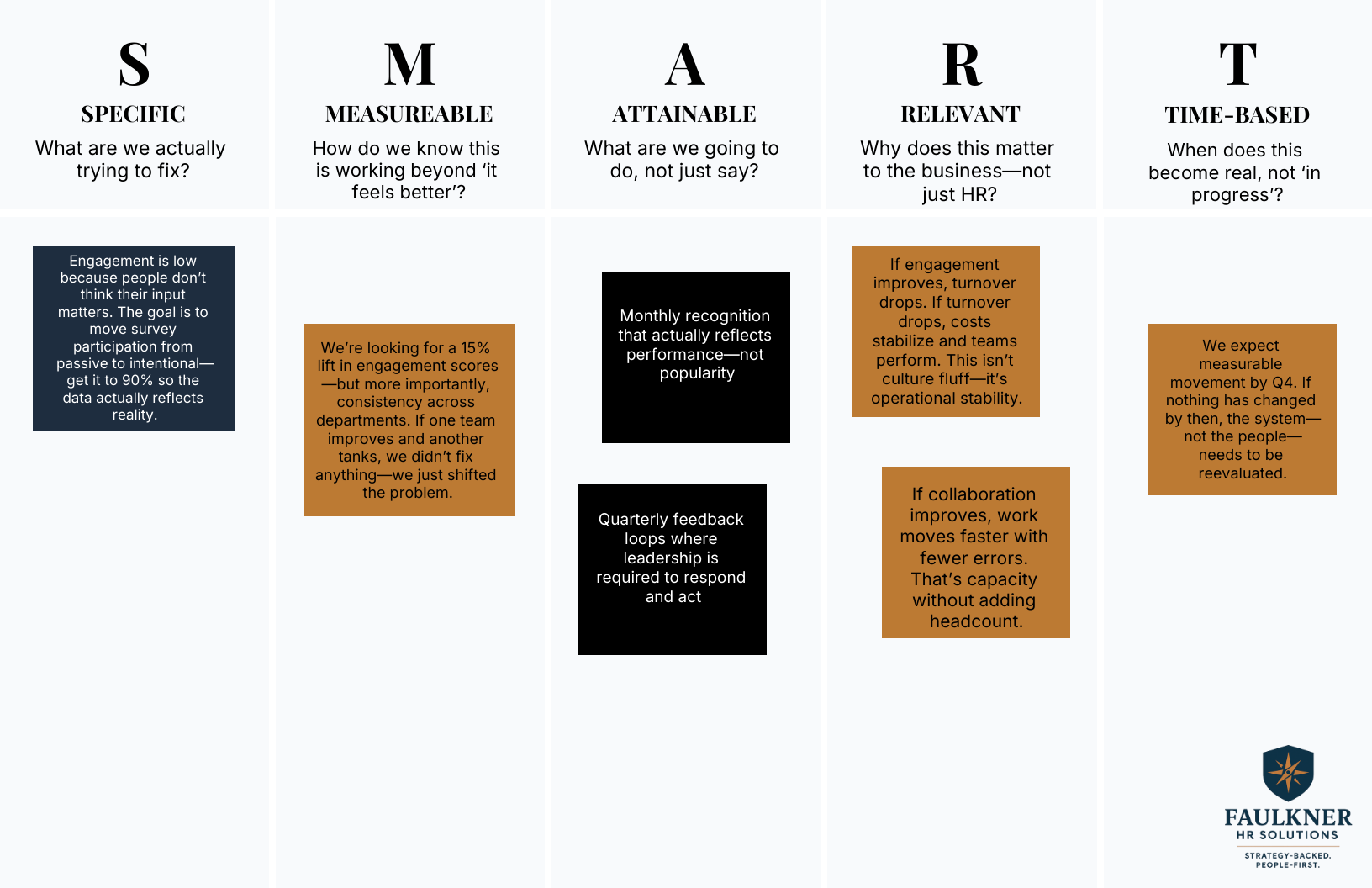
Performance goals are not a set-it-and-forget-it HR task. They are the operating instructions for accountability. For stronger manager execution, see manager performance and leadership training. For building the broader structure around goals, review leadership development consulting and workforce development consulting. For related goal-setting strategy, see SMART goals for employee engagement.
Frequently Asked Questions
Examples of employee performance goals include increasing task completion rates, reducing errors, improving customer response time, completing required training, improving documentation accuracy, meeting production standards, and contributing to process improvement.
Measurable employee goals include a defined result, timeline, and tracking method. For example, “Reduce report errors by 20% within 90 days” is measurable because the expected result, percentage, and deadline are clear.
Good employee evaluation goals are specific, role-related, measurable, documented, and reviewed during the evaluation period. They should connect performance expectations to evidence instead of relying on general impressions.
Write performance objectives by identifying the role outcome, defining the measurement, setting a timeline, and connecting the objective to a real business or operational need. A strong objective tells the employee what success looks like and how progress will be reviewed.
A SMART performance goal example is: “Reduce customer response time from 48 hours to 24 hours by the end of Q2 while maintaining a customer satisfaction score of at least 90%.” The goal is specific, measurable, achievable, relevant, and time-bound.
Common mistakes include using vague language, failing to define measurement, setting goals unrelated to the role, ignoring workload constraints, skipping progress reviews, and waiting until the annual evaluation to discuss performance concerns.
Related HR Questions, Answered
Direct answers from our HR FAQ library for Texas employers: