Many nonprofits, despite passionate teams and genuine mission commitment, hit a structural wall during growth. The early-stage approach — capable people carrying more than their share, decisions made informally, everything flowing through whoever is available — works until it does not. What follows is usually not a single dramatic failure but a slow accumulation of the same problems: decisions stall, new staff take months to become functional, high performers quietly start looking for the exit, and the Executive Director becomes the default answer to every unresolved question.
These are nonprofit organizational design problems. They present as people problems because that is where the symptoms appear. Addressing them with culture initiatives, leadership coaching, or another motivational retreat without touching the underlying structure is how organizations stay stuck in the same loop.
What Is Nonprofit Organizational Design?
Nonprofit organizational design is the intentional structure of roles, responsibilities, reporting relationships, decision authority, governance boundaries, and workflows that allow a nonprofit to deliver its mission consistently. A strong nonprofit organizational structure does not simply show who reports to whom. It clarifies who owns decisions, how work moves, how accountability is measured, and where board authority ends and staff authority begins.
Good nonprofit organizational design connects mission, structure, people, process, governance, and execution. It helps leaders reduce unnecessary escalation, clarify nonprofit roles and responsibilities, improve staff accountability, and build a scalable nonprofit operating model that can grow without burning out the people carrying the work.
For organizations needing hands-on support, Faulkner HR Solutions provides nonprofit HR consulting, organizational development consulting, and HR process improvement to help mission-driven organizations repair the structure beneath recurring workforce problems.
Why Nonprofit Organizational Design Gets Ignored Until It Fails
The reason most nonprofits avoid structural work is understandable. Early on, urgency is real and resources are thin. Getting the work done is the priority, not documenting how the work gets done. That model has a shelf life organizations routinely ignore until they have passed it.
When headcount doubles and programs multiply, the informal systems that kept things moving begin to fail — not dramatically, but persistently. The same conversations happen repeatedly. New staff take months to become functional because nobody has written down how things actually work. Decisions that should take an afternoon take a week.
Organizations that double their budget and staff in a few years often find their internal processes remain stuck in startup mode. The Executive Director becomes a bottleneck not because of poor leadership, but because the structure never gave anyone else clear authority to decide.
This lack of proactive design produces predictable downstream effects: decision fatigue at the top as leaders handle operational minutiae that should never reach them; duplication of effort across teams without clear departmental boundaries; staff frustration from ambiguous responsibilities and constant approval requirements; and early turnover among high performers who have options.
The Three Nonprofit Organizational Structures Most Organizations Actually Use
Understanding nonprofit organizational structure in practice — not just in theory — is where design work starts. The structure itself is rarely what breaks. What breaks is what gets left undefined inside it.
The functional structure groups teams by discipline — Programs, Development, Finance — with a clear department head for each. It works well for small to mid-sized organizations with a limited program portfolio. The failure point is cross-departmental communication, which breaks down as scale increases and creates silos that slow decisions and frustrate staff.
The program-based structure organizes the organization around its core services, each with its own dedicated team. It is well-suited for larger organizations with distinct, well-funded programs requiring specialized staff. The failure point is duplication of administrative and support functions across programs — the same HR, finance, and communications work gets done three times because no one owns it centrally.
The hybrid structure combines functional and program-based approaches, with centralized support services such as HR, finance, and communications serving decentralized program teams. Most mature nonprofits with 30 or more employees land here. The failure point is authority gaps and unresolved conflicts between program needs and central support capacity — arguments about who decides and who serves whom that consume more leadership bandwidth than they should.
What Good Nonprofit Roles and Responsibilities Actually Look Like
Most nonprofit job descriptions define roles by task. They describe what someone does each day. A well-designed role defines what someone is accountable for producing. That difference matters more than it sounds.
A task-defined role creates institutional dependency. When the person leaves, the knowledge walks out with them. A role defined by outcomes creates a standard the organization can hold regardless of who fills the seat.
Each role in a properly designed nonprofit staff structure should be able to answer four questions without ambiguity:
- What outcomes is this role accountable for producing?
- What decisions can this role make without approval?
- How is success in this role measured?
- When does this role escalate, and to whom?
If those questions cannot be answered cleanly for a given role, that role will generate confusion and upward dependency. Staff will default to asking permission for decisions they should own. Leaders will spend time on issues that should never reach them. This applies at every level — not just for individual contributors. Program design is also a question of accountability. Who owns what inside the program? Who can commit organizational resources? What requires executive involvement?
Nonprofit Leadership Structure: Where Most Organizations Break
Nonprofit leadership structure is where the most expensive failures happen, and they almost always land on the Executive Director.
The Bottleneck That Nobody Designed
In a nonprofit that grew without intentional structure, the Executive Director ends up as the default decision-maker for a range of issues that should never require their involvement. Not because the ED wants that role — because the structure never gave anyone else clear authority to decide. Staff hesitate because the boundaries are unclear. Program managers escalate because they are not sure what latitude they have. The ED fields questions and approvals all day while strategic work waits.
The response most people reach for is "the ED needs to delegate more." That is the wrong intervention. Delegation without structural clarity is just pushing confusion downstream. The actual fix is defining where authority lives for each category of decision, then documenting it, communicating it, and holding it.
The Flat Organization Illusion
Many nonprofits respond to the bottleneck problem by flattening. Titles get softened. Decision-making becomes collaborative. The org chart looks horizontal. What usually happens instead is that hierarchy goes underground. Informal influence replaces formal authority. The people with the most tenure or the most access to leadership make the real decisions, but nobody can say so out loud. Accountability becomes almost impossible to assign because the structure is impossible to read.
A flat organization is not a democratic organization. It is an organization where authority is operating without transparency.
Nonprofit Governance Structure: The Layer Most Organizations Treat as Compliance
Nonprofit governance gets treated as a legal obligation — file the 990, hold the board meetings, maintain the minutes. That is the floor, not the function.
Governance is a structural layer. How it works — or does not work — shapes everything below it. When governance is functioning, the board and executive team have a clear division of authority: the board sets direction and holds the executive accountable, staff execute, and that boundary is understood by everyone involved.
When governance is not functioning, three failure modes show up consistently. Micromanaging boards insert themselves into operational decisions, undermining executive authority at the exact moment it is needed. Disengaged boards show up for compliance minimums and offer nothing strategic. Most commonly, there are undefined boundaries between board authority and executive authority, producing slow-moving tension that consumes leadership bandwidth without ever reaching resolution.
Governance design is not a separate conversation from organizational design. How the board engages with the Executive Director shapes how the Executive Director engages with staff. The accountability culture either moves through the organization or stops at the top.
What a Nonprofit Organizational Design Project May Include
A nonprofit organizational design project should produce practical tools and decisions, not just a prettier nonprofit org chart. The goal is to clarify how work, authority, accountability, governance, and leadership should function as the organization grows.
- Current-state nonprofit organizational structure review
- Nonprofit org chart assessment
- Role clarity and responsibility mapping
- Board and staff authority boundary review
- Decision-making matrix
- Program structure and support function analysis
- Executive Director bottleneck assessment
- Governance and management role clarification
- Nonprofit restructuring recommendations
- Implementation roadmap for a scalable nonprofit structure
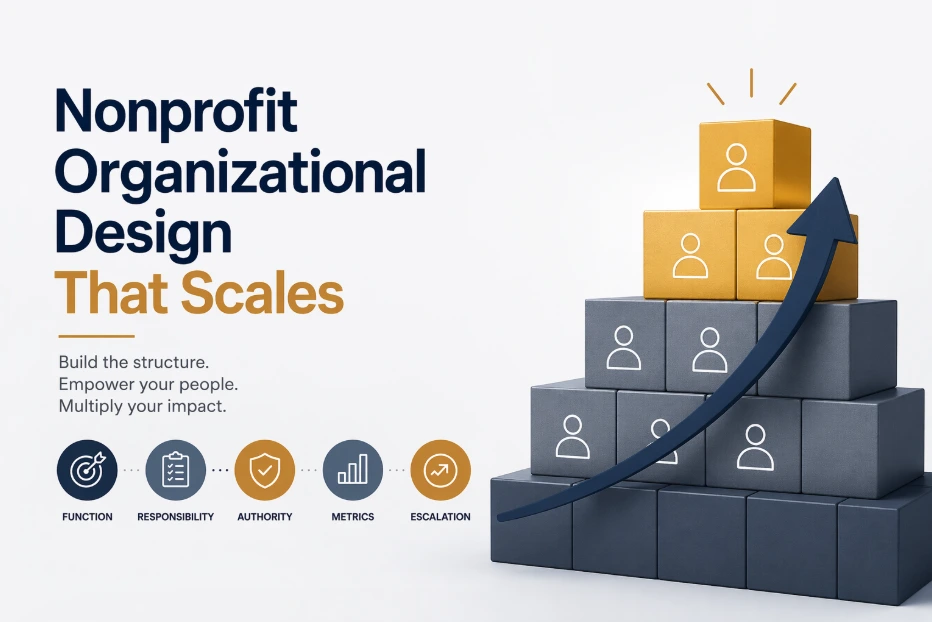
The F.R.A.M.E.™ Model for Scalable Nonprofit Structure
Faulkner HR Solutions developed the F.R.A.M.E.™ model to give nonprofit leaders a repeatable framework for structuring roles and functions that hold up as the organization grows. Every role and every team should be able to answer questions relative to the five domains:
Function
Why does this role exist? What is its core purpose in the organization? Function is not a job title or a task list. It is the answer to: "If this role were removed, what would the organization lose the capacity to do?" If that question is hard to answer, the role is likely either redundant or poorly scoped.
Responsibility
What outcomes must this role produce? Tasks are not outcomes. An outcome is a measurable result the role is expected to deliver. "Manages the volunteer program" is a task description. "Ensures 95% of program shifts are fully staffed with trained volunteers" is an outcome. The distinction determines whether you can hold the role accountable for anything specific.
Authority
What decisions can this role make independently? Where does the role need approval? What is explicitly off-limits? Without documented authority boundaries, staff default to escalating everything and leaders default to deciding everything. Authority clarity is the single most direct fix for the ED bottleneck problem described above.
Measures
How is success measured for this role? What are the KPIs? Roles without measures are roles without accountability. When performance conversations happen without a shared definition of what good looks like, they produce defensiveness rather than development. Measures should be defined when the role is designed, not after a performance problem surfaces.
Environment
What resources, tools, and support does this role need to succeed? What are the dependencies? A role that is well-defined but under-resourced will fail anyway. Environment mapping surfaces the hidden assumptions about what the role requires — assumptions that only become visible after an employee has already burned out trying to work around them.
Common Pitfalls in Nonprofit Organizational Design
- Mission drift from unclear roles. When roles are not defined by outcomes, staff prioritize whatever feels urgent rather than whatever is central to the mission. Impact dilutes gradually and invisibly.
- Burnout from overlapping responsibilities. Ambiguous accountability means either multiple people attempt the same work, or critical work falls through entirely. Both are exhausting.
- Decision paralysis. Without clear authority structures, minor decisions require multiple layers of approval. The bottleneck effect described above is the predictable result.
- No accountability infrastructure. When measures of success are vague or absent, performance conversations become personal rather than structural. That makes performance issues harder to address and easier to avoid.
- Treating redesign as a one-time event. Organizational design drifts. Programs change, staff turns over, funding priorities shift. A structure that is never revisited will eventually describe an organization that no longer exists.
When to Re-evaluate Your Nonprofit Organization's Design
The signals that a structural re-evaluation is overdue tend to be consistent across organizations and sizes: the same decisions keep requiring executive involvement; new staff take unusually long to become functional; high performers are leaving at a higher rate than low performers; programs are expanding but service quality is declining; and leadership conversations about strategy keep getting derailed by operational problems.
None of these are conclusive on their own. Together, they indicate a structure that was designed for a smaller, simpler organization and has been outpaced by what the organization has become.
The re-evaluation does not have to be a full redesign. Often the most effective intervention is targeted: clarify authority boundaries for the Executive Director, rewrite three or four role descriptions using outcome language, define the governance boundary between board and staff, or redesign the approval pathway that creates the most delay. Start where the friction is loudest and build from there.
If this describes your organization, the next step is a conversation. Contact Faulkner HR Solutions to discuss where the structural friction is showing up and what a focused intervention looks like for your specific situation.
Related Support for Nonprofit Structure and Capacity Building
Nonprofit organizational design often connects with broader capacity building, leadership development, HR process improvement, governance clarification, and workforce development. Related services and resources include:
Frequently Asked Questions About Nonprofit Organizational Design
Nonprofit organizational design is the intentional structuring of roles, responsibilities, authority, governance boundaries, workflows, and decision-making processes to help the organization deliver its mission efficiently and sustainably.
The best nonprofit organizational structure depends on size, program complexity, funding model, and leadership capacity. Most nonprofits start with a functional structure and may move toward a hybrid structure as programs and staff expand.
Nonprofit roles and responsibilities should be defined by outcomes, decision authority, success measures, escalation rules, and resource needs rather than by task lists alone.
The Executive Director often becomes a bottleneck when staff lack clear decision authority. When authority boundaries are undefined, the default is to escalate. The fix is documenting where decision authority lives for each category of choice, communicating it clearly, and holding that structure consistently.
Nonprofit governance refers to board-level direction, oversight, and accountability. Management refers to staff-led execution, operations, supervision, and daily decision-making. Problems emerge when board authority and staff authority are not clearly separated.
F.R.A.M.E.™ is a role design framework developed by Faulkner HR Solutions covering Function, Responsibility, Authority, Measures, and Environment. Applying it to each role produces a structure where accountability is explicit rather than assumed.
A formal review should happen whenever a significant change occurs, including new executive leadership, significant growth in headcount or programs, major funding shifts, or persistent operational friction that normal management has not resolved.
Related HR Questions, Answered
Direct answers from our HR FAQ library for Texas employers: