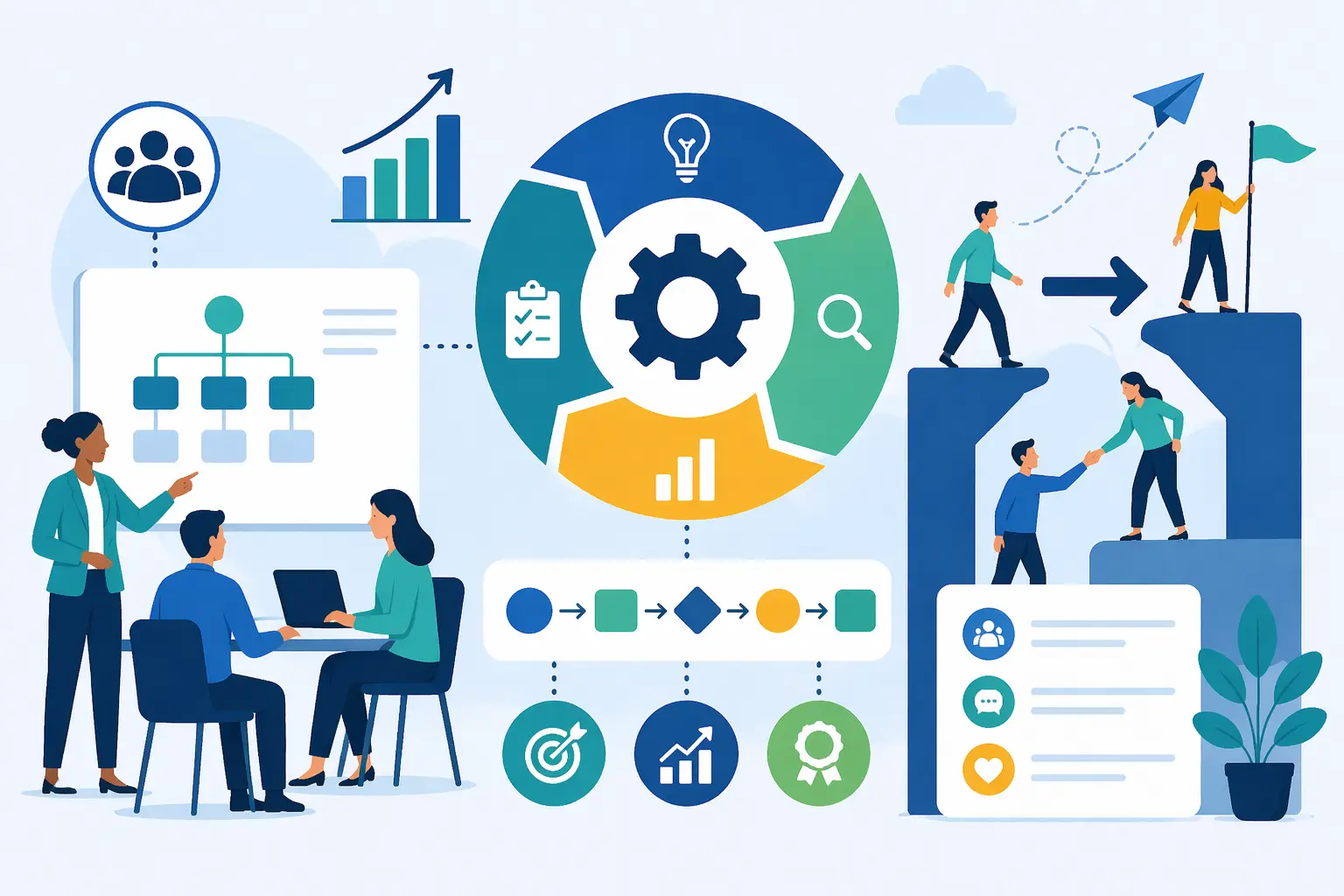
An organizational development consultant helps organizations fix the structure behind recurring performance problems. When roles are unclear, workflows break down, leaders make inconsistent decisions, or change initiatives fail to stick, the issue is rarely solved by another training session. Organizational development consulting focuses on the systems that shape how people work: structure, communication, authority, workflows, accountability, and execution.
The OD consultant role sits at the intersection of organization design, business process improvement, change management, leadership alignment, and workforce execution. The work is not about motivational messaging. It is about diagnosing the system, redesigning the operating conditions, and helping leaders sustain better performance.
What Problems Does an Organizational Development Consultant Solve?
An organizational development consultant helps identify and correct the structural problems that prevent organizations from executing consistently. The work often overlaps with a business process improvement consultant, change management consultant, and organization design consultant, but the core focus remains the same: improving how the organization functions as a system.
- Unclear roles and responsibilities
- Broken workflows and excessive handoffs
- Slow or inconsistent decision-making
- Weak management accountability
- Failed change initiatives
- Growth that has outpaced structure
- Department silos and communication breakdowns
- Turnover caused by preventable system friction
- Leadership expectations that do not translate into daily behavior
- Processes that depend too heavily on memory, personality, or informal workarounds
Most recurring people problems are system problems with names attached. OD consulting looks past the symptom and examines the conditions creating the behavior.
What Is Organizational Development Consulting?
Organizational development consulting is a professional service focused on improving how an organization functions by analyzing and redesigning its structure, workflows, roles, communication patterns, and decision-making systems. Unlike narrow training or policy projects, OD consulting looks at the operating environment that determines whether people can perform consistently.
Effective organizational development consulting connects people, process, and structure. It helps leaders clarify expectations, reduce operational friction, improve workflow accountability, and build systems that hold under pressure.
When Should You Hire an Organizational Development Consultant?
Hiring an OD consultant makes sense when the organization keeps experiencing the same execution problems even after meetings, reminders, training, or policy updates. Repetition is the clue. If the same issue keeps returning, the problem is probably built into the system.
- Growth has outpaced structure. Informal processes that once worked no longer support the size or complexity of the organization.
- Roles are unclear. Employees and managers are unsure who owns decisions, handoffs, follow-up, or outcomes.
- Workflows are slow or inconsistent. Work gets delayed, duplicated, reworked, or trapped between departments.
- Leadership practices vary too much. Managers interpret expectations differently and employees experience inconsistent accountability.
- Change efforts keep failing. New initiatives launch with energy but fall apart during implementation.
- Turnover has a pattern. Employees leave because frustration, unclear expectations, poor communication, or weak management systems continue unchecked.
The OD Consultant Role: What They Actually Do
The OD consultant role is practical. A strong consultant does not simply provide observations and leave behind a slide deck. The role includes diagnosis, design, implementation support, and measurement.
Diagnose
The consultant reviews workflows, interviews stakeholders, observes how decisions are made, examines documentation, evaluates leadership consistency, and identifies the system conditions creating repeated problems.
Design
The consultant develops targeted changes to roles, workflows, decision rights, communication protocols, accountability systems, leadership expectations, or operating structure.
Implement
The consultant supports leaders and teams as changes are communicated, tested, adjusted, and embedded. This may include manager coaching, change management planning, process rollout support, or workforce training.
Measure and Adjust
The consultant helps define success metrics and review whether the new structure is actually working. Strong OD consulting includes adjustment because systems rarely improve permanently from one static recommendation.
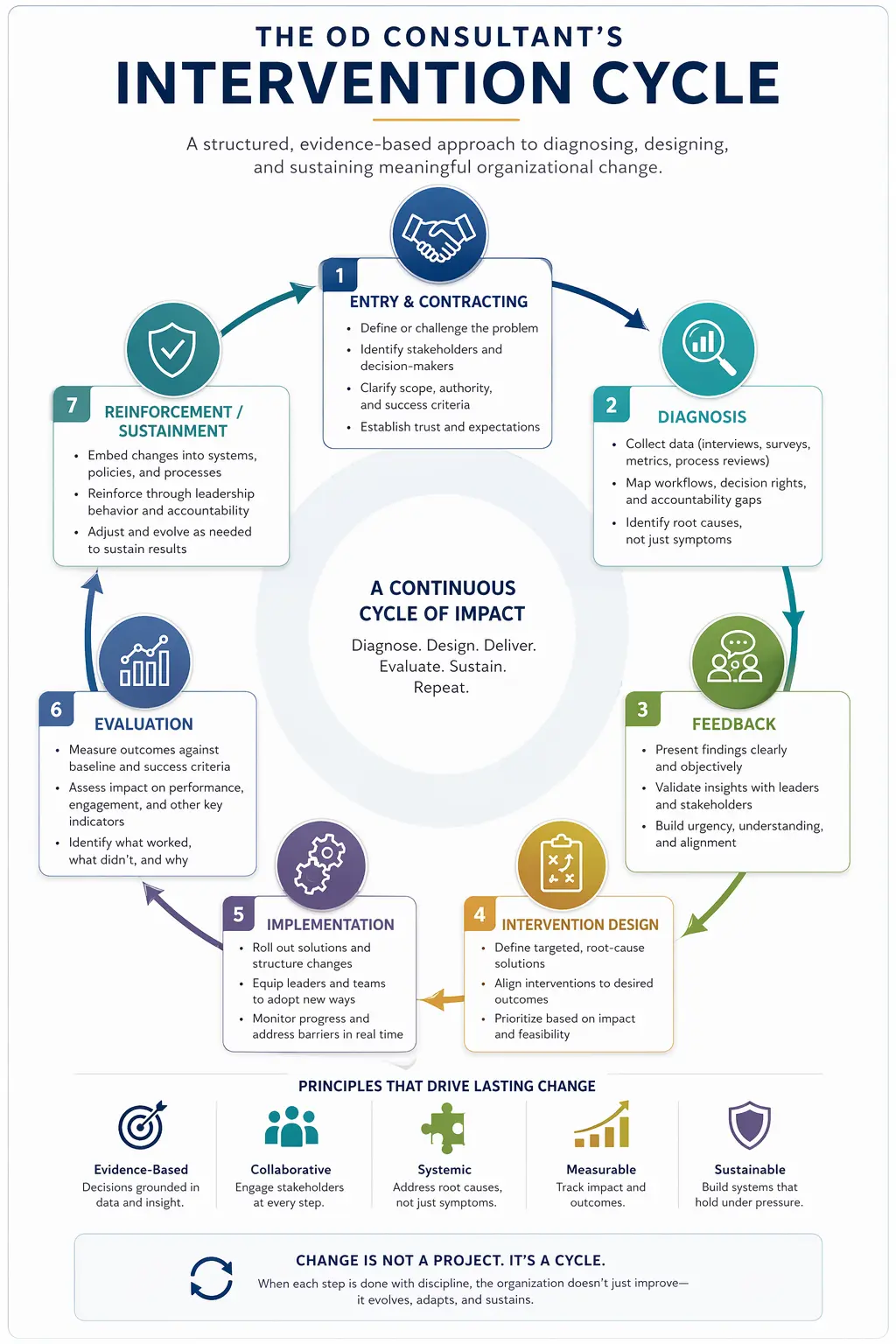
OD Consultant Intervention Cycle: Diagnose → Design → Implement → Measure and Adjust
How OD Consulting Differs from Other Consulting Roles
Organizational development consulting overlaps with several consulting disciplines, but the emphasis is different. Understanding the distinction helps leaders hire the right kind of help.
| Consulting Role | Primary Focus | Best Use Case |
|---|---|---|
| Business Process Improvement Consultant | Workflow efficiency, waste reduction, process redesign | Work is slow, duplicated, unclear, or trapped in handoffs |
| Change Management Consultant | Communication, adoption, resistance, transition support | A major change needs employee buy-in and implementation support |
| Organization Design Consultant | Structure, reporting lines, role design, decision rights | Growth or restructuring requires a clearer operating model |
| Organizational Development Consultant | System-wide alignment of people, process, structure, leadership, and change | Recurring performance problems require diagnosis and integrated redesign |
Hiring an OD consultant to “fix culture” without addressing structure is a costly mistake. Culture is shaped by expectations, incentives, workflow design, leadership behavior, and accountability systems.
Common Deliverables from Organizational Development Consulting
The value of an OD consultant should not stop at advice. Strong organizational development consulting produces practical tools leaders can use to improve structure, workflow, and accountability.
- Organizational diagnostic summary
- Workflow and process maps
- Role clarity and responsibility matrix
- Decision-rights map
- Change management plan
- Leadership accountability recommendations
- Business process improvement priorities
- Organization design recommendations
- Implementation roadmap
- Measurement and follow-up plan
- Manager communication and rollout guidance
A Practical Framework for Organizational Development Consulting
1. Conduct an Organizational Diagnostic
The consultant examines how work actually gets done. This includes workflows, approvals, decision points, reporting relationships, role expectations, manager practices, documentation, and performance data.
2. Identify the Root System Issues
OD consulting separates symptoms from causes. A turnover problem may actually be a supervisor accountability problem. A communication problem may actually be a decision-rights problem. A morale problem may actually be workflow overload.
3. Prioritize the Highest-Risk Friction Points
Not every problem deserves equal attention. The consultant helps leaders identify which issues create the most risk, cost, delay, turnover, or execution failure.
4. Redesign Roles, Workflows, and Decision Rights
Based on the diagnostic findings, the consultant clarifies responsibilities, reduces unnecessary handoffs, improves workflow design, and establishes decision ownership.
5. Support Change Implementation
Good designs fail without implementation support. This is where OD consulting connects with change management, manager communication, training, and follow-up.
6. Measure Whether the System Holds
Improvement should be tracked through operational indicators, employee feedback, cycle times, turnover patterns, decision speed, manager consistency, and follow-through.
Practical Example: When Growth Outpaces Structure
A growing organization may begin with informal communication, flexible roles, and quick verbal decisions. That works until the organization adds departments, managers, locations, or service lines. At that point, the same flexibility that once helped the organization move quickly can start creating confusion, duplicated work, missed handoffs, and inconsistent accountability.
An organizational development consultant would diagnose the workflow breakdowns, clarify role ownership, map decision rights, reduce unnecessary handoffs, and help leaders implement a structure that supports continued growth.
Common Mistakes When Hiring an OD Consultant
- Expecting a quick fix. Structural problems usually require diagnosis, redesign, implementation, and follow-up.
- Confusing training with development. More training will not fix unclear authority, broken workflows, or poor accountability systems.
- Skipping the diagnostic phase. Recommendations made without diagnosis are educated guesses.
- Accepting a report without implementation support. A report may explain the problem without changing the system.
- Failing to define success metrics. Without measurable outcomes, leaders cannot determine whether the engagement worked.
- Treating culture as separate from structure. Culture follows what the system rewards, tolerates, requires, and repeats.
Implementation Checklist for Hiring and Working with an OD Consultant
- Define the specific organizational problems you need solved
- Identify whether the issue is structural, process-related, leadership-related, or change-related
- Ask for a diagnostic phase before accepting recommendations
- Clarify expected deliverables before the engagement begins
- Require implementation support, not only a final report
- Define KPIs related to workflow, turnover, decision speed, or accountability
- Build leadership coaching and manager support into the project
- Schedule follow-up reviews to test whether the new structure holds
For related support, review organizational development consulting, HR process improvement, leadership development consulting, workforce development consulting, and HR audit consulting.
How Faulkner HR Solutions Approaches Organizational Development Consulting
Faulkner HR Solutions approaches organizational development consulting as practical system repair. The work begins by identifying where structure, roles, workflows, leadership expectations, and accountability are misaligned. The goal is not a prettier strategy document. The goal is a better operating model.
Depending on the engagement, the work may include business process improvement, organization design, change management support, leadership development, workforce planning, role clarity mapping, or manager accountability systems.
This approach is especially useful for Texas municipalities, nonprofits, and growing businesses where informal systems often hold longer than they should, then break under growth, turnover, compliance pressure, or leadership transition.
Start with organizational development consulting or explore related resources on organizational development training programs, change management in HR, and HR process improvement.
Frequently Asked Questions About Organizational Development Consultants
An organizational development consultant analyzes and improves structure, workflows, roles, decision-making, leadership systems, and accountability practices to help an organization execute more consistently.
You should hire an organizational development consultant when roles are unclear, workflows break down, change initiatives fail, growth outpaces structure, or execution problems keep repeating despite more training or communication.
The OD consultant role includes diagnosing organizational problems, designing structural improvements, supporting implementation, improving workflows and decision rights, and measuring whether the changes improve performance.
HR consulting often focuses on compliance, policies, employee relations, and HR administration. Organizational development consulting focuses on the broader operating system: structure, roles, workflows, authority, leadership alignment, and execution.
A change management consultant focuses on communication, adoption, and transition support. An OD consultant focuses on the underlying system design that determines whether change can actually work.
If unclear roles, broken workflows, failed change efforts, or inconsistent leadership practices are slowing execution, the organization probably does not need another motivational workshop. It needs a clearer operating system.
Related HR Questions, Answered
Direct answers from our HR FAQ library for Texas employers: