A learning and development strategy should do more than send employees to seminars, assign online courses, or create the appearance of professional growth. The real purpose of an L&D strategy is to connect employee skill development, manager reinforcement, and workforce capability to measurable business outcomes. When training is not tied to real work, clear expectations, and performance data, organizations usually get activity instead of capability.
A learning and development strategy is a structured plan for identifying workforce skill gaps, building employee development programs, reinforcing new behaviors through managers, and measuring whether training improves business outcomes.
What Is a Learning and Development Strategy?
A learning and development strategy is an organization-wide plan for building the skills, behaviors, and competencies employees need to perform current work and prepare for future business needs. A strong L&D strategy connects training and development programs to role expectations, performance metrics, workforce development strategy, and manager accountability.
The difference between a real strategy and a training calendar is intent. A training calendar lists topics. A learning and development strategy explains why those topics matter, who needs them, what business problem they address, how managers will reinforce the learning, and which outcomes will be measured after the training ends.
Why Most L&D Strategies Fail
Most organizations do not fail at learning and development because employees refuse to learn. They fail because the system around training is poorly designed. Training is often selected because a topic sounds important, a compliance deadline is approaching, or leadership wants to “do something” about performance problems without defining the actual skill gap.
Completion rates and satisfaction scores are not evidence of development. They only prove that training occurred and people had an opinion about it.
- Training is disconnected from business outcomes. Employees attend sessions but no one defines what performance should improve afterward.
- Managers are not part of the reinforcement cycle. New skills decay when supervisors do not coach, observe, and reinforce the expected behavior.
- Training is generic. Off-the-shelf content often misses the actual workflow, customer, compliance, leadership, or operational context employees face.
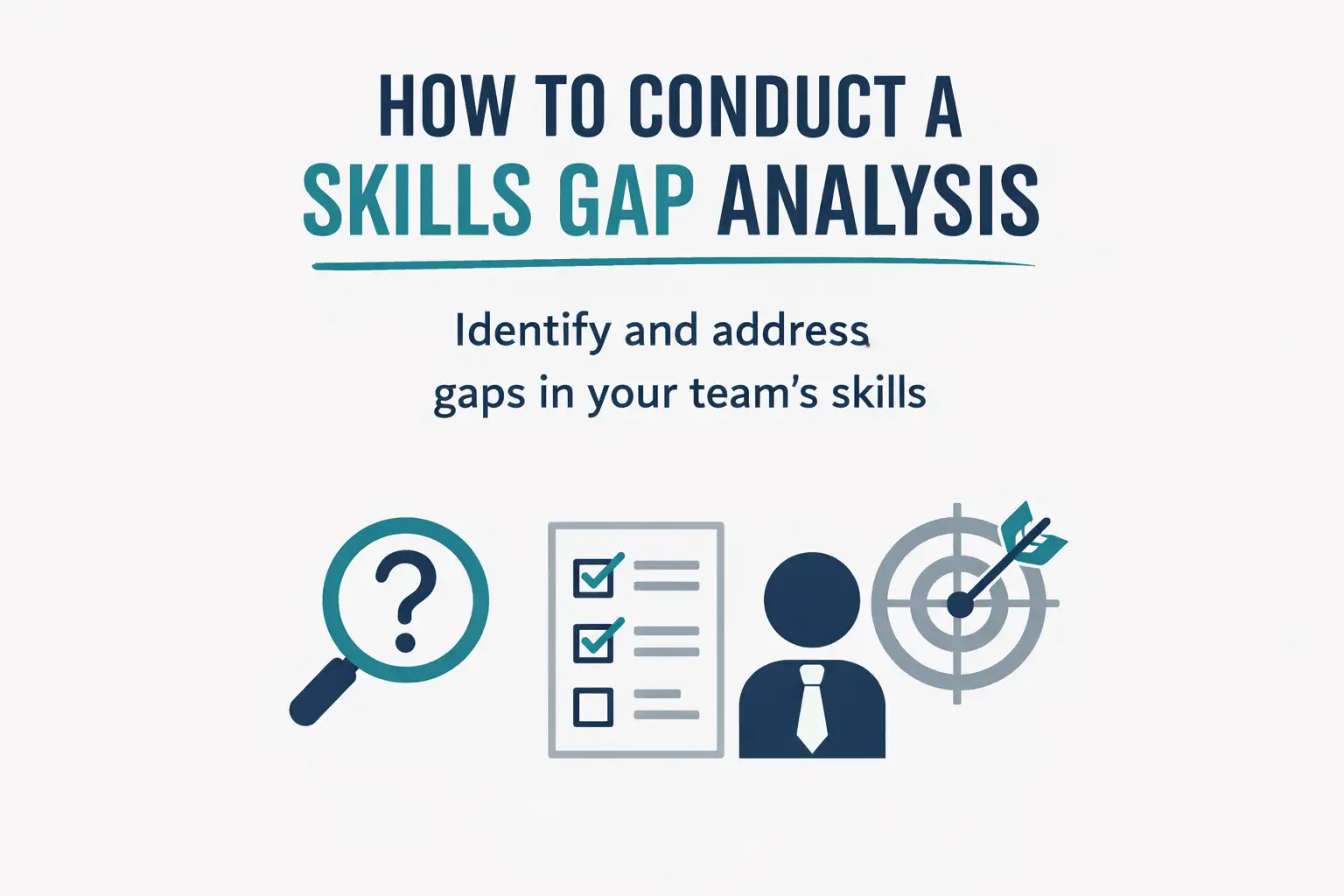
- Skill gaps are assumed instead of diagnosed. Leaders guess at the problem instead of validating the gap with performance data, manager input, and work samples.
- There is no quarterly review process. A strategy that does not change with business needs becomes a static catalog.
L&D Strategy vs. Corporate Training Strategy
A corporate training strategy usually focuses on what training the organization will deliver. A learning and development strategy focuses on what workforce capability the organization must build. The distinction matters because training delivery is only one part of employee development.
| Corporate Training Strategy | Learning and Development Strategy |
|---|---|
| Focuses on courses, workshops, and required training | Focuses on workforce capability, behavior change, and business results |
| Often measured by attendance or completion | Measured by performance, quality, retention, productivity, or compliance outcomes |
| Usually owned by HR or training staff | Shared by HR, leaders, managers, and employees |
| May be generic or vendor-driven | Built from role expectations, skill gaps, business priorities, and workforce needs |
Learning and Development Strategy Template
A useful L&D strategy template should force the organization to connect training decisions to operational need. If a training request cannot be tied to a skill gap, role expectation, or measurable outcome, the request may be noise rather than strategy.
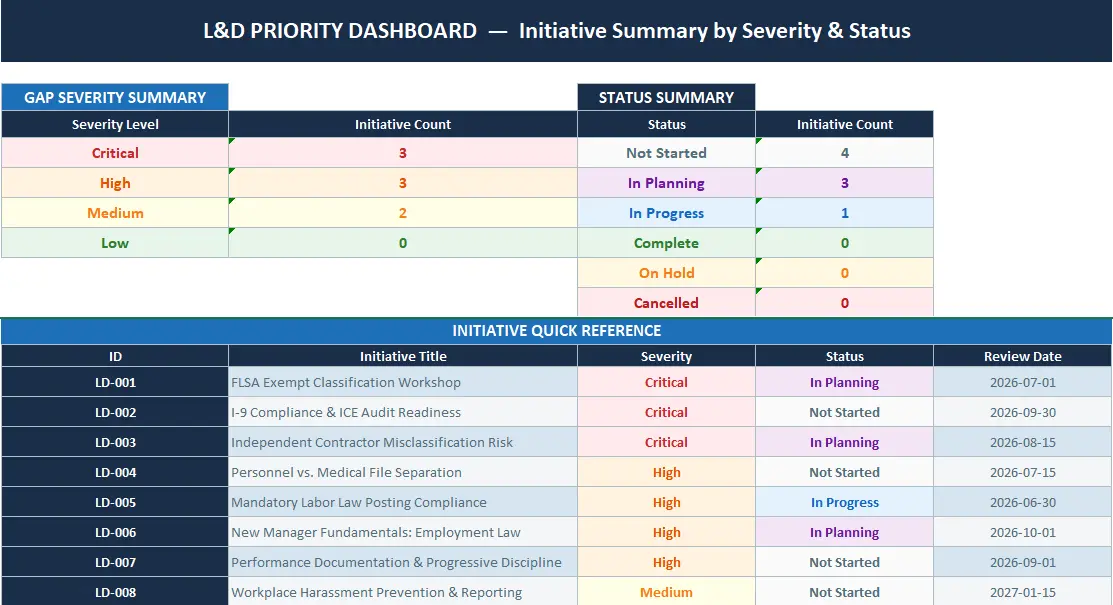
- Business priority: What organizational goal does the development effort support?
- Workforce capability needed: What must employees be able to do better?
- Current skill gap: What evidence shows the gap exists?
- Target employee group: Which roles, teams, managers, or departments need development?
- Training method: What format best supports the skill: workshop, coaching, simulation, job aid, mentoring, or blended learning?
- Manager reinforcement plan: How will supervisors coach, observe, and reinforce the expected behavior?
- Success metric: Which business or performance measure should move?
- Review date: When will results be reviewed and the strategy adjusted?
The Faulkner L&D Execution Model
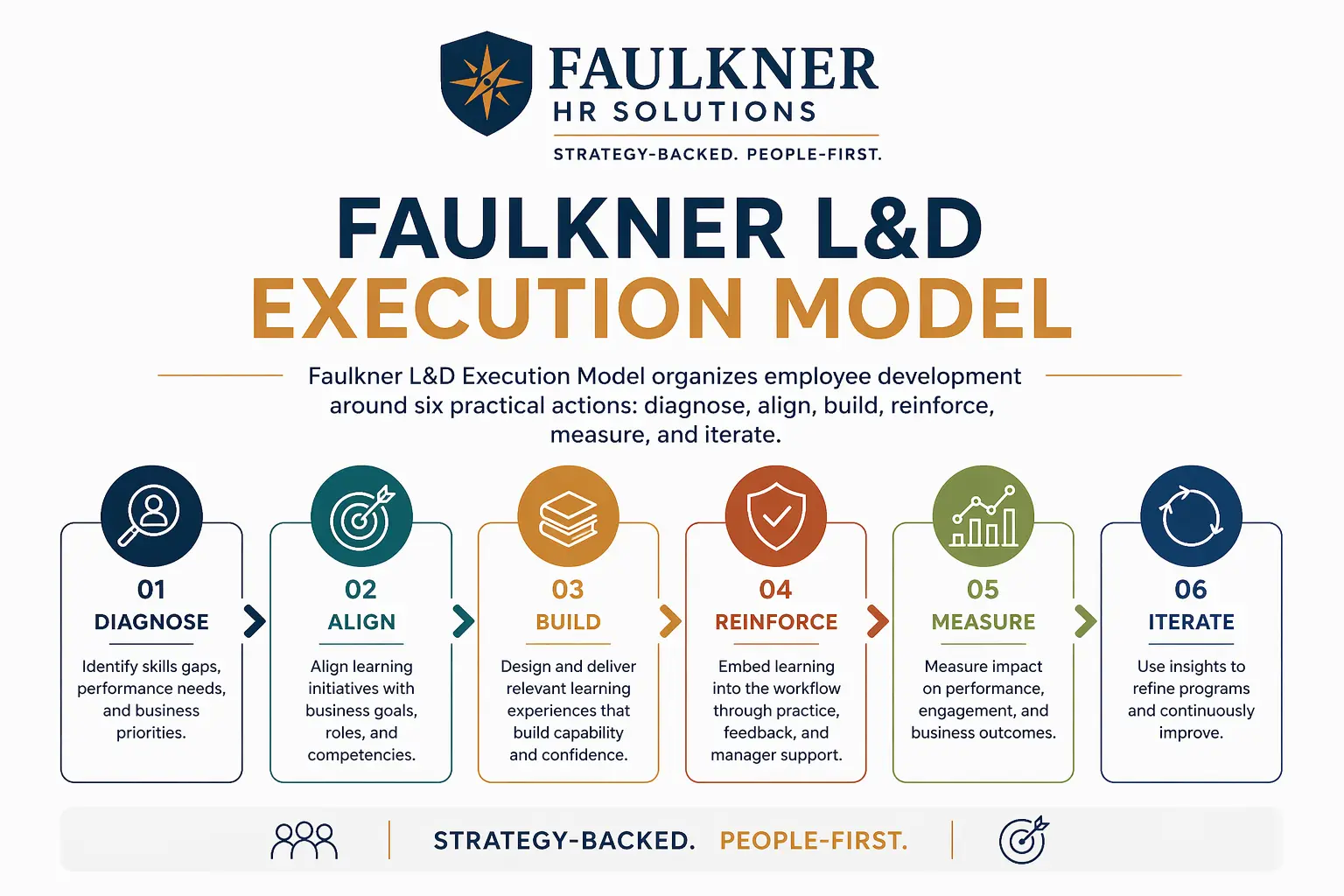
A competitive learning and development strategy needs an execution model. Without one, training decisions become a collection of disconnected requests. The Faulkner L&D Execution Model organizes employee development around six practical actions: diagnose, align, build, reinforce, measure, and iterate.
Diagnose the Skills Gap
Start with evidence. Use performance data, manager observations, employee input, customer feedback, error trends, rework rates, and role expectations to identify the actual skill gap. Guessing at the gap wastes training dollars and frustrates employees.
Align Development to Business Outcomes
Every development effort should support a business goal. If leadership wants better customer service, faster project completion, safer work practices, stronger supervision, or lower turnover, the L&D strategy must define the behavior that supports that result.
Build Targeted Training and Development Programs
Training should be modular, role-specific, and tied to work employees actually perform. Scenario-based practice, simulations, guided discussion, job aids, coaching guides, and applied assignments often produce stronger transfer than broad lecture-based sessions.
Reinforce Learning Through Managers
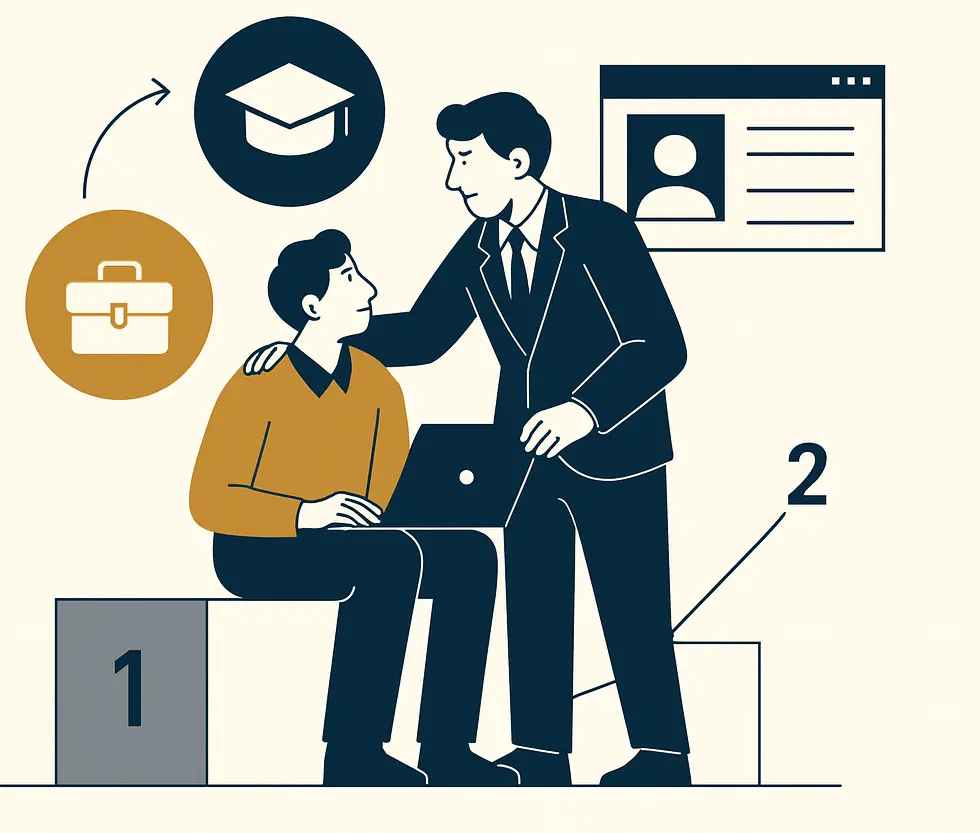
Managers are the primary transfer mechanism. A training program that does not equip managers to coach, observe, and reinforce new skills will underperform. Employees need structured follow-up after training, not vague encouragement.
Measure Outcomes, Not Activity
Training activity is easy to measure. Development impact is harder, which is why many organizations avoid it. A real L&D strategy measures whether behavior, quality, productivity, compliance, retention, safety, or customer experience improved after the intervention.
Iterate Quarterly
Workforce needs change. A learning and development strategy should be reviewed quarterly to determine which programs worked, which gaps remain, and which business priorities require new capability. Static training calendars become outdated quickly.
How an Employee Development Plan Fits Into L&D Strategy
A learning and development strategy operates at the organizational level. An employee development plan applies that strategy to the individual employee. The plan should clarify what the employee needs to learn, why the skill matters, how progress will be supported, and how improvement will be evaluated.
- Role expectation: What should the employee be able to do?
- Current performance: What is happening now?
- Skill gap: What specific knowledge, skill, behavior, or judgment gap exists?
- Development activity: What training, coaching, mentoring, or practice will close the gap?
- Manager support: What follow-up will the supervisor provide?
- Success measure: What observable behavior or performance result will confirm progress?
- Review cycle: When will the employee and manager evaluate progress?
The strongest employee development plans are specific enough to guide action. “Improve leadership skills” is not a plan. “Conduct weekly delegation check-ins using the department priority tracker for the next 60 days” is closer to a usable development action.
Examples of Training and Development Programs That Support L&D Strategy
Training and development programs should be selected because they support workforce capability, not because they are easy to schedule. The right program depends on the organization’s skill gaps, risk exposure, operational priorities, and manager capacity.
- New manager training: Builds supervision, delegation, documentation, coaching, accountability, and communication skills.
- Onboarding development: Helps new employees understand role expectations, workflows, performance standards, and cultural norms.
- Leadership development: Prepares current and future leaders to manage people, decisions, change, and organizational performance.
- Compliance training: Reduces employment risk by aligning behavior with policy, law, documentation standards, and reporting obligations.
- Customer service training: Improves communication, de-escalation, service recovery, and public-facing professionalism.
- Technical skill training: Builds job-specific capability required for quality, productivity, safety, or operational execution.
- Cross-training: Reduces single-point dependency and supports workforce continuity when employees are absent or roles change.
- Succession development: Prepares employees for future leadership or critical operational roles.
For organizations that need support designing custom programs around real performance expectations, Faulkner HR Solutions provides training and development consulting focused on practical skill transfer, not generic course completion.
How L&D Supports Workforce Development Strategy
A workforce development strategy focuses on whether the organization has the people, skills, capacity, and leadership pipeline needed to operate effectively. Learning and development supports that strategy by closing current skill gaps and preparing employees for future demands.
In Texas municipalities, nonprofits, and growing businesses, workforce development often requires more than training. It may require role clarity, better onboarding, supervisor accountability, cross-training, performance management, retention planning, and succession development. L&D becomes most effective when connected to those broader systems.
For a broader system-level approach, see workforce development consulting, organizational development consulting, and leadership development consulting.
Real-World Application: Turning Training Into Workforce Capability
A Texas nonprofit was struggling with turnover, inconsistent project execution, and uneven communication across teams. Leadership had invested in training workshops, but the sessions were not tied to role expectations, manager follow-up, or measurable workforce outcomes.
The organization shifted from broad training topics to a focused development plan. The process began with a skills gap analysis, followed by targeted modules on project ownership, communication expectations, workflow handoffs, and manager-led reinforcement. Instead of measuring attendance, leadership began tracking project completion, onboarding consistency, manager follow-up, and retention indicators.
The lesson is direct: training did not become more valuable because the organization added more courses. Training became more valuable because the organization connected development to work, supervision, and performance outcomes.
Common Mistakes in L&D Strategy Development
- Using off-the-shelf programs without customization. Generic content rarely addresses the organization’s actual operating environment.
- Confusing information with development. Employees can understand a concept and still fail to apply the skill under pressure.
- Leaving managers out of the process. Managers must reinforce the behavior or the learning will fade.
- Measuring activity instead of outcomes. Completion rates, attendance, and satisfaction surveys are not enough.
- Ignoring workload and role design. Employees cannot apply new skills inside a broken workflow.
- Failing to prioritize. Trying to train everyone on everything produces shallow development and weak adoption.
- No quarterly review cycle. Workforce needs evolve too quickly for annual review to be enough.
When to Bring in External Support
External support makes sense when internal teams do not have the time, tools, or objectivity to diagnose skill gaps, build training and development programs, create employee development plans, or hold managers accountable for reinforcement. A good partner should help the organization define the problem before recommending training.
The key evaluation criterion is whether the partner measures outcomes or just deliverables. A partner who reports on training hours delivered is not the same as one who reports on performance change. Faulkner HR Solutions helps Texas organizations build L&D systems around workforce gaps, manager accountability, and measurable business outcomes.
If a provider recommends training before asking about performance data, role expectations, manager reinforcement, and business outcomes, they are probably selling content instead of solving the development problem.
Learning and Development Strategy Implementation Checklist
- Define the business problem the L&D strategy must support
- Complete a detailed skills gap analysis using multiple data sources
- Identify the workforce capabilities needed for current and future work
- Prioritize skill gaps by risk, urgency, performance impact, and strategic value
- Translate each gap into a measurable learning objective
- Build role-specific training and development programs
- Create employee development plans for targeted roles or individuals
- Assign manager coaching responsibilities before training begins
- Measure baseline performance before the intervention
- Conduct 30-, 60-, and 90-day reinforcement check-ins
- Measure post-training performance against the original business metric
- Review the strategy quarterly and adjust based on evidence
Frequently Asked Questions
A learning and development strategy is a structured plan for identifying workforce skill gaps, building employee development programs, reinforcing new behaviors through managers, and measuring whether training improves business outcomes.
A training strategy usually focuses on delivering courses or sessions. An L&D strategy connects training to business goals, employee development plans, manager reinforcement, workforce capability, and measurable performance outcomes.
Training and development programs should be measured by comparing pre-training and post-training outcomes tied to productivity, quality, retention, customer service, compliance, or other business metrics.
An employee development plan turns the broader L&D strategy into an individual roadmap by defining role expectations, current skill gaps, development activities, manager coaching, and measurable progress checkpoints.
An L&D strategy should be reviewed at least quarterly because business priorities, skill gaps, workforce needs, and performance data change throughout the year.
About the Author
Dr. Thomas W. Faulkner is an SPHR-certified HR consultant, Lean Six Sigma Black Belt, U.S. Army veteran, and founder of Faulkner HR Solutions. His work focuses on workforce development, manager accountability, organizational design, employee training systems, and practical HR strategy for Texas employers.
For examples of applied workforce, training, and organizational system design, review the Faulkner HR Solutions case studies.
Related HR Questions, Answered
Direct answers from our HR FAQ library for Texas employers: