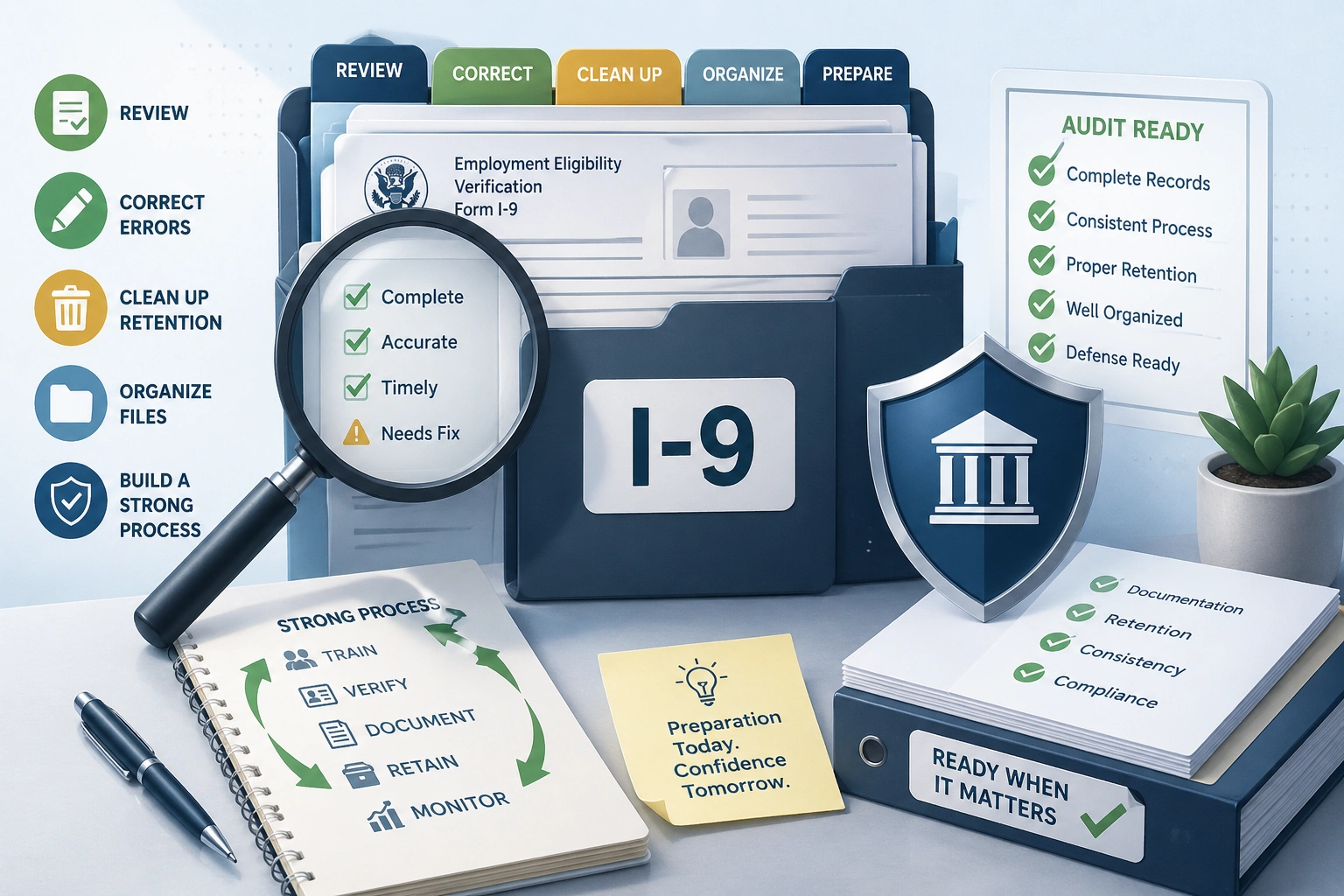
Most organizations do not fail an I-9 audit because they ignored the requirement. They fail because the system cannot execute the requirement consistently. That distinction matters. An I-9 audit is not a paperwork review. It is a documentation integrity test under legal scrutiny.
When the system is inconsistent, errors accumulate quietly: missing signatures, incorrect dates, incomplete sections, outdated forms, poor storage, and unclear correction practices. Those errors do not stay administrative. They convert into financial exposure.
I-9 audit preparation is the process of identifying and correcting those failures before enforcement makes the decision for you.
I-9 audit preparation is the process of reviewing, correcting, and organizing Form I-9 records to ensure compliance with U.S. employment eligibility verification requirements before an audit occurs. It includes internal I-9 audits, document correction protocols, retention review, process standardization, storage controls, and manager training to reduce legal risk and financial penalties.
Why I-9 Audit Preparation Matters More Than Most HR Tasks
I-9 compliance is one of the few HR functions where a small administrative mistake can become a direct financial problem. The requirement is not complicated in theory. The difficulty comes from consistent execution across real hiring conditions.
Errors Are Strict
Good intentions do not erase missing signatures, late completion, or improper verification.
Fines Are Per Form
Exposure increases with every incomplete, missing, late, or improperly corrected I-9.
Intent Does Not Save the Process
A disorganized employer can be penalized even when the organization meant to comply.
A missing signature can create exposure. A late completion can create exposure. An outdated form version can create exposure. Improper document verification can create exposure. Multiply those issues across a workforce and the problem stops being paperwork. It becomes risk containment.
Who Needs I-9 Audit Preparation?
Any organization with employees needs I-9 audit preparation. The risk increases when hiring is frequent, decentralized, or handled by multiple managers without a standardized onboarding process.
I-9 audit preparation is especially important for:
- Organizations with 50 or more employees
- Multi-location employers
- High-turnover workplaces
- Rapidly growing companies
- Municipalities and public sector entities with layered approval processes
- Nonprofits with limited HR bandwidth
- Small businesses that have outgrown informal onboarding practices
- Employers where supervisors or department heads help complete new hire paperwork
If hiring is inconsistent, I-9 compliance is inconsistent. The I-9 form usually exposes the broader onboarding problem. It rarely creates the problem by itself.
The Real Problem: I-9 Failures Are Process Failures
Most organizations approach I-9 compliance as a form problem.
It is not.
It is a workflow problem.
Common root causes include no standardized onboarding process, managers completing forms differently, HR reviewing inconsistently, no internal audit cycle, no correction protocol, and no clear ownership of compliance. When those conditions exist, errors are not surprising. They are predictable.
This is why I-9 audit preparation should connect directly to broader HR compliance consulting, HR audit consulting, and HR process improvement. The form is only the visible evidence. The system underneath the form determines whether the organization can comply consistently.
Common I-9 Audit Findings
Effective I-9 audit preparation starts with knowing what usually gets cited. These findings tend to fall into four categories: Section 1 errors, Section 2 errors, Section 3 errors, and system-level failures.
Section 1 Errors: Employee Information and Attestation
- Missing employee signature
- Missing date of completion
- Incomplete citizenship or immigration attestation
- Missing preparer or translator information when required
- Employee completing Section 1 late
Section 2 Errors: Employer Review and Verification
- Late completion beyond the required timeframe
- Missing document title, issuing authority, document number, or expiration date
- Improper document acceptance
- Missing employer certification signature
- Incorrect first day of employment entry
Section 3 Errors: Reverification and Rehire
- Failure to reverify expiring work authorization
- Incorrect use of Section 3 for rehires
- Missing documentation for reverification
- Failure to track reverification deadlines
System-Level Failures
- Using outdated I-9 forms
- Missing I-9 forms entirely
- Inconsistent storage methods
- No internal audit log
- No documented correction process
- Improper retention and destruction practices
How to Conduct an Internal I-9 Audit
I-9 audit preparation starts with a controlled internal audit. The goal is not to panic-review files after a notice arrives. The goal is to identify risk before an outside agency does.
Define the Audit Scope
Decide what the audit will cover. Options include all employees, active employees only, terminated employees still within the retention window, or a focused sample. Full-scope review is usually the strongest starting point when the organization has not audited I-9 records recently.
Gather All I-9 Forms
Pull records from HR files, digital systems, onboarding platforms, departmental folders, and any other storage location. If I-9 records are stored in multiple places without a central index, that is already a compliance risk.
Verify Form Version Compliance
Review whether the correct Form I-9 version was used based on the date of completion. Outdated forms, incomplete forms, and improperly modified forms should be flagged for correction review.
Review Each Section Systematically
Use the same checklist for every file. Review Section 1, Section 2, and Section 3 separately. Do not rely on a quick visual scan. A visual scan finds obvious problems. A checklist finds patterns.
Identify and Categorize Errors
Separate findings into technical errors, substantive errors, missing forms, retention issues, and process failures. The distinction matters because not every issue is corrected the same way.
Apply Proper Correction Protocols
Never backdate. Never conceal the original entry. Never rewrite history. Corrections should be clear, dated, and traceable. The correction process should show good-faith effort rather than panic cleanup.
Document the Audit
Maintain the audit date, scope, findings, correction actions, reviewer name, and follow-up requirements. Audit documentation shows that the organization is not relying on memory or informal file cleanup.
How to Correct I-9 Errors Without Making the Problem Worse
Improper correction can create additional exposure. The goal is to correct the record while preserving a transparent audit trail.
Use these baseline correction principles:
- Do not backdate corrections.
- Do not use correction fluid or conceal the original entry.
- Use a single-line strike-through when correcting incorrect information.
- Enter the correct information clearly.
- Initial and date the correction.
- Attach a short audit note when the correction needs context.
- Use a consistent correction process across all forms.
The correction should not make the file look perfect. It should make the file accurate, transparent, and defensible.
I-9 Retention Requirements
I-9 retention is simple in theory and frequently mishandled in practice. Employers must retain Form I-9 for the later of three years after the date of hire or one year after the date employment ends.
The common failure points are predictable. Some organizations destroy forms too early. Others keep forms too long and create unnecessary audit exposure. Some keep active and terminated employee I-9s mixed together with no retention tracking. That is not retention management. That is hoping the files behave themselves.
I-9 audit preparation should include a retention review that identifies:
- Active employee I-9s
- Terminated employee I-9s still inside the retention window
- Terminated employee I-9s eligible for destruction
- Missing termination dates needed to calculate retention
- Files stored in the wrong location
Where Should I-9 Forms Be Stored?
I-9 forms should generally be stored separately from personnel files. Separate storage helps the organization respond to an I-9 audit without exposing unrelated personnel records, disciplinary documentation, medical information, performance records, or other employment documents outside the audit scope.
A strong I-9 storage process should be centralized, secure, accessible to authorized personnel, separate from general personnel files, and organized by active and terminated status. If the organization cannot produce I-9s quickly, the storage system is not audit-ready.
For broader documentation strategy, review Employee Documentation Best Practices for Legal Defense.
I-9 Audit Preparation Checklist
Documentation Review
- Confirm every active employee has a Form I-9 on file.
- Confirm terminated employees still within the retention window have retained I-9s.
- Confirm the correct form version was used.
- Review Section 1 for employee completion, signature, date, and attestation.
- Review Section 2 for employer completion, document information, certification, and timing.
- Review Section 3 for reverification and rehire accuracy.
Process Review
- Confirm a standard onboarding workflow exists.
- Assign clear ownership for I-9 completion and review.
- Define when HR reviews the form for accuracy.
- Create escalation steps for late or incomplete forms.
Audit Controls
- Conduct an internal I-9 audit at least annually.
- Use a consistent checklist for each review.
- Categorize errors by type and severity.
- Document corrections and retain audit notes.
Storage and Retention
- Store I-9s separately from personnel files.
- Separate active and terminated employee files.
- Track destruction dates for terminated employee forms.
- Limit access to authorized personnel.
Training
- Train managers who participate in onboarding.
- Train HR staff on correction protocols.
- Train hiring teams on timing requirements.
- Eliminate “figure it out” onboarding.
Case Pattern: What Happens Without I-9 Audit Preparation
A Texas-based organization conducted a late-stage internal audit after receiving notice of inspection. The audit found that 27% of forms had errors, multiple I-9s were missing, document verification practices were inconsistent, and no clear audit trail existed.
The issue was not lack of awareness. The issue was process fragmentation.
After implementing a standardized onboarding workflow, centralized storage, and quarterly audit cycle, error rates dropped below 5%, completion timelines stabilized, and audit readiness became routine rather than reactive.
That is the point. I-9 audit preparation is not just cleanup. It is system stabilization.
Common Mistakes in I-9 Audit Preparation
1. Treating I-9 Compliance as a One-Time Cleanup
Compliance is not a project. It is a system. A one-time audit may reduce immediate exposure, but the same errors will return if the onboarding process remains unchanged.
2. Letting Managers Handle I-9s Independently
Decentralized execution guarantees inconsistency unless every manager is trained, monitored, and held to the same standard. Most organizations do not have that control in place.
3. Overcorrecting Improperly
Backdating, rewriting, concealing errors, or recreating forms without explanation can create additional problems. Corrections should be transparent.
4. Ignoring Retention Rules
Keeping forms too long creates unnecessary exposure. Destroying forms too early creates noncompliance. Retention must be tracked intentionally.
5. Assuming Software Solves the Problem
Software can improve control, but it cannot fix unclear ownership, bad review habits, or managers who do not understand the process. Bad processes automated become faster bad processes.
How I-9 Audit Preparation Fits Into Broader HR Compliance
I-9 compliance does not exist in isolation. It connects directly to hiring process design, onboarding workflows, documentation standards, compliance infrastructure, and supervisor consistency.
Organizations that struggle with I-9s often struggle with other compliance areas as well: incomplete personnel files, inconsistent discipline, outdated policies, poor leave tracking, weak documentation, and unclear manager responsibilities.
That makes I-9 audit preparation a useful diagnostic tool. If I-9 files are disorganized, the problem may extend beyond employment eligibility verification. Related support may include HR compliance consulting, HR audits and diagnostics, hiring and onboarding process consulting, and employee handbook consulting.
When to Bring in Outside I-9 Audit Support
Internal audits are effective when the process is mostly stable, errors are minor, and ownership is clear. Outside support becomes more useful when the organization does not know where the records are, error rates are high, an audit notice has already arrived, leaders disagree over responsibility, or I-9 issues are part of a broader compliance breakdown.
At that point, the issue is not the form.
It is the system.
Faulkner HR Solutions helps Texas employers review I-9 records, identify process failures, standardize onboarding workflows, and build compliance controls that reduce repeat exposure. Schedule a no-obligation strategy call or call 210.446.8730 to assess where your I-9 process stands.
Final Position
I-9 audit preparation is not about avoiding penalties.
It is about building a system that does not create them in the first place.
If the organization depends on memory, individual judgment, or inconsistent execution, the audit outcome is already predictable. The fix is not more reminders. The fix is structure.
Frequently Asked Questions
I-9 audit preparation is the process of reviewing, correcting, organizing, and retaining Form I-9 records before an audit occurs. It includes internal audits, correction protocols, retention review, storage review, and manager training.
I-9 audits may be triggered by random selection, complaints, industry targeting, workforce investigations, or related enforcement activity by ICE or the Department of Homeland Security.
Employers generally have three business days to produce I-9 forms after receiving a Notice of Inspection.
Yes. Employers may correct certain I-9 mistakes using proper correction protocols. Corrections should not be backdated, concealed, or rewritten as if completed correctly the first time.
Penalties vary based on the type, severity, and frequency of violations. Errors may be assessed per form, which is why small mistakes can become expensive when repeated across a workforce.
No. I-9 forms should generally be stored separately from personnel files so the organization can respond to an audit without exposing unrelated employment records.
Employers should conduct an internal I-9 audit at least annually. Higher-risk organizations with frequent hiring, high turnover, or decentralized onboarding should review I-9 records more frequently.