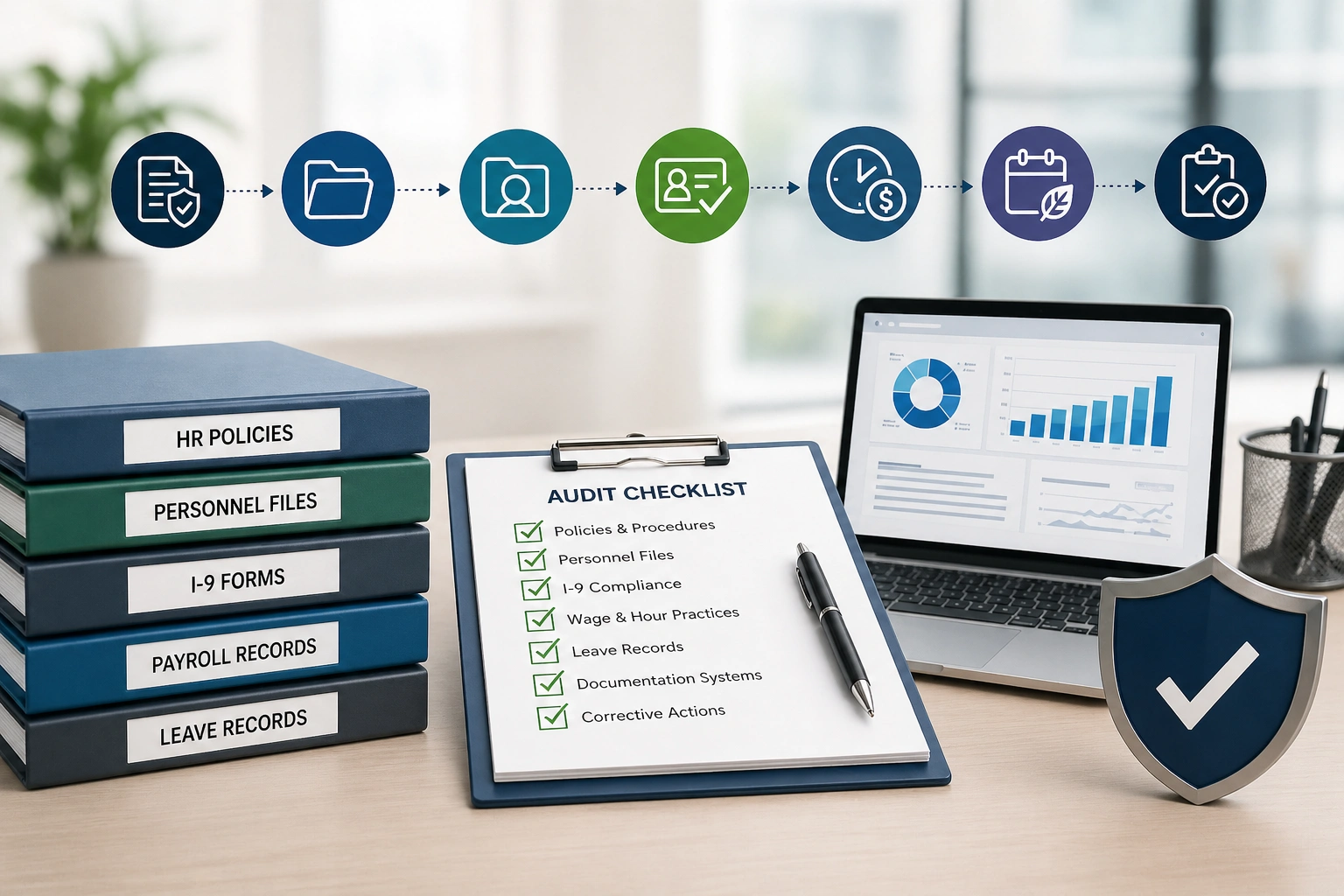
An HR compliance audit is not a paperwork ritual. It is a pressure test for the systems that protect employment decisions. When personnel files are incomplete, I-9 records are inconsistent, managers discipline employees differently, or leave requests are tracked from someone’s inbox, the organization is not operating with a compliance system. It is operating on hope. Hope is not a control mechanism.
HR compliance audit is the practice of reviewing policies, documentation, and HR processes to ensure alignment with federal, state, and local employment laws. The goal is to identify risk, enforce consistency, and build systems that hold under real operating conditions.
What Is an HR Compliance Audit?
An HR compliance audit is a structured review of employment policies, records, workflows, and management practices to determine whether an organization is following applicable federal, state, and local employment requirements. A useful audit does more than confirm whether a policy exists. It tests whether the policy is understood, documented, followed, and defensible.
The distinction matters. A handbook can say the right thing while managers do something entirely different. A personnel file can look clean while the real decision trail sits in email, text messages, or memory. A leave policy can comply on paper while the actual tracking system misses deadlines. Compliance failure usually shows up where written rules and operating reality separate.
For organizations that need outside support, Faulkner HR Solutions provides HR audit consulting that connects compliance review with practical workflow improvement, documentation cleanup, and manager accountability.
Why HR Compliance Audits Matter
HR compliance audits matter because employment risk rarely appears all at once. Risk accumulates through small inconsistencies: incomplete I-9s, outdated job descriptions, undocumented coaching conversations, missed leave deadlines, misclassified employees, stale handbook language, and supervisors who apply the same rule differently across departments.
The audit gives leadership a clear view of where the organization is exposed before an employee complaint, agency inquiry, unemployment claim, wage complaint, discrimination charge, or lawsuit forces the issue. That is the real value. The audit turns invisible risk into a prioritized action plan.
A compliance audit is not complete when the checklist is filled out. It is complete when every major finding has an owner, a corrective action, a deadline, and a verification method.
Who Needs an HR Compliance Audit?
Any employer can benefit from an HR compliance audit, but some organizations need one more urgently than others. Small businesses, nonprofits, municipalities, and growing employers often rely on informal HR practices longer than the risk profile allows. That approach works until the organization grows, a manager mishandles a termination, payroll practices get challenged, or a long-running documentation gap becomes evidence.
An audit should be prioritized when the organization is hiring quickly, expanding into new locations, approaching major employee-count thresholds, changing payroll systems, updating handbooks, preparing for leadership turnover, receiving employee complaints, or seeing repeated inconsistency in discipline and documentation.
Texas employers should also consider state-specific risks and industry realities. Faulkner HR Solutions supports HR compliance consulting in Texas for municipalities, nonprofits, and growing businesses that need practical compliance infrastructure instead of generic policy language.
What an HR Compliance Audit Should Cover
A complete HR compliance audit should review the full employment lifecycle. The goal is not to inspect isolated forms. The goal is to determine whether the organization can prove that employment decisions are lawful, consistent, and documented.
Employee Handbook and Policies
Review the employee handbook, standalone policies, acknowledgments, complaint procedures, anti-harassment language, leave policies, disciplinary standards, remote work language, technology use rules, and reporting channels. The audit should identify outdated language, missing policies, policies that are not being followed, and policies that describe a process the organization no longer uses.
Personnel Files and Documentation
Review personnel files for offer letters, job descriptions, policy acknowledgments, performance records, corrective actions, training records, pay changes, status changes, and separation documents. Personnel files should be complete, consistent, and organized in a way that allows HR to retrieve records quickly when needed.
I-9 Compliance
Review whether Form I-9 exists for each employee, whether forms were completed on time, whether sections are complete, whether re-verifications are handled correctly, and whether records are retained separately from general personnel files. Employers must complete and retain Form I-9 for every person hired for employment after November 6, 1986, and USCIS retention rules generally require keeping I-9s for three years after the date of hire or one year after employment ends, whichever is later.
Wage and Hour Compliance
Review employee classifications, overtime practices, timekeeping records, pay deductions, meal and rest practices where applicable, off-the-clock work risks, and compensation rules. Under the FLSA, most covered nonexempt employees must receive at least the federal minimum wage and overtime pay at one and one-half times the regular rate for hours worked over 40 in a workweek unless an exemption applies.
Leave and Accommodation Records
Review FMLA administration, ADA accommodation documentation, workers’ compensation coordination, pregnancy accommodation practices where applicable, medical certification tracking, return-to-work documentation, and confidentiality of medical records. Leave administration failures often happen because no single owner tracks deadlines, notices, documentation, and communication.
Workplace Postings and Notices
Review required workplace posters, employee notices, policy acknowledgments, electronic access for remote workers, and documentation of notice distribution. OSHA requires covered employers to display the Job Safety and Health poster where workers can easily see it.
Training and Manager Practice
Review whether managers understand documentation standards, escalation triggers, complaint handling, anti-harassment obligations, wage and hour boundaries, leave procedures, and discipline consistency. A policy no manager can apply is not a control. It is decoration.
How to Conduct an HR Compliance Audit: 7 Steps
The following seven-step process gives employers a practical method for conducting an internal HR compliance audit without turning the project into a never-ending administrative excavation.
Define the Audit Scope
Start by deciding what the audit will review. Do not audit every HR function at once unless the organization has the time, staff, and authority to act on the findings. A focused audit is more useful than a broad audit that produces a report no one implements.
Gather Real HR Records
Pull actual records, not blank templates. Review a sample of personnel files, I-9s, job descriptions, offer letters, payroll records, timekeeping reports, leave files, disciplinary records, investigation records, training logs, and policy acknowledgments.
Compare Documents Against Legal and Policy Requirements
Review whether each required document exists, whether the document is complete, whether the language is current, and whether the practice matches the written policy. This step should include federal requirements, Texas-specific considerations, local requirements where applicable, and internal policy commitments.
Test Actual HR Workflows
Follow real processes from beginning to end. Track a new hire from requisition to first day. Track a disciplinary issue from incident to final documentation. Track a leave request from notice to return-to-work. The workflow will show where compliance depends on memory, personality, or informal workarounds.
Rank Compliance Risks
Rank findings by legal exposure, frequency, documentation weakness, operational impact, and likelihood of repeat failure. High-risk findings should receive immediate corrective action. Moderate findings should be scheduled with clear ownership. Low-risk findings should be corrected without distracting from serious exposure.
Create Corrective Actions
Every finding needs a specific action, owner, deadline, and verification method. “Update the process” is not a corrective action. “Revise the disciplinary documentation template, train supervisors, and audit five new corrective actions within 60 days” is a corrective action.
Monitor Whether the Fix Holds
Audit findings have a habit of returning when no one monitors the correction. Track repeat findings, documentation completion rates, turnaround time, manager adherence, policy acknowledgment completion, and error rates after implementation.
HR Compliance Audit Checklist
Use this HR compliance audit checklist as a practical starting point. The goal is not to treat every item as equal. The goal is to identify where the organization has the greatest exposure and where leadership needs cleaner controls.
Handbook and Policy Review
- Employee handbook is current and aligned with actual practice
- Anti-harassment and discrimination policies are clearly stated
- Complaint reporting procedures are easy to understand
- Leave policies match current legal and operational requirements
- Disciplinary procedures reflect actual manager practice
- Policy acknowledgments are signed and retained
- Remote, hybrid, technology, and confidentiality policies are current where applicable
Personnel File Review
- Offer letters and employment agreements are retained
- Job descriptions are current and accurate
- Pay changes and status changes are documented
- Performance reviews and corrective actions are retained
- Training records are complete
- Medical records are stored separately from general personnel files
- Separation documentation is complete and consistent
I-9 Compliance Review
- Form I-9 exists for each active employee hired after November 6, 1986
- Section 1 and Section 2 completion timing is reviewed
- Forms are complete, legible, and signed
- Reverification requirements are tracked where applicable
- I-9s are retained according to USCIS retention rules
- I-9s are stored separately from general personnel files
- Correction practices are standardized and documented
Wage and Hour Review
- Exempt and nonexempt classifications are reviewed
- Overtime practices align with FLSA requirements
- Timekeeping records are accurate and complete
- Off-the-clock work risks are reviewed
- Payroll deductions are reviewed for compliance
- Compensatory time practices are reviewed where applicable
- Job duties align with classification decisions
Leave and Accommodation Review
- FMLA eligibility, notices, certifications, and tracking are reviewed where applicable
- ADA accommodation requests are documented and stored properly
- Workers’ compensation coordination is reviewed
- Pregnancy, disability, and medical leave practices are reviewed
- Return-to-work processes are documented
- Medical confidentiality practices are reviewed
- Managers know when to escalate leave or accommodation issues to HR
Workplace Postings and Notices
- Required federal and state workplace posters are current and visible
- Remote workers have appropriate electronic access where applicable
- Required notices are distributed and documented
- OSHA posting requirements are reviewed
- Policy updates are communicated and acknowledged
Common HR Compliance Audit Findings
The same findings appear in organizations of every size. The names change. The exposure does not.
- Incomplete personnel files. Key employment records are missing, scattered, outdated, or stored inconsistently.
- I-9 errors. Forms are incomplete, late, over-documented, under-documented, or retained incorrectly.
- Misclassification risk. Employees are classified as exempt without a current review of salary basis and job duties.
- Inconsistent discipline. Similar conduct produces different outcomes depending on the department or supervisor.
- Weak leave tracking. Leave decisions are handled through email threads, supervisor memory, or disconnected spreadsheets.
- Outdated handbook language. Policies describe a version of the organization that no longer exists.
- Missing policy acknowledgments. Employees cannot be shown to have received or acknowledged current rules.
- Workplace posting gaps. Required notices are missing, outdated, or inaccessible to remote employees.
- Training without proof of application. Employees complete training, but managers cannot demonstrate changed practice.
- No corrective action tracking. Findings are identified but never verified after implementation.
Internal HR Audit vs. External HR Compliance Audit
An internal HR compliance audit can work well when the organization has clear ownership, current HR expertise, access to records, and leadership authority to correct findings. Internal audits are faster and less expensive, but they can miss problems that have become normalized.
An external HR compliance audit makes sense when findings could create legal exposure, when leadership needs objective prioritization, when HR is understaffed, when managers resist standardization, or when the organization needs a corrective action plan that is not shaped by internal politics.
Conduct the audit internally when the issue is administrative cleanup. Bring in outside support when the issue involves legal exposure, repeated inconsistency, manager behavior, or leadership disagreement about risk.
How to Prioritize HR Compliance Audit Findings
Not every finding deserves the same response. Prioritization prevents the organization from spending three weeks cleaning file labels while wage and hour exposure sits untouched.
High-Risk Findings
High-risk findings involve likely legal exposure, missing required documentation, wage and hour issues, repeat discrimination or retaliation risk, improper leave handling, or inconsistent discipline that could affect termination decisions. Correct these first.
Moderate-Risk Findings
Moderate-risk findings involve weak controls, unclear ownership, incomplete processes, or inconsistent manager practice that could become legal exposure if ignored. Assign owners and deadlines.
Low-Risk Findings
Low-risk findings involve administrative cleanup, formatting, file organization, or policy language that should be improved but does not create immediate exposure. Fix them without letting them consume the audit.
HR Compliance Audit Corrective Action Plan
A corrective action plan turns audit findings into implementation. Without this step, the audit becomes a decorative report. Decorative reports are where improvement goes to die.
Each corrective action should include:
- Finding: What was discovered?
- Risk level: High, moderate, or low?
- Corrective action: What exactly will change?
- Owner: Who is accountable?
- Deadline: When will the fix be complete?
- Verification: How will leadership know the fix worked?
- Follow-up audit date: When will the issue be reviewed again?
For example, if disciplinary documentation is inconsistent, the fix should not be “train managers.” The fix should include a standardized corrective action template, supervisor guidance, escalation rules, HR review checkpoints, and a follow-up review of newly completed corrective actions.
For deeper support on the documentation side, read Employee Documentation Best Practices for Legal Defense.
HR Compliance Audit Metrics to Track
Audit metrics should be simple enough to maintain and specific enough to show whether the organization improved. Track the indicators that prove the system changed.
- Personnel file completion rate: Percentage of files with required documents present.
- I-9 error rate: Percentage of audited I-9 forms with correctable or substantive errors.
- Policy acknowledgment completion rate: Percentage of employees with signed current acknowledgments.
- Documentation consistency rate: Percentage of corrective actions completed using the approved process.
- Leave deadline adherence: Percentage of leave actions completed within required timelines.
- Manager adherence rate: Percentage of reviewed cases where managers followed the required process.
- Repeat finding rate: Percentage of findings that appear again after corrective action.
If the repeat finding rate stays high, the organization did not solve the problem. It renamed it.
Case Example: Documentation Gaps Created Compliance Exposure
A Texas public-sector employer was experiencing recurring employee relations problems. Managers were trying to address performance issues, but each department documented corrective action differently. Some supervisors kept detailed notes. Others relied on verbal coaching with no record. HR often learned about issues late, after the pattern had already become difficult to defend.
The audit found three root problems: no standardized documentation template, no escalation framework for repeated issues, and no consistent review step before formal corrective action. The policy language existed, but the operational system did not.
The corrective action plan created a standardized documentation workflow, defined escalation triggers, trained supervisors on what to document, and required HR review before higher-risk disciplinary action. The result was not more paperwork for the sake of paperwork. The result was a cleaner decision trail and a more defensible employee relations process.
You cannot defend what you cannot document. You also cannot document consistently unless the organization defines the process before the conflict starts.
Official Compliance Reference Points
Employers should verify audit criteria against current legal requirements and official agency guidance. This guide is practical HR guidance, not legal advice. For legal interpretation, consult qualified employment counsel.
- USCIS Form I-9 guidance for employment eligibility verification.
- USCIS I-9 retention rules for how long employers must retain Form I-9.
- Department of Labor FLSA overtime exemption guidance for executive, administrative, and professional exemptions.
- EEOC recordkeeping requirements for employment records.
- OSHA workplace poster guidance for required safety and health postings.
HR Compliance Audit Consulting for Texas Employers
Faulkner HR Solutions helps Texas municipalities, nonprofits, and growing businesses conduct HR compliance audits that go beyond checkbox review. The work focuses on policies, documentation, manager practice, workflow design, and corrective action implementation.
The goal is not to bury leadership in legal jargon. The goal is to identify where HR risk is building, explain what needs to change, and create practical controls that the organization can actually maintain.
Related support may include HR audits and diagnostics, HR compliance consulting, employee handbook consulting, hiring and onboarding process improvement, and HR process improvement.
When to Get Outside Help
Outside help makes sense when the audit involves wage and hour exposure, leave administration concerns, repeated employee relations issues, inconsistent manager discipline, missing documentation, rapid growth, or leadership uncertainty about where risk begins. Internal teams can complete basic cleanup. Structural compliance problems usually need a more objective diagnostic process.
If your organization needs to know where HR compliance risk is hiding, schedule a strategy call or call 210.446.8730. The first goal is simple: identify the risk, prioritize the fix, and stop pretending informal systems are holding.
Frequently Asked Questions
Define the audit scope, gather real HR records, compare documents against legal and policy requirements, test actual workflows, rank risk gaps, assign corrective actions, and monitor whether the fixes hold. The audit should evaluate both written documentation and actual management practice.
An HR compliance audit should include employee handbook review, personnel files, I-9 records, wage and hour practices, classification decisions, leave administration, accommodation records, employee relations documentation, training records, workplace postings, and manager compliance practices.
Employers should conduct a focused HR compliance audit at least annually and perform targeted reviews whenever the organization grows, enters a new state, crosses a major employee-count threshold, changes payroll systems, updates policies, or experiences repeated employee relations problems.
Yes. A small business can conduct a basic internal HR compliance audit for documentation, handbook, I-9, onboarding, and posting requirements. Outside HR support becomes more useful when findings involve wage and hour exposure, leave administration, repeated manager inconsistency, or corrective action with legal risk.
An HR audit may review overall HR effectiveness, including hiring, onboarding, performance, training, retention, and workforce planning. An HR compliance audit focuses specifically on whether HR policies, records, and practices align with legal and regulatory requirements.
Common findings include incomplete personnel files, I-9 errors, outdated handbooks, inconsistent disciplinary documentation, misclassified employees, missing workplace postings, weak leave tracking, incomplete policy acknowledgments, and managers applying policies differently across departments.