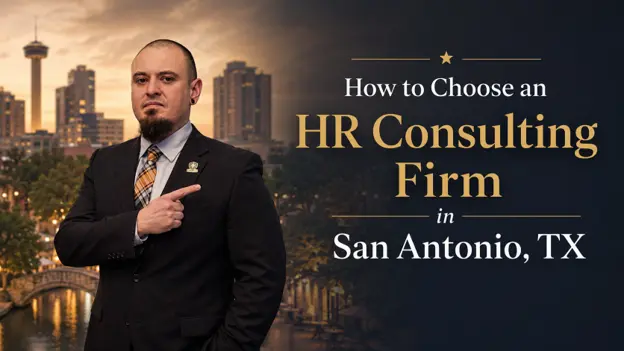
Every organization that starts searching for an HR consulting firm in San Antonio, TX is dealing with something. It may be documented or still vague, visible to leadership or only felt by the people closest to the work. But something prompted the search, and it is rarely just a desire to have better paperwork.
Whatever it is, the phrase "HR help" covers so much ground that it can point you in the wrong direction before you even start. An HR consultant who specializes in training is not the same as one who builds compliance infrastructure. A firm that produces policy documents is not the same as one that can look at how decisions are actually being made inside your organization and tell you why they keep producing the same bad outcomes. A pleasant discovery call does not mean the consultant can walk into a difficult workplace situation, identify the real problem, and build something that will hold after they leave.
Before you start evaluating vendors, it is worth getting clear on what you are actually trying to fix. Not the surface presentation of the problem that is visible through employee behavior, but the source of it.

| What It Looks Like | What It Often Actually Is | Where the Fix Lives |
|---|---|---|
| Constant turnover | Supervision, onboarding, or unspoken expectations | Management systems and role clarity |
| Discipline problems | Documentation failures and untrained supervisors | Documentation discipline and supervisor training |
| Compliance exposure | Outdated policies and inconsistent application | HR audit and policy modernization |
| Low morale | Inconsistent management and tolerated friction | Leadership accountability |
| Hiring struggles | Weak process and unclear expectations | Hiring and onboarding design |
Start With the Problem, Not the Vendor List
Most organizations type "HR consulting San Antonio" or "HR consultant San Antonio" into Google, skim a few websites, and try to compare firms based on service lists that may not even describe the same kind of work.
A more useful starting point is getting honest about where the pressure is coming from. HR problems tend to show up in one place and originate somewhere else entirely.
Constant turnover usually looks like a recruiting problem, but it is often a supervision problem, an onboarding problem, or an expectations problem that nobody is willing to name directly. Discipline issues look like employee behavior, but at Faulkner HR Solutions we argue they start sooner, at the frequent documentation failures, or with supervisors who were never trained to have the hard conversation early enough.
A good HR consultant should help you separate the symptom from what is actually causing it. If they skip that step and go straight to solutions, that is worth noticing. If you suspect the real issue is retention, our work on improving employee retention and engagement is a useful place to pressure-test that hunch.
HR problems tend to show up in one place and originate somewhere else entirely. The first job of a good consultant is to separate the symptom from the source.
Watch What a Consultant Does in the First Conversation
This is the easiest evaluation tool available. Do they ask questions or pitch a package? Do they talk about your situation or theirs? Do they push a prebuilt solution before they understand how decisions are actually made inside your organization?
A serious HR consultant wants to understand your documentation practices, your turnover patterns, how supervisors handle conflict, where leadership feels exposed, and whether the handbook reflects how things actually operate day to day. Because HR is not really paperwork. I mean, it is, but it is so much more, too, in that it is the framework of decision infrastructure. It determines how people get hired, corrected, promoted, protected, and eventually separated. When that infrastructure is weak, organizations keep running, but they are running on luck, and luck has a short shelf life.
The honest truth that honest consultants will not tell you is that not every HR problem needs a consultant. Some just need clarity. Faulkner HR Solutions offers a no-obligation clarity call to help you understand the issue, the risk, and the next practical step. If you choose not to work with us, you still leave with tools you can use.
If the first conversation is a capabilities presentation instead of a set of questions about your organization, you are being sold a package, not offered a diagnosis.
San Antonio Employers Have Specific Needs
An HR consultant in San Antonio needs to understand more than employment law and policy templates. San Antonio is not a generic market and its complex industry mix will never allow it to be. It is a military-connected, healthcare-heavy, construction-congested, manufacturing-supported, tourism-influenced, small-business-driven city with a workforce culture that does not always fit neatly inside corporate HR assumptions.
That matters. A strong HR consulting firm in San Antonio, TX should understand how those local workforce realities change the advice, the implementation plan, and the level of support an employer actually needs.
A growing contractor on the South Side does not have the same HR problem as a medical practice near the Medical Center. A city department does not operate like a professional services firm downtown. A nonprofit trying to stretch every dollar does not need the same solution as a manufacturer dealing with attendance, safety, shift coverage, and supervisor consistency. Generic HR advice treats those problems as interchangeable when they are not.
San Antonio employers need Texas-based HR support, not generic advice. The right San Antonio HR consulting strategy should account for Texas employment expectations, regional labor conditions, military-transition talent, bilingual workforce realities, public-sector constraints, lean nonprofit operations, and the practical management challenges that show up when organizations grow faster than their systems. Our San Antonio HR consulting page goes deeper on the local picture, and we work the same way for public sector, nonprofit, and small business employers.

The needs are usually concentrated in a few areas.
Compliance and documentation matter because policies, classifications, discipline practices, and employee files need to be current and defensible, not inherited from a previous administration and left untouched for years. If that describes your files, an HR audit and HR compliance review are usually the right first move.
Supervisor effectiveness matters because frontline managers create or reduce HR risk every day through how they communicate, document, correct behavior, and respond to problems. Many organizations underinvest in supervisors until the cost shows up as turnover, complaints, unemployment claims, morale issues, or legal exposure. Structured new manager training closes that gap before it becomes a performance problem.
Retention matters because employees rarely leave randomly. In San Antonio's competitive labor market, especially across healthcare, skilled trades, public service, aerospace, manufacturing, hospitality, and professional services, retention problems often point back to weak onboarding, inconsistent management, unclear expectations, or workplace friction leadership has learned to tolerate. That is the core of our employee retention consulting.
HR audits matter because organizations should not wait for a complaint, resignation pattern, or disciplinary challenge to discover where the exposure is.
Choosing an HR consultant in San Antonio is not like purchasing software. You are not buying a template, a checklist, or a corporate presentation from someone who could be talking about any city in America. You are buying judgment. You are buying someone's ability to understand what is actually happening inside your organization, account for the local workforce realities around you, and build systems that work in the environment you actually operate in.
San Antonio does not need HR advice that sounds imported. It needs HR strategy grounded in Texas, built for real employers, and practical enough to survive Monday morning.
Watch Out for the Deliverable-and-Disappear Model
There is a version of HR consulting that looks thorough on paper and produces almost nothing of lasting value. The engagement starts with a discovery phase, moves through assessment, and ends with a 200-page report or a policy manual that represents weeks of billable hours and takes up space on a shelf while the actual problems continue.
This model is more common than it should be, and it is easy to sell. Thick documents feel like serious work. A policy binder looks comprehensive. A lengthy report communicates effort. None of that means anything if it does not connect to how decisions are actually made inside the organization.
Most HR problems are not caused by missing documents. They are caused by a lack of discipline around those documents. The form exists, but nobody uses it. The policy is written, but managers apply it differently depending on who is involved. The training happened, but behavior never changed. The handbook is thorough but stopped reflecting operational reality about eighteen months ago. The consultant handed everything over, collected the final invoice, and left.
Practical HR consulting produces things the organization can actually use. Clear policies that match how the organization operates. Supervisor training with accountability built in, not a one-day session that fades within the week. Documentation systems people will actually follow. Recommendations sized to the organization's capacity to implement them, not designed to look impressive in a binder.
Before you hire, ask directly: what does implementation look like? If the answer is a deliverables list with no plan for what happens after delivery, that tells you something important. When comparing HR consulting firms in San Antonio, TX, the question is not who has the longest service menu. The question is who can diagnose the pressure inside the organization and turn that diagnosis into usable systems.
A 200-page report is not a result. Most HR problems are caused by a lack of discipline around documents, not a lack of documents.
Questions Worth Asking Before You Hire
Before signing anything, push past the service list.
- How do you diagnose the problem before recommending a solution? If the answer is a capabilities presentation or a package pitch, that is your signal.
- What kinds of organizations do you actually know? Not "we work with all types," but what specific operating contexts they understand from the inside.
- What does implementation look like in practice? A consultant who delivers a report and exits before anything changes is not a full solution.
- How do you handle supervisor accountability? That question separates consultants who understand where HR risk actually comes from and those who are focused on producing documents.
What Makes Faulkner HR Solutions Different
At Faulkner HR Solutions, HR is infrastructure. That is the foundation of our approach to HR consulting in Texas, especially for San Antonio employers, rural local governments, nonprofits, and growing organizations that need practical systems rather than paperwork disguised as busywork. Not theory, not a policy binder that gets filed and ignored, not a compliance checkbox someone runs through once a year.
We look at the systems that determine whether an organization can make clear, consistent, defensible people decisions when things are under pressure. That work involves workforce stabilization, leadership accountability, documentation discipline, and building HR practices that match how the organization actually operates, not how it intended to operate when someone wrote the handbook three years ago.
The clients we work with are not the easiest ones to serve. We work with small business owners who are fervent, capable, and completely consumed by the work of running the business, people who know exactly what they want to build but have not had the time, or the framework, to build the systems underneath it. We work with nonprofits whose leadership got into the work because they believed in the mission, and who now spend most of their energy trying to make a constrained budget serve their volunteers, their people, and their purpose all at once. We work with rural local governments that are not glamorous talent destinations, organizations operating under political and budgetary constraints, competing for staff in markets that larger employers have already picked over, trying to build something stable with limited resources and no margin for HR mistakes.
These organizations are doing real, consequential work under real constraints, and they deserve the same quality of HR thinking that well-resourced organizations take for granted. The gap between their mission and their operational capacity is exactly where this work lives.
Dr. Thomas W. Faulkner brings over 15 years of HR experience across municipal government, behavioral health, professional services, and businesses at various stages of growth. He holds a doctorate in Organizational Leadership, SPHR certification, a Lean Six Sigma Black Belt, and veteran service in the U.S. Army.
A turnover crisis might be a process problem. A leadership failure might be a behavioral accountability problem. A compliance gap might be a documentation problem. Sometimes the real issue is not that HR needs more performative activity but a better architecture. When the underlying issue is structural, the right path is usually organizational development consulting rather than another round of policies.
What to Hold Consultants Accountable For
A good consultant should not make your organization dependent on them. They should make it stronger after they leave. That means clearer systems, more capable supervisors, documentation that holds under scrutiny, and leadership habits that do not unravel once the engagement ends.
That is the standard San Antonio employers should hold. Not someone who makes HR sound manageable on a slide. Someone who will tell you what is actually wrong, build the system to address it, and leave the organization in a fundamentally different position than they found it.
If your organization has outgrown informal HR and is looking for an HR consultant in San Antonio or a practical HR consulting firm in San Antonio, TX, an infrastructure review is the right first step, and the right time for it is before the next people problem becomes a legal, operational, or retention problem.
Not Sure What You Are Actually Trying to Fix?
Book a no-cost diagnostic call. We will help you understand the issue, the risk, and the next practical step. If you choose not to work with us, you still leave with tools you can use.
Frequently Asked Questions
Start with the problem, not the vendor list. Get clear on where the pressure is actually coming from, then evaluate whether a consultant diagnoses the root cause before pitching a solution, understands San Antonio's specific workforce realities, and has a real plan for implementation after the deliverables are handed over.
A serious HR consultant asks questions instead of pitching a package. They want to understand your documentation practices, turnover patterns, how supervisors handle conflict, where leadership feels exposed, and whether the handbook reflects how the organization actually operates day to day.
San Antonio is a military-connected, healthcare-heavy, construction-congested, manufacturing-supported, tourism-influenced, small-business-driven market. A strong HR consulting firm accounts for Texas employment expectations, regional labor conditions, military-transition talent, bilingual workforce realities, and public-sector constraints rather than applying interchangeable advice.
Ask how they diagnose a problem before recommending a solution, what specific operating contexts they understand from the inside, what implementation looks like in practice, and how they handle supervisor accountability. Those questions separate consultants who understand where HR risk comes from from those focused only on producing documents.
A good consultant should make your organization stronger after they leave, not dependent on them. That means clearer systems, more capable supervisors, documentation that holds under scrutiny, and leadership habits that do not unravel once the engagement ends.
Talk to an HR Consulting Firm That Builds Systems, Not Binders
Faulkner HR Solutions helps San Antonio employers, rural local governments, nonprofits, and growing Texas organizations build HR systems that hold up under pressure. The goal is not more paperwork. The goal is clear, consistent, defensible people decisions, and supervisors who can actually carry them out.
If you are weighing HR consulting firms in San Antonio, TX, start with a diagnosis instead of a deliverables list. Book a free HR clarity call or contact Faulkner HR Solutions to discuss the right next step.