FMLA compliance for mid-sized companies usually fails in the space between policy and execution. The handbook says employees may be eligible for protected leave. The federal poster is on the wall. HR knows the basic rule. Then real life happens: a supervisor receives a vague text message, payroll tracks absences separately, medical certification sits in an inbox, and nobody is sure whether the leave has been formally designated.
That is where risk begins. Not because the organization ignored FMLA. Because the organization did not build a leave administration process strong enough to execute FMLA consistently.
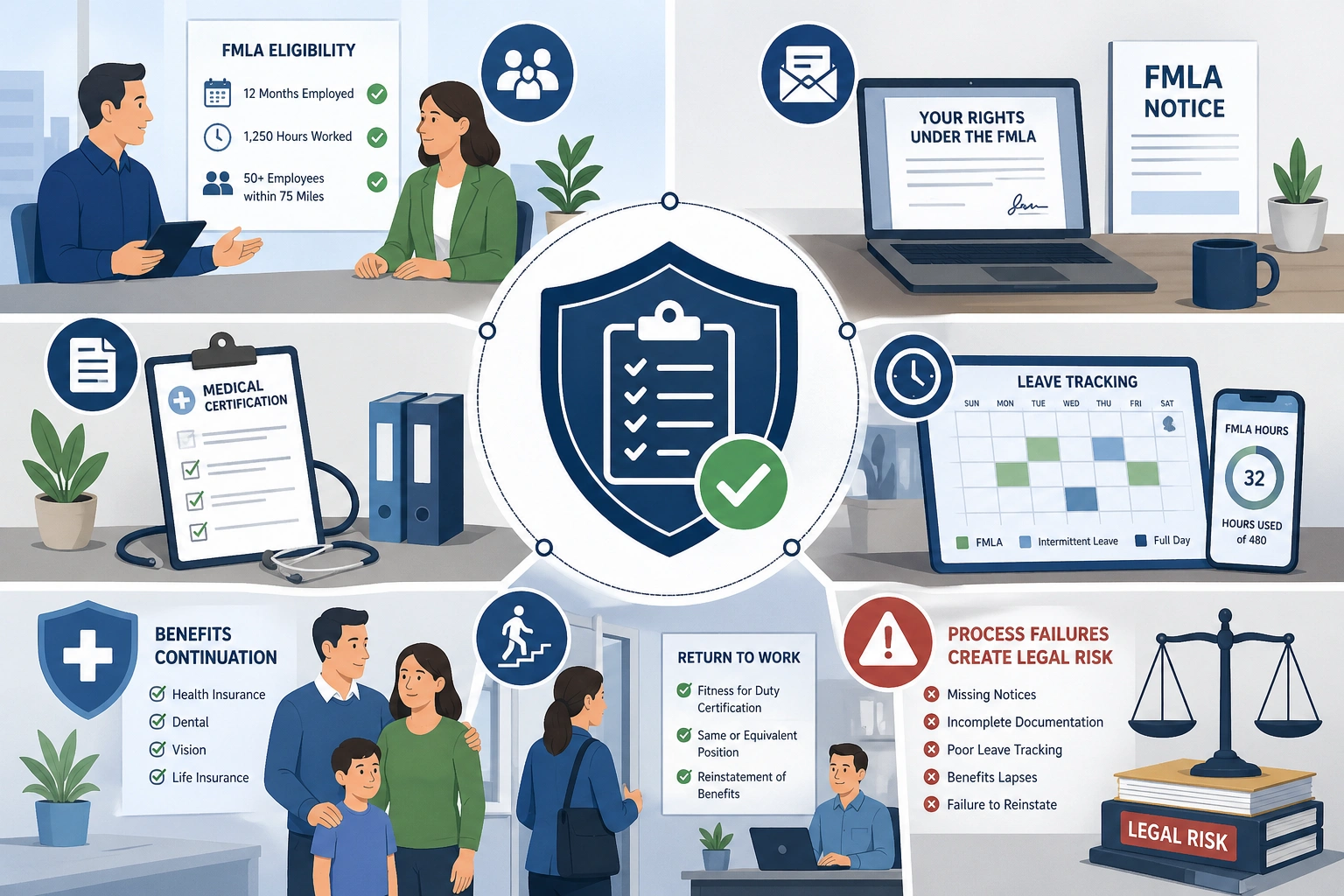
FMLA compliance for mid-sized companies means building a reliable system for determining eligibility, issuing required notices, managing medical certification, tracking continuous and intermittent leave, maintaining benefits, restoring employees to work, and preserving documentation. Mid-sized employers usually face the most risk when FMLA is handled through informal supervisor habits instead of a centralized HR-controlled workflow.
Why FMLA Compliance Matters More for Mid-Sized Companies
Mid-sized companies sit in a difficult compliance position. Smaller organizations may not yet meet the private-sector FMLA coverage threshold. Large organizations often have dedicated leave teams, HRIS systems, and third-party administrators. Mid-sized companies frequently have enough employees to trigger federal leave obligations but not enough internal infrastructure to manage those obligations cleanly.
That middle ground is dangerous. The organization is large enough to be covered, complex enough to have inconsistent practices across departments, and lean enough that one HR generalist may be expected to manage recruiting, onboarding, employee relations, payroll questions, benefits, handbook updates, and FMLA administration at the same time.
FMLA is unforgiving in that environment. Leave administration depends on timing, documentation, notice, consistency, and accurate tracking. A single missed step can create an interference claim, retaliation allegation, discrimination argument, or documentation gap that becomes difficult to defend later.
Important note: This article is educational and operational in nature. It is not legal advice. Employers should consult qualified employment counsel when evaluating specific FMLA disputes, litigation exposure, or complex leave scenarios.
What FMLA Requires from Covered Employers
The Family and Medical Leave Act provides eligible employees with job-protected leave for qualifying family and medical reasons. For most covered employers, the core entitlement is up to 12 workweeks of unpaid, job-protected leave in a 12-month period for qualifying reasons. Military caregiver leave may provide up to 26 workweeks in a single 12-month period for eligible employees caring for a covered servicemember.
The legal rules matter. The operational workflow matters just as much. A mid-sized company must know when FMLA applies, who is eligible, when notices must be issued, how medical certification should be handled, how leave is tracked, and what restoration obligations apply when the employee returns.
Covered Employers
Private-sector employers are generally covered by FMLA if they employ 50 or more employees in 20 or more workweeks in the current or preceding calendar year. Public agencies and public or private elementary and secondary schools are covered regardless of employee count.
Eligible Employees
An employee is generally eligible for FMLA leave when the employee works for a covered employer, has worked for the employer for at least 12 months, has at least 1,250 hours of service during the 12 months before leave begins, and works at a location where the employer has at least 50 employees within 75 miles.
Qualifying Reasons for FMLA Leave
FMLA may apply to leave for the employee's own serious health condition, care for a covered family member with a serious health condition, birth and bonding, adoption or foster placement and bonding, qualifying exigencies related to military service, and military caregiver leave.
The mistake is assuming employees must use legal language. Employees do not have to say “FMLA” to trigger employer obligations. They only need to provide enough information for the employer to recognize that leave may be for an FMLA-qualifying reason.
Why Mid-Sized Companies Struggle with FMLA Compliance
Most mid-sized companies do not fail FMLA because HR has never heard of the statute. They fail because the process is not designed for real operational pressure.
1. Supervisors Become the Accidental Intake System
Employees usually tell their supervisor first. That is normal. The problem begins when the supervisor decides whether the absence “counts,” approves leave informally, ignores the pattern, or fails to notify HR. Once supervisors become the gatekeepers for protected leave, consistency disappears.
2. HR Finds Out Too Late
HR cannot issue timely notices or evaluate eligibility if HR does not know the leave issue exists. In many mid-sized companies, HR discovers the situation after several absences have already occurred. By that point, deadlines may already be compromised.
3. Payroll and HR Track Different Realities
Payroll may track paid time off, unpaid absences, and wage deductions. HR may track protected leave entitlement. Supervisors may track schedule coverage. If those systems do not reconcile, the company may not know how much FMLA leave has actually been used.
4. Intermittent Leave Breaks Weak Systems
Continuous leave is easier to track. Intermittent leave is where weak systems collapse. A few hours here, a late arrival there, recurring treatment, flare-ups, partial-day absences, schedule changes, and supervisor frustration can create a messy compliance record if the employer lacks a clear tracking method.
5. Documentation Lives Everywhere
Eligibility notices in email. Certification forms in a manager's drawer. Payroll notes in a spreadsheet. Text messages on a supervisor's phone. That is not documentation. That is a scavenger hunt with legal consequences.
FMLA Compliance Checklist for Mid-Sized Companies
A strong FMLA compliance checklist should function as an operating system. The checklist should not merely confirm that a policy exists. It should verify that the organization can execute every required step consistently.
| Compliance Area | What to Confirm | Common Failure |
|---|---|---|
| Coverage | Confirm whether the employer meets FMLA coverage requirements. | The company crosses the 50-employee threshold but continues using informal leave practices. |
| Eligibility | Review tenure, hours worked, worksite location, and 75-mile rule. | Eligibility is assumed without reviewing hours or location requirements. |
| Notice | Issue eligibility, rights and responsibilities, and designation notices on time. | HR misses the five-business-day response window. |
| Certification | Request, receive, evaluate, and store medical certification properly. | Incomplete certifications are accepted or medical information is mishandled. |
| Tracking | Track leave used, remaining entitlement, intermittent leave, and calculation method. | Supervisors and payroll track leave differently. |
| Benefits | Maintain group health benefits under required conditions during FMLA leave. | Premium payment expectations are not clearly communicated. |
| Return to Work | Confirm restoration rights, fitness-for-duty requirements, and equivalent position obligations. | Managers change duties, shifts, or schedules without HR review. |
| Recordkeeping | Store records in a centralized, confidential, audit-ready structure. | Key leave documents are scattered across email, payroll, and supervisor files. |
Required FMLA Notices Employers Must Control
Notice failures are one of the most preventable FMLA compliance problems. Mid-sized companies need a workflow that makes notice timing automatic, not dependent on memory.
General Notice
Covered employers must provide general notice of FMLA rights. This usually includes displaying the required FMLA poster and including FMLA policy information in the employee handbook or written guidance when a handbook exists.
Eligibility Notice
When the employer learns that leave may be for an FMLA-qualifying reason, the employer generally must notify the employee whether the employee is eligible for FMLA leave within five business days, absent extenuating circumstances.
Rights and Responsibilities Notice
The rights and responsibilities notice explains employee obligations and expectations, including certification requirements, paid leave substitution rules, benefits continuation, premium payment requirements, and consequences for failing to meet responsibilities.
Designation Notice
Once the employer has enough information to determine whether leave qualifies as FMLA leave, the employer must provide a written designation notice within five business days, absent extenuating circumstances.
If the company relies on one person remembering FMLA notice deadlines, the process is already too fragile. Notice deadlines should be tracked through a centralized leave log, HR calendar, task system, or HRIS workflow.
Medical Certification: Where Employers Overreach or Underreact
Medical certification is one of the most sensitive parts of FMLA administration. Employers have the right to request appropriate certification in many cases. Employers also have limits. The goal is to verify the leave need without turning HR into an amateur medical investigator.
Mid-sized companies need a standard certification workflow that answers six questions:
- When will certification be requested?
- Which form will be used?
- Who reviews returned certifications?
- What happens when certification is incomplete or insufficient?
- Where will medical documentation be stored?
- When may recertification be requested?
The process must protect confidentiality. Medical documentation should not sit in a supervisor's inbox, general personnel file, payroll folder, or shared drive with broad access. That is how a compliance issue becomes a privacy issue.
Intermittent FMLA Tracking for Mid-Sized Employers
Intermittent FMLA leave creates the highest day-to-day friction because it affects scheduling, attendance, payroll, production, client coverage, and supervisor trust. The legal right exists, but the operational burden is real. Pretending otherwise does not help anyone.
The organization needs a structured process that protects the employee's rights while preventing administrative chaos.
Intermittent Leave Controls to Define
- The minimum increment used to track intermittent FMLA leave
- The call-in procedure employees must follow unless unusual circumstances apply
- The process supervisors use to notify HR of FMLA-related absences
- The method HR uses to reconcile leave used against total entitlement
- The process for reviewing patterns that may require recertification or clarification
- The communication rules supervisors must follow to avoid retaliation or interference concerns
Intermittent leave should not be managed through frustration, suspicion, or silence. It should be managed through process.
A Practical FMLA Workflow for Mid-Sized Companies
The best FMLA process is boring. Boring means predictable. Predictable means defensible.
Trigger Identification
Train supervisors to recognize potential FMLA triggers without making eligibility decisions. Triggers may include repeated absences for medical treatment, hospitalization, pregnancy-related leave, caregiving needs, chronic conditions, or an employee stating that medical issues are affecting work.
HR Intake and Eligibility Review
HR reviews whether the employer is covered, whether the employee meets tenure and hours requirements, and whether the worksite requirement applies. The review should be documented in a standard eligibility checklist.
Notice Issuance
HR issues required notices and documents the date each notice was sent. Delivery proof should be stored in the leave file. The goal is not just to send the notice. The goal is to prove the notice was sent on time.
Certification and Designation
HR requests certification when appropriate, evaluates the returned documentation, follows the required process for incomplete or insufficient certification, and issues the designation notice once enough information exists to determine whether leave qualifies.
Leave Tracking and Payroll Coordination
HR tracks leave usage against entitlement. Payroll tracks wage and benefit implications. Supervisors track schedule coverage. The three functions must reconcile regularly so the company does not operate from conflicting data.
Return-to-Work and Restoration
HR manages fitness-for-duty requirements when applicable, confirms job restoration obligations, coordinates with the supervisor, and documents the employee's return. Managers should not alter duties, schedules, or role conditions without HR review.
Common FMLA Compliance Mistakes
These mistakes create quiet exposure because they often look administratively harmless until the employee files a complaint, submits an attorney letter, or challenges a termination.
Mistake 1: Treating FMLA as a Policy Instead of a Workflow
A policy explains rights. A workflow executes obligations. Mid-sized companies often have the policy but not the workflow. That gap is where notices get missed, documentation disappears, and inconsistent supervisor habits take over.
Mistake 2: Waiting for Employees to Say “FMLA”
Employees are not required to use perfect terminology. When the employer has enough information to know leave may qualify, the employer must act. Training supervisors to recognize potential triggers is essential.
Mistake 3: Letting Supervisors Make Leave Decisions
Supervisors can report information. They should not decide eligibility, pressure employees not to use leave, question medical legitimacy, or punish absences that may be protected.
Mistake 4: Tracking Intermittent Leave Inconsistently
Intermittent leave must be tracked with discipline. If one supervisor tracks hours, another tracks days, and payroll only tracks paid time off, the company does not know what happened.
Mistake 5: Failing to Maintain an Audit Trail
FMLA compliance requires proof. If the organization cannot show when notices were sent, what certification was received, how leave was counted, and how return-to-work decisions were handled, the defense gets weaker.
Mistake 6: Using Retaliation-Coded Language
Managers sometimes say the quiet part out loud in performance notes: “Attendance has been unreliable since leave started.” That wording can create retaliation risk when absences are protected. Managers need clear guidance on how to address legitimate performance concerns without penalizing protected leave.
How to Conduct an Internal FMLA Compliance Audit
An FMLA compliance audit should review the process from the first employee communication through return to work. The point is not to admire the handbook. The point is to test whether the leave process actually works.
1. Review Recent Leave Files
Select a sample of FMLA and potential FMLA files from the last 12 to 24 months. Review whether eligibility was evaluated, notices were issued, certification was handled correctly, leave was designated, and the return-to-work process was documented.
2. Interview Supervisors
Ask supervisors what they do when an employee mentions a medical issue, ongoing treatment, pregnancy, caregiving obligations, or recurring absences tied to health. If the answers vary, the process is not standardized.
3. Test the Tracking System
Compare HR records, payroll records, attendance records, and supervisor notes. If the records do not match, the company does not have one leave system. It has multiple partial systems.
4. Check Notice Timing
Review whether eligibility notices, rights and responsibilities notices, and designation notices were issued within required timing expectations. Missed deadlines should be treated as process failures, not clerical accidents.
5. Review Benefits Continuation
Confirm that health benefit continuation, premium payment communication, and employee payment expectations were handled consistently and documented clearly.
6. Review Job Restoration
Confirm that employees returning from FMLA leave were restored to the same or an equivalent position unless a lawful exception applied and was reviewed carefully.
For broader compliance review, see HR audit consulting. For a related pillar guide, review how to conduct an HR compliance audit.
FMLA, ADA, Workers’ Compensation, and PTO: The Overlap Problem
FMLA rarely lives alone. Mid-sized companies often run into trouble because FMLA intersects with other employment obligations and internal policies.
FMLA and ADA
An employee may exhaust FMLA leave and still have rights under the Americans with Disabilities Act if the employee has a qualifying disability and a reasonable accommodation is required. The end of FMLA is not automatically the end of the employer's obligation to evaluate leave-related issues.
FMLA and Workers’ Compensation
A work-related injury may trigger workers' compensation and FMLA at the same time if the condition qualifies and the employee is eligible. Employers need a coordinated process so departments do not treat the same absence differently.
FMLA and Paid Time Off
Employers must clearly explain whether paid leave will run concurrently with FMLA leave and how substitution of paid leave works under company policy. This should be addressed in the rights and responsibilities notice and reflected consistently in payroll.
Leave compliance is not one law at a time. The employer needs a workflow that recognizes overlap before HR, payroll, risk management, and supervisors create conflicting decisions.
FMLA Documentation and Recordkeeping
Documentation protects decisions. That principle matters most when an employment action follows protected leave. If the company disciplines, denies restoration, changes schedules, or terminates employment after FMLA activity, the documentation trail will be reviewed closely.
Mid-sized companies should maintain centralized FMLA files that include:
- Employee request or triggering communication
- Eligibility determination
- Required notices
- Medical certification requests and responses
- Designation notice
- Leave calculation method
- Leave used and remaining entitlement
- Intermittent leave logs
- Benefits continuation communication
- Return-to-work documentation
- Related supervisor communications
For deeper documentation guidance, review employee documentation best practices for legal defense. For support modernizing related policies, review employee handbook consulting.
When a Mid-Sized Company Should Get FMLA Compliance Help
Outside help makes sense when the organization is large enough to face FMLA exposure but does not yet have a mature leave administration system.
Common signs include:
- Supervisors handle medical absences differently across departments
- HR learns about leave requests after absences already occurred
- Intermittent leave is tracked manually without reconciliation
- Notice deadlines depend on memory
- Certification forms are incomplete, inconsistent, or scattered
- Payroll, HR, and supervisors disagree about leave used
- Employees return from leave without a structured restoration process
- Performance or attendance actions occur close to protected leave activity
Faulkner HR Solutions helps Texas organizations strengthen FMLA compliance by reviewing leave workflows, identifying documentation gaps, improving HR process controls, training supervisors on leave escalation, and building practical compliance systems that hold under pressure.
Related services include HR compliance consulting, HR audits and diagnostics, HR process improvement, and organizational development consulting.
FMLA Implementation Checklist
- Confirm whether the company meets FMLA coverage requirements
- Build a centralized FMLA intake process controlled by HR
- Train supervisors to recognize possible FMLA triggers and escalate immediately
- Create a standard eligibility determination checklist
- Track eligibility, rights and responsibilities, certification, and designation notice deadlines
- Standardize medical certification request and review procedures
- Create one source of truth for continuous and intermittent leave tracking
- Define how HR, payroll, and supervisors reconcile leave records
- Store FMLA documentation separately from general personnel files
- Document benefits continuation and premium payment expectations
- Create return-to-work and restoration review procedures
- Audit FMLA files at least annually or after any high-risk leave dispute
FMLA Compliance Consulting for Mid-Sized Companies
FMLA compliance is not just a legal requirement. It is an HR infrastructure test. When the leave process is weak, every difficult medical absence exposes the organization to inconsistent decisions, missed deadlines, documentation gaps, and avoidable employee relations problems.
Faulkner HR Solutions helps mid-sized companies diagnose where FMLA administration is breaking, redesign the workflow, train supervisors, strengthen documentation, and build practical controls around eligibility, notices, certification, intermittent leave tracking, and return-to-work decisions.
If your company has crossed the 50-employee threshold, is struggling with intermittent leave, or is not confident that your FMLA files would survive an audit, schedule a no-obligation strategy call or call 210.446.8730.
Frequently Asked Questions
Private-sector employers are generally covered by FMLA when they employ 50 or more employees in 20 or more workweeks in the current or preceding calendar year. Employee eligibility also depends on tenure, hours worked, and whether the employee works at a location where the employer has at least 50 employees within 75 miles.
Employers generally must provide an eligibility notice within five business days of learning that an employee may need FMLA-qualifying leave, absent extenuating circumstances.
The biggest risk is inconsistent execution. Missed notice deadlines, unclear ownership, weak intermittent leave tracking, and scattered documentation create preventable legal exposure.
Supervisors should not independently approve, deny, or designate FMLA leave. Supervisors can identify potential leave issues and communicate attendance information, but HR should control eligibility, notice, documentation, designation, and compliance decisions.
Software can help, but it does not replace process design. A company still needs centralized intake, clear ownership, standardized notices, reliable tracking, documentation controls, and supervisor escalation training.
An FMLA compliance checklist should include eligibility review, required notices, medical certification handling, continuous and intermittent leave tracking, benefits continuation, job restoration, return-to-work documentation, and recordkeeping.