Employee reward ideas are often misunderstood. Many organizations rely on surface-level perks like gift cards or pizza parties, assuming they will improve morale and retention. In reality, effective employee rewards programs are structured systems designed to reinforce performance, recognize contributions, and align with what employees actually value.
The best employee recognition ideas and incentive ideas for employees go beyond one-time rewards. They combine monetary and non-monetary rewards for employees into a consistent, strategic approach that improves engagement and reduces turnover over time.
Employee Rewards Programs and Recognition Systems
Employee reward idea programs are structured systems used to recognize performance, reinforce behaviors, and improve retention. These programs often include a mix of financial incentives, recognition initiatives, and non-monetary rewards for employees such as flexibility, development opportunities, and public acknowledgment.
Organizations searching for reward systems for employees or employee recognition ideas are typically trying to solve one problem: how to motivate employees consistently without relying on short-term incentives.
What Are Employee Reward Programs?
Employee reward programs are formalized systems organizations use to acknowledge and incentivize desirable behaviors, achievements, or milestones. These programs include monetary and non-monetary employee rewards designed to motivate employees, reinforce company values, and improve retention. Effective programs are strategic, consistent, and aligned with performance metrics rather than ad hoc or purely reactive gestures.
One-off rewards and generic recognition ideas do not build retention. Retention is a system outcome requiring integrated reward structures that align with organizational priorities and what individual employees actually value.
8 Employee Reward Ideas and Incentive Ideas for Employees That Work
Tie Rewards to Clear Performance Metrics
Reward systems that are vague or based on subjective judgment breed mistrust and inconsistency. Effective programs link recognition and incentives directly to transparent, measurable performance goals. This clarity ensures employees understand what behaviors and outcomes are valued — and rewarded — without having to guess what the manager is looking for.
Setting quarterly productivity benchmarks or customer satisfaction targets and rewarding employees who meet or exceed them creates predictability and fairness. It also helps managers avoid accusations of favoritism, one of the most common ways recognition programs lose credibility.
Incorporate Meaningful Non-Monetary Rewards
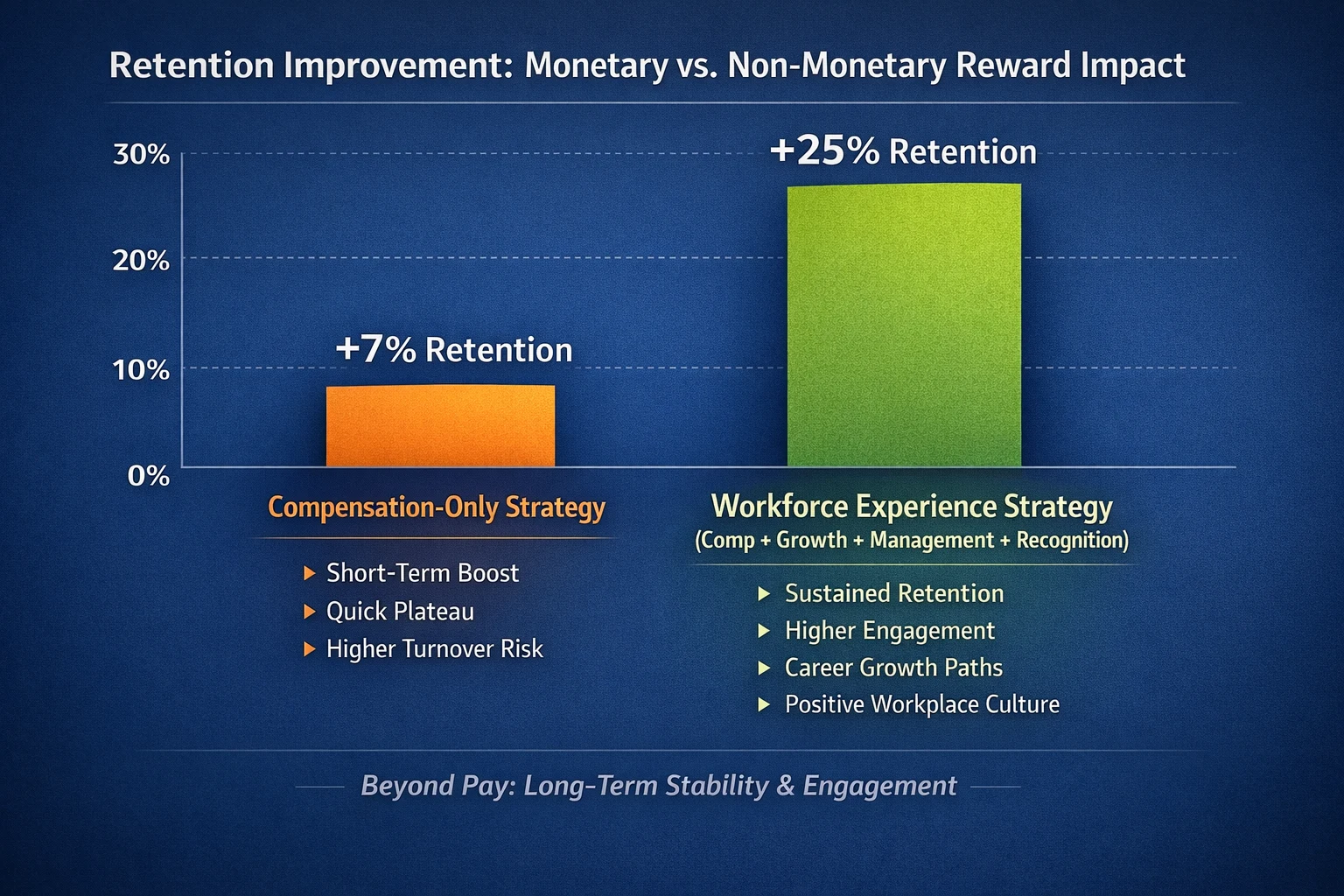
Money is not the only motivator — and for some employees, it barely registers. Non-monetary rewards for employees like additional paid time off, flexible scheduling, or public acknowledgment can create lasting impact without inflating compensation budgets. These rewards communicate trust, respect, and genuine appreciation, which are primary drivers of engagement and retention.
Consider implementing focus days where employees work on projects of their choosing, or offering reserved parking for top performers. Such incentives often signal value more effectively than a cash bonus because they enhance autonomy and work-life balance — two things cash cannot directly provide.
Effective incentive ideas for employees include both financial rewards and non-monetary recognition that reinforce performance, collaboration, and long-term engagement.These types of non-monetary rewards for employees often outperform cash incentives because they improve autonomy and work-life balance.
Use Peer Recognition to Build a Culture of Appreciation
Top-down recognition programs are important but insufficient on their own. Peer-to-peer recognition taps into social motivation and builds a culture where appreciation is normalized rather than rationed. Creating platforms or regular forums where employees can publicly recognize one another's contributions reinforces positive behavior and increases collective accountability.
Programs like recognition boards or digital badges encourage wider participation and make appreciation more authentic and frequent — two factors that sustain engagement over time rather than producing a short-term spike after a recognition event.
These approaches are among the most effective employee recognition ideas because they scale across teams and reinforce culture.
Customize Rewards to Individual Preferences
Retention does not come from one-size-fits-all incentives. What motivates one employee may be irrelevant to another. Conducting stay interviews or preference surveys helps identify what kinds of rewards employees actually value — whether that is professional development, wellness programs, schedule flexibility, or public acknowledgment.
Tailoring rewards increases their perceived value and effectiveness. It also sends a clear message that the organization sees employees as individuals, not interchangeable roles. That message is often more powerful than the reward itself.
Integrate Learning and Development as a Reward
Professional growth is a powerful retention tool. Rewarding employees with opportunities for skill development — paid training, tuition reimbursement, or conference attendance — addresses both motivational and career progression needs simultaneously. These rewards reinforce a growth mindset and demonstrate investment in employees' futures, not just their current output.
Development rewards also reduce turnover by increasing engagement and building internal candidates for promotion, which feeds the leadership pipeline organically rather than requiring external hiring every time a leadership gap opens.
Recognize Milestones and Tenure Strategically
Celebrating work anniversaries and other milestones is a classic recognition idea — and it is often executed as an afterthought. Integrating milestone recognition into a broader reward system ensures it reinforces loyalty and signals long-term value rather than just ticking a box with a generic card and a handshake.
Strategic milestone rewards might include personalized gifts selected based on what the employee actually values, public acknowledgment at team meetings, or additional benefits tied to tenure. The key word is meaningful — token gestures that feel obligatory often produce more cynicism than appreciation.
Leverage Team-Based Rewards to Encourage Collaboration
Individual rewards, when they dominate the recognition system, can inadvertently foster internal competition rather than collaboration. Incorporating team-based incentives aligns recognition with organizational goals that require cross-functional cooperation. Rewarding a team for meeting project deadlines or quality standards reinforces shared accountability and collective ownership of outcomes.
Team rewards do not have to be monetary. Team lunches, recognition events, or shared time off create social bonds that are strong predictors of retention. Employees who feel connected to their team are more resistant to competitive offers.
Team-based approaches are essential in modern reward systems for employees where collaboration drives results.
Ensure Timeliness and Consistency in Reward Delivery
Delays or inconsistencies in giving rewards negate their impact. A reward system must operate on a reliable timeline with clear processes that ensure recognition happens promptly after the desired behavior or achievement. A reward that arrives three months after the fact is not reinforcement — it is administrative closure.
Consistency also means applying criteria uniformly across teams and departments to maintain fairness and trust. This requires training managers on the program criteria and providing clear guidelines that prevent the reward system from becoming another place where manager discretion creates perceived inequity.
Implementing rewards without addressing underlying management and workload issues is like putting a bandage on a broken bone. Rewards amplify the impact of good systems but cannot fix broken ones.
Employee Rewards Programs, Recognition Ideas, and Incentive Systems
Employee reward ideas only work when they are part of a broader system. Without structure, consistency, and alignment, even the best incentives fail to produce lasting impact.
If your organization is struggling with retention, implementing effective employee reward ideas is not optional. Strong employee rewards programs combine incentives, recognition, and performance alignment to create a system that consistently motivates employees.
Schedule a consultation to design a reward system tailored to your workforce.
Checklist: Building a Reward System That Drives Retention
- Define clear, measurable performance metrics linked to each reward category
- Incorporate a mix of monetary and non-monetary rewards tailored to employee preferences
- Embed peer recognition alongside manager-led recognition
- Customize rewards based on stay interview insights and preference data
- Include professional development opportunities as reward options
- Recognize milestones strategically with personalized acknowledgment
- Offer team-based rewards to reinforce collaboration alongside individual recognition
- Establish timely, consistent delivery processes with written guidelines for managers
- Train managers on equitable application and communication of rewards
- Integrate reward programs into the broader retention and engagement strategy
Effective reward programs are not stand-alone solutions. They are parts of a comprehensive retention strategy. For deeper coverage of how employee retention functions as an organizational system, see How to Improve Employee Retention and Engagement. For the morale drivers that reward programs reinforce, see How to Fix Low Employee Morale. For the performance goals that determine what gets rewarded, see SMART Goals for Employee Engagement.
Organizations struggling with retention often find that reward programs are just the tip of the iceberg. The real challenge lies in designing integrated systems that address role clarity, management practices, workload design, and growth visibility. If retention challenges persist despite offering perks, a comprehensive review of the overall retention strategy is the next step. For expert guidance, explore our Employee Retention Consulting services.
Frequently Asked Questions
When designed strategically, reward programs reinforce desired behaviors, demonstrate organizational appreciation, and increase motivation — all of which contribute to lower voluntary turnover. The key word is strategically: programs that feel arbitrary or inconsistently applied produce the opposite effect.
Yes, and often more so than cash bonuses. Non-monetary rewards like flexible work options, public recognition, and professional development frequently have a more lasting impact on engagement and retention because they address autonomy, belonging, and growth — motivational drivers that a bonus deposit does not touch.
Recognition should be timely — as close to the achievement as possible. Milestone and team rewards can follow a scheduled cadence. The worst frequency is erratic: infrequent enough that employees feel unseen, and inconsistent enough that they cannot predict what earns recognition.
No. Rewards amplify good systems and leadership but cannot fix fundamental management failures, workload imbalances, or structural problems that cause turnover. An employee who is burned out and poorly managed will not be retained by a gift card.
Identify the specific behaviors and performance outcomes that drive your business priorities, then tie rewards explicitly to those metrics. If customer retention is a strategic priority, reward behaviors that directly support it. Generic rewards tied to generic behaviors produce generic results.