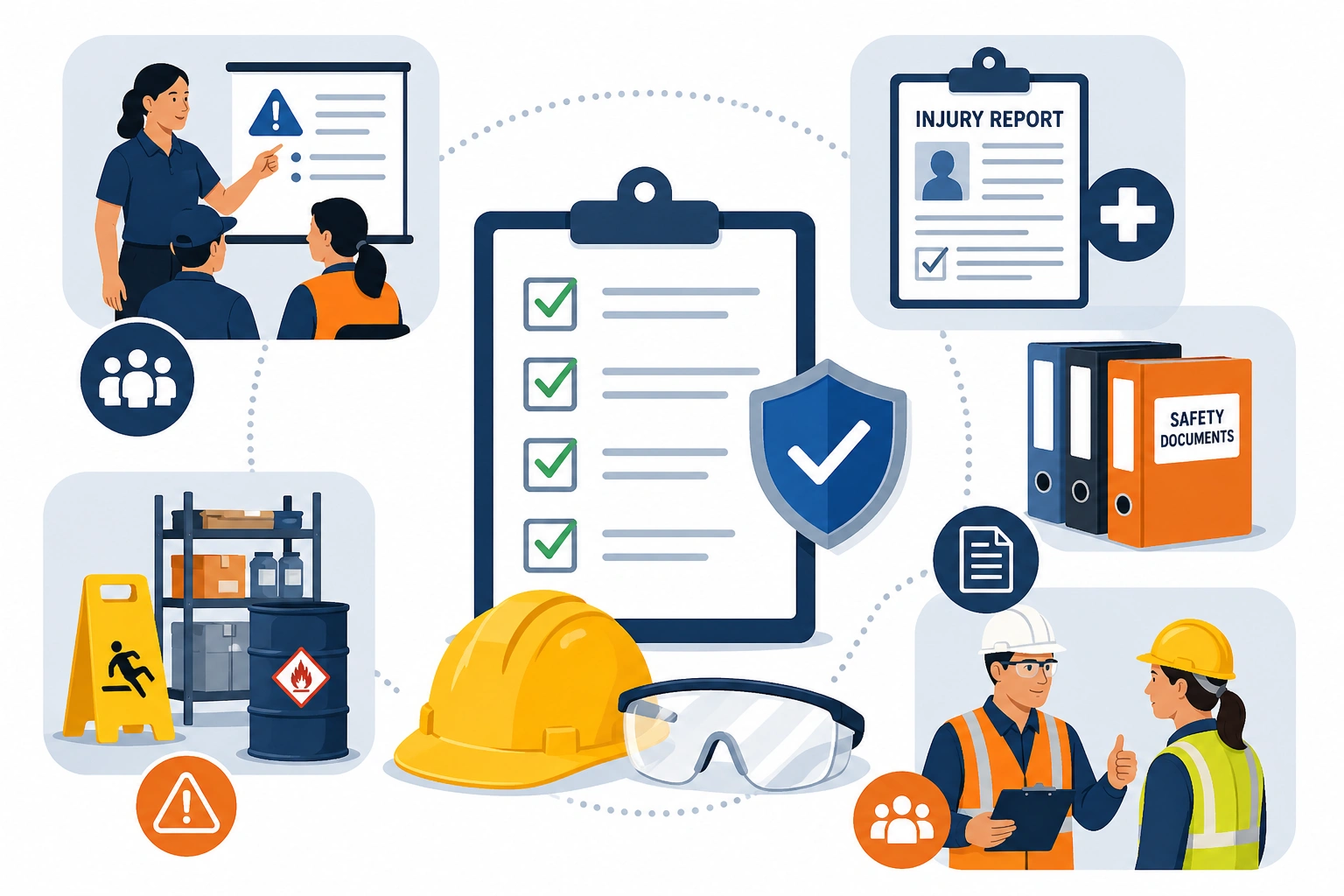
OSHA requirements for small businesses include providing a safe workplace, identifying and correcting hazards, training employees, reporting serious injuries, and maintaining required injury and illness records when applicable. Businesses with 10 or fewer employees may be partially exempt from routine OSHA recordkeeping, but they are still responsible for workplace safety and serious injury reporting.
OSHA requirements for small businesses are widely misunderstood because too many owners treat OSHA like a paperwork issue. It is not paperwork. It is operational control. A small business does not need a bloated safety department to stay compliant, but it does need a working system for preventing hazards, training employees, documenting what happened, and correcting problems before those problems become injuries, complaints, or inspections.
The hard truth: OSHA compliance for small business owners usually fails in the same place HR compliance fails. The business relies on memory, informal habits, and “common sense.” That works until someone gets hurt, an employee files a complaint, or a supervisor cannot explain why the rule was enforced one way last month and another way today.
What OSHA Requires Small Businesses to Do
OSHA requirements for small businesses start with a basic duty: employers must provide a workplace free from recognized hazards that are likely to cause serious harm. That requirement applies whether the business has three employees or three hundred.
Provide a Safe Workplace
Identify hazards, correct unsafe conditions, and prevent avoidable injuries through practical controls.
Train Employees
Train employees on job-specific hazards, safe work practices, emergency procedures, and required protective measures.
Document Key Actions
Keep records of safety training, incidents, corrective actions, and required OSHA logs when applicable.
Report Severe Incidents
Report work-related fatalities, hospitalizations, amputations, and loss of an eye within OSHA’s required deadlines.
Small business does not mean “no OSHA.” It means the system needs to be simple enough to maintain and strong enough to hold under pressure.
OSHA Compliance Checklist for Small Businesses
Use this OSHA compliance checklist for small business operations as a practical starting point. Do not overcomplicate the system before the basics work.
- Identify workplace hazards by department, role, and task.
- Create written safety procedures for recurring high-risk work.
- Train employees before assigning hazardous work.
- Document employee safety training and refresher training.
- Provide required personal protective equipment when applicable.
- Post required OSHA notices and safety information.
- Maintain OSHA injury and illness logs if required.
- Report serious injuries and fatalities within OSHA deadlines.
- Create a simple internal hazard reporting process.
- Correct hazards and document the corrective action taken.
- Hold supervisors accountable for enforcing safety rules consistently.
- Review safety practices after incidents, near misses, or operational changes.
The checklist matters because OSHA compliance does not survive through good intentions. It survives through repeatable action.
OSHA Requirements for Businesses With 10 or Fewer Employees
One of the most common searches around OSHA rules for small businesses is whether companies with fewer than 10 employees are exempt. The answer is limited.
That distinction matters. Small businesses often hear “recordkeeping exemption” and translate it into “OSHA does not apply.” That is wrong. OSHA still applies. The paperwork threshold and the safety obligation are not the same thing.
Source reference: OSHA’s recordkeeping rule explains the partial exemption for employers with 10 or fewer employees, while OSHA’s reporting guidance explains that all employers must report fatalities and severe injuries within required timeframes. See OSHA 1904.1 and OSHA severe injury reporting.
OSHA Recordkeeping Requirements for Small Businesses
OSHA recordkeeping requirements for small businesses depend on employee count and industry classification. Many employers with more than 10 employees must maintain OSHA injury and illness records using OSHA Forms 300, 300A, and 301 unless the business falls within a partially exempt industry.
Common OSHA Recordkeeping Forms
- OSHA Form 300: Log of Work-Related Injuries and Illnesses.
- OSHA Form 300A: Summary of Work-Related Injuries and Illnesses.
- OSHA Form 301: Injury and Illness Incident Report.
Even when a small business is exempt from routine OSHA logs, internal documentation still matters. Training records, hazard reports, corrective actions, and incident notes help prove that the business took safety seriously before something went wrong.
That is also where OSHA compliance overlaps with HR documentation. Weak documentation turns a manageable issue into a defensibility problem. For a deeper documentation framework, read employee documentation best practices for legal defense.
OSHA Reporting Requirements for Small Businesses
OSHA reporting requirements are not optional because a company is small. Employers must report serious work-related incidents within specific deadlines.
Fatality
Report to OSHA within 8 hours.
Hospitalization
Report work-related in-patient hospitalization within 24 hours.
Amputation
Report work-related amputation within 24 hours.
Loss of an Eye
Report work-related loss of an eye within 24 hours.
Reporting is not the same as recordkeeping. A business may be exempt from routine OSHA logs and still have a duty to report a fatality or severe injury.
OSHA Training Requirements for Small Businesses
OSHA training requirements for small businesses depend on the hazards employees face. A small office, a construction contractor, a machine shop, a water utility, and a cleaning service do not carry the same risk profile.
Training should answer four practical questions:
- What hazards exist in the job?
- What should employees do to prevent injury?
- What protective equipment or procedures are required?
- What should employees do when something goes wrong?
Training also needs documentation. If a supervisor says, “I told them,” that is not a system. That is a memory with legal exposure attached.
For businesses struggling to turn training into actual workplace behavior, review workforce development consulting for Texas organizations.
Common OSHA Compliance Mistakes Small Businesses Make
Small businesses usually do not fail OSHA compliance because leadership wants employees hurt. They fail because the business grows faster than the safety system.
1. No Written Safety Process
The owner knows how the work should be done. The supervisor kind of knows. The employee learns by watching whoever was available that day. That is not training. That is workplace folklore.
2. Inconsistent Enforcement
One employee is corrected for skipping PPE. Another employee is ignored because they are “experienced.” Inconsistent enforcement creates risk because it suggests the rule is optional.
3. Poor Incident Documentation
An employee gets hurt, and the business starts reconstructing events through text messages and hallway conversations. If documentation begins after the crisis, the system already failed.
4. Missing Hazard Communication
Chemicals, cleaning products, fuels, solvents, and maintenance supplies often create OSHA exposure in businesses that do not think of themselves as high-risk.
5. Supervisors Who Do Not Know Their Role
Supervisors are the enforcement layer. If supervisors ignore hazards, fail to correct unsafe work, or do not document issues, the company does not have a safety program. It has a poster.
OSHA Compliance for Small Businesses in Texas
Texas small businesses need to treat OSHA compliance as part of broader HR and operational risk management. Workplace safety issues often overlap with employee relations, workers’ compensation, documentation, discipline, supervisor training, and compliance audits.
For Texas employers, OSHA problems can also expose weak HR infrastructure. The pattern is familiar: inconsistent onboarding, unclear training expectations, informal documentation, and supervisors who enforce rules differently across shifts or departments.
That is why OSHA compliance should not sit in a separate binder away from HR. Safety expectations should be built into onboarding, job descriptions, supervisor accountability, training records, and corrective action procedures.
Related resources:
How OSHA Compliance Connects to HR Systems
OSHA compliance is not separate from HR. It depends on HR infrastructure.
You cannot maintain safety consistency without:
- Clear job expectations
- Structured onboarding
- Training records
- Supervisor accountability
- Corrective action procedures
- Reliable documentation
For workflow-level issues, review HR process improvement consulting for broken HR workflows. For businesses that need broader structure around policies and documentation, review employee handbook consulting.
How to Audit OSHA Readiness in a Small Business
A practical OSHA readiness audit does not need to begin with a 90-page report. Start with operational reality.
Step 1: Walk the Workplace
Look for hazards employees have normalized: blocked exits, missing PPE, poor chemical labeling, unsafe lifting practices, damaged equipment, improvised tools, and informal shortcuts.
Step 2: Review Training Records
Confirm who was trained, when training occurred, what topics were covered, and whether the training matched the employee’s actual work.
Step 3: Review Incident History
Look for patterns in injuries, near misses, complaints, corrective actions, and repeated issues by department or supervisor.
Step 4: Test Supervisor Consistency
Ask supervisors how they handle the same safety violation. If every answer is different, the organization has a consistency problem.
Step 5: Fix the Highest-Risk Process First
Do not try to fix everything at once. Start where legal risk, injury risk, and operational frequency overlap.
When Small Businesses Should Get OSHA Compliance Help
Outside help makes sense when the business has grown beyond informal practices, supervisors are inconsistent, safety training is undocumented, or leadership is unsure whether current practices would survive an inspection.
Faulkner HR Solutions supports Texas small businesses, nonprofits, and municipalities through HR compliance audits, documentation review, process improvement, supervisor accountability systems, onboarding structure, and practical implementation support. The goal is not to create a binder full of safety language nobody uses. The goal is to build a compliance system that works on a normal Tuesday, not just during an inspection.
Start with HR compliance consulting for Texas organizations or schedule a no-obligation strategy call.
Frequently Asked Questions
Yes. Most small businesses must provide a safe workplace, train employees on workplace hazards, report serious injuries, and comply with applicable OSHA standards. Some small businesses may be partially exempt from routine injury and illness recordkeeping, but they are not exempt from safety obligations.
Businesses with 10 or fewer employees during the previous calendar year are generally exempt from OSHA injury and illness recordkeeping unless OSHA or the Bureau of Labor Statistics tells them otherwise. The exemption does not remove the duty to maintain a safe workplace or report serious injuries.
Many employers with more than 10 employees must maintain OSHA Forms 300, 300A, and 301 unless classified in a partially exempt industry. Even exempt small businesses should keep internal records of training, incidents, corrective actions, and hazard reports.
Employers must report a work-related fatality to OSHA within 8 hours. Employers must report a work-related in-patient hospitalization, amputation, or loss of an eye within 24 hours.
The most important OSHA requirement is maintaining a workplace free from recognized serious hazards. Small businesses need practical systems for identifying hazards, training employees, enforcing safety rules, and documenting corrective action.