
Most leadership activities for employees fail because they are designed to feel productive instead of change behavior. A team-building exercise can fill a calendar. A workshop can produce decent survey scores. Neither one proves that employees can communicate clearly, make better decisions, delegate work, or lead under pressure.
Leadership activities for employees are structured workplace exercises that help employees practice communication, decision-making, delegation, accountability, conflict resolution, and team leadership. The best activities use realistic scenarios, require active participation, include feedback, and connect directly to job expectations.
Leadership development activities should build observable workplace skills. The goal is not to make employees memorize leadership terms. The goal is to help employees practice the behaviors they will need when priorities shift, deadlines tighten, conflict appears, or a team needs direction.
Use the leadership training activities below as practical exercises, not performative meeting fillers. Each activity works best when connected to a real workplace expectation, followed by feedback, and repeated until the skill becomes easier to apply on the job.
| Activity | Skill Built | Best For |
|---|---|---|
| Decision-Making Scenario Drill | Judgment and prioritization | Emerging leaders and managers |
| Delegation Practice Exercise | Role clarity and accountability | Supervisors and team leads |
| Difficult Conversation Role-Play | Feedback and conflict management | Managers and supervisors |
| Team Leadership Problem-Solving | Facilitation and group decision-making | Team leads and project leads |
| Accountability Follow-Up | Consistency and performance follow-through | Managers and department leads |
| Communication Clarity Exercise | Expectation-setting and instruction clarity | All employees |
| Peer Feedback Practice | Influence and professional communication | Cross-functional teams |
| Priority-Setting Challenge | Time management and escalation discipline | Supervisors and operations staff |
| Manager Shadowing Reflection | Leadership awareness and judgment | Future leaders |
| After-Action Review | Accountability and continuous improvement | Teams and project groups |
What Are Leadership Activities for Employees?
Leadership activities for employees are structured exercises that help employees practice leadership behaviors before those behaviors are tested in higher-stakes situations. Effective activities focus on skills such as communication, delegation, prioritization, accountability, decision-making, conflict management, and team coordination.
The best leadership exercises for the workplace are practical. They are tied to job expectations, realistic scenarios, and measurable behavior. A good activity should help the employee answer a basic question: “What should I do differently at work after practicing this?”
Leadership development does not happen because employees attended a session. Leadership development happens when employees practice a defined skill, receive feedback, and apply that skill again in the flow of work.
Unstructured leadership training activities for managers and employees can create cynicism when the activity feels disconnected from real work. If the activity does not change what people do on the job, it is probably not development.
Leadership Activities for Employees: 10 Practical Exercises
The activities below can be used with employees, supervisors, emerging leaders, and managers. Each one targets a specific leadership skill and can be adapted for public sector teams, nonprofits, small businesses, healthcare organizations, and growing companies.
Decision-Making Scenario Drill
Give employees a realistic workplace scenario where they must make a decision with incomplete information. The scenario should include competing priorities, a time constraint, and a clear consequence for inaction.
How to run it: Present the scenario, give participants five to ten minutes to decide, then ask each person to explain the decision, the risk considered, and the communication needed after the decision.
Skill built: Judgment, prioritization, risk awareness, and decision communication.
Delegation Practice Exercise
Delegation fails when employees assign tasks without explaining expectations, authority, deadlines, or decision limits. This leadership activity teaches employees how to delegate without dumping work or micromanaging the outcome.
How to run it: Ask participants to delegate a sample task using five required elements: outcome, deadline, authority level, quality standard, and check-in point. Have a partner identify what was unclear.
Skill built: Delegation, role clarity, communication, and accountability.
Difficult Conversation Role-Play
This is one of the most useful leadership training activities for managers because difficult conversations expose whether a leader can stay clear, calm, and specific under pressure.
How to run it: Give one person a supervisor role and another person an employee role. Use a realistic prompt involving attendance, missed deadlines, poor communication, conflict, or performance concerns. The leader must explain the issue, name the expected behavior, and confirm the follow-up step.
Skill built: Feedback delivery, conflict management, documentation awareness, and professional communication.
Team Leadership Problem-Solving Exercise
Team leadership exercises should show whether a person can guide a group toward a decision without dominating the room or allowing the conversation to drift.
How to run it: Give a small group a workplace problem to solve. Assign one participant as the discussion lead. The leader must clarify the issue, involve quieter participants, manage disagreement, and summarize the final decision.
Skill built: Facilitation, team leadership, decision structure, and inclusive communication.
Accountability Follow-Up Simulation
Many leadership skills development activities focus on the first conversation. The harder leadership skill is follow-up. Accountability requires leaders to revisit expectations after the first discussion.
How to run it: Give participants a scenario where an employee agreed to correct a behavior but did not follow through. The participant must conduct a follow-up conversation that references the original expectation, states the gap, and identifies the next consequence or support step.
Skill built: Accountability, consistency, performance management, and follow-through.
Communication Clarity Exercise
Leadership often breaks down because expectations sound clear to the speaker but remain vague to the listener. This exercise helps employees learn how to communicate with enough precision that action can follow.
How to run it: Ask participants to rewrite vague instructions into clear workplace expectations. For example, “communicate better” becomes “send a project status update every Friday by 2 p.m. with completed tasks, blockers, and next steps.”
Skill built: Clarity, instruction design, performance communication, and expectation-setting.
Peer Feedback Practice
Peer feedback helps employees practice leadership without relying on formal authority. This activity is especially useful for emerging leaders, project leads, and employees who influence others across departments.
How to run it: Pair participants and give each person a short workplace scenario. One person gives feedback using a simple structure: observed behavior, work impact, expected adjustment, and support needed. The other person reflects back what was heard.
Skill built: Feedback, listening, influence, and professional courage.
Priority-Setting Challenge
Leadership requires employees to separate what is urgent, important, delayed, delegated, or declined. Without that skill, people stay busy but miss the work that matters.
How to run it: Give participants a list of 12 competing tasks with limited time and resources. Ask them to rank the tasks, explain what gets done first, what gets delayed, what gets delegated, and what requires escalation.
Skill built: Prioritization, resource judgment, time management, and escalation discipline.
Manager Shadowing Reflection
Leadership development activities do not always need to happen in a classroom. Shadowing allows employees to observe leadership decisions in real time and reflect on what effective leadership looks like in practice.
How to run it: Have an employee observe a manager during a meeting, planning session, or operational check-in. Afterward, the employee answers three questions: What decision was made? What communication helped or hurt clarity? What leadership behavior should be repeated?
Skill built: Observation, judgment, leadership awareness, and reflective learning.
After-Action Review
An after-action review turns completed work into leadership development. Instead of asking whether the project was “good” or “bad,” the review examines what was expected, what happened, why it happened, and what should change next time.
How to run it: After a project, event, or difficult situation, ask the team four questions: What was supposed to happen? What actually happened? What caused the gap? What will we do differently next time?
Skill built: Reflection, accountability, process improvement, and continuous learning.
Leadership Development Activities That Build Real Skills
Leadership development activities work when the activity is connected to a defined skill. “Be a better leader” is not specific enough. Employees need to know the behavior they are practicing and the standard that will be used to evaluate improvement.
Before choosing an activity, identify the leadership skill that matters most for the role. A frontline supervisor may need delegation and difficult conversation practice. A project lead may need facilitation and priority-setting practice. A department head may need decision-making, change communication, and accountability practice.
Organizations that need leadership growth across multiple roles should connect these activities to a broader leadership development consulting strategy instead of treating each activity as a standalone workshop.
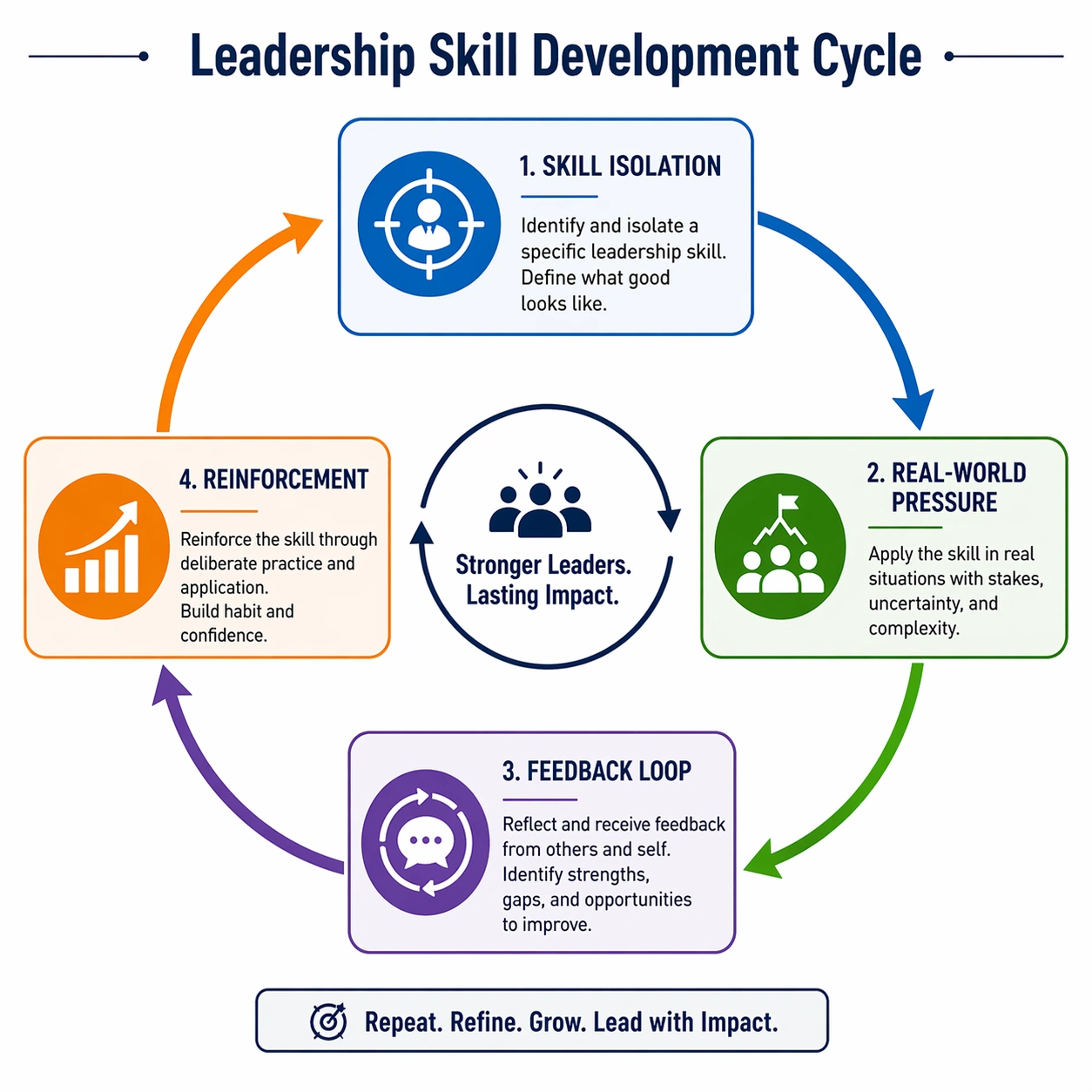
You cannot coach what you have not defined. Leadership activities should begin with a clear behavior, not a motivational phrase.
Leadership Training Activities for Managers
Managers need leadership activities that match the pressure of the role. A manager is expected to communicate expectations, document concerns, correct behavior, support employees, make decisions, and protect team performance. Training that avoids those realities may feel comfortable, but it does not prepare managers to lead.
The strongest leadership training activities for managers usually focus on four areas:
- Difficult conversations: Correcting behavior without becoming vague, emotional, or avoidant.
- Delegation: Assigning work with clear outcomes, authority, and follow-up expectations.
- Accountability: Following up consistently when expectations are missed.
- Decision-making: Making timely decisions with imperfect information.
These activities should be supported by job descriptions, performance expectations, supervisory procedures, and coaching routines. If the organization expects managers to lead but gives them no structure, training becomes a cover for system failure.
For managers who are new to supervision, pair these activities with structured new manager training so employees learn expectations before leadership gaps become performance problems.
Team Leadership Exercises for the Workplace
Team leadership exercises are useful when employees need to lead through influence, not just authority. This includes project leads, senior employees, committee chairs, shift leads, department coordinators, and employees preparing for supervisory responsibility.
The best team leadership exercises for the workplace require participants to clarify the problem, involve others, manage disagreement, and move the group toward a decision. Avoid activities that only reward charisma or confidence. Leadership is not the loudest person getting the most airtime.
Do not confuse icebreakers with leadership development. Icebreakers may help people talk. Leadership exercises should help people lead.
Useful team leadership exercises include meeting facilitation practice, group decision simulations, peer feedback activities, cross-functional problem-solving exercises, and after-action reviews. These exercises can also support broader workforce development consulting efforts when leadership capability gaps are affecting performance across departments.
How to Run Leadership Activities at Work
Effective leadership exercises for the workplace should be built around the work employees actually perform. Generic exercises may create discussion, but practical exercises create behavior change because participants can immediately connect the activity to the job.
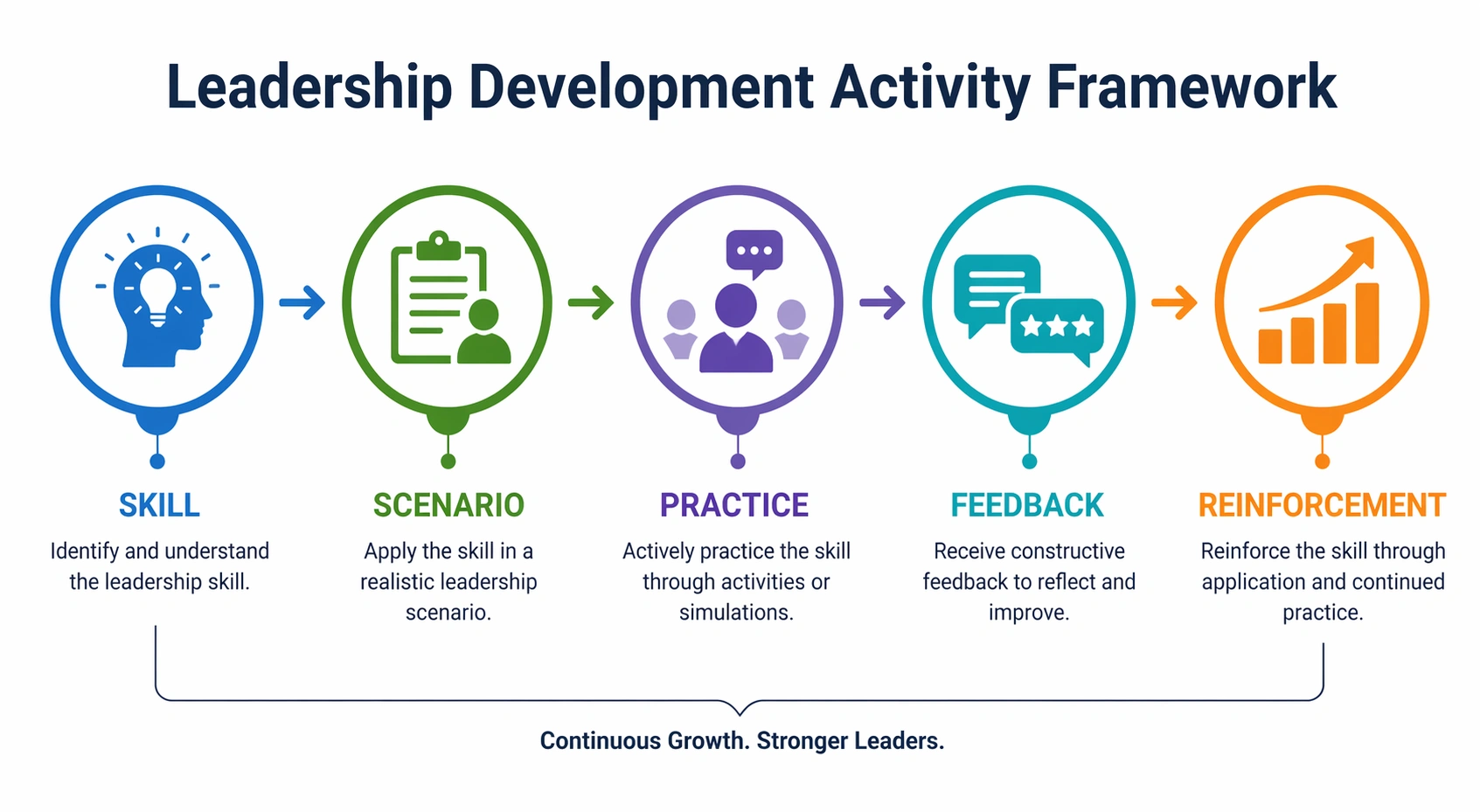
Define the Leadership Skill
Start by naming the specific skill the activity should build. Examples include delegation, feedback, prioritization, decision-making, conflict resolution, meeting facilitation, or accountability.
Use a Realistic Scenario
The scenario should resemble the decisions, conversations, or conflicts employees actually face. The more realistic the exercise, the easier it is to transfer the lesson back to the workplace.
Add Structured Feedback
Feedback should be specific and tied to the skill being practiced. Participants should leave knowing what worked, what missed the mark, and what to adjust next time.
Reinforce the Skill After Training
Leadership skills fade when practice stops. Reinforcement can include manager check-ins, peer accountability, job aids, follow-up exercises, performance goals, and after-action reviews.
When leadership exercises reveal role confusion, broken workflows, or unclear authority, the issue may require organizational development consulting rather than another training session.
Leadership Skills Development Activities: What to Measure
Leadership skills development activities should be measured by behavior change, not attendance. A full room does not prove the training worked. A completed activity does not prove the skill improved.
Measure whether employees are applying the leadership skill after the activity. Depending on the activity, useful measures may include:
- Improved clarity in delegated assignments
- More consistent follow-up after performance conversations
- Fewer repeated misunderstandings between departments
- Better meeting decisions and documented next steps
- Improved employee feedback on manager communication
- Reduced escalation of routine issues
- Stronger project ownership and deadline follow-through
- Better documentation of expectations and corrective conversations
If the activity cannot be connected to behavior, the organization should redesign the activity before repeating it.
Checklist: Building Effective Leadership Development Activities
- Define the specific leadership competency before choosing the activity.
- Connect the activity to real workplace responsibilities.
- Use realistic pressure, conflict, or decision-making scenarios.
- Require participants to practice, not just discuss.
- Use structured feedback tied to observable behavior.
- Repeat the activity until the skill becomes easier to apply.
- Measure behavior change after the activity.
- Connect leadership activities to performance expectations.
- Train managers to reinforce the skill after the session.
- Remove activities that feel good but do not change workplace behavior.
For broader development planning, connect these activities to workforce development consulting, organizational development consulting, and formal leadership development consulting systems.
Frequently Asked Questions
The best leadership activities for employees are practical exercises that build observable skills such as communication, delegation, decision-making, accountability, conflict resolution, and team leadership. Examples include decision-making drills, delegation practice, difficult conversation role-plays, after-action reviews, and peer feedback exercises.
Leadership development activities focus on structured practice, real workplace application, feedback, and reinforcement. Regular training often relies on passive learning, while effective leadership activities require employees and managers to apply leadership behaviors in realistic situations.
Leadership training activities for managers work best when they focus on difficult conversations, delegation, coaching, accountability, prioritization, performance feedback, and team decision-making. The activity should connect directly to the manager’s actual job responsibilities.
Organizations can measure leadership exercises by tracking changes in observable behavior, employee feedback, team performance, retention, project follow-through, quality of documentation, and manager consistency after the activity.
Leadership skills development activities should be used regularly instead of as one-time workshops. Monthly practice, manager coaching, structured feedback, and follow-up exercises help convert training into consistent leadership behavior.
Most organizations do not fail because they lack leadership training. They fail because leadership training is not connected to job expectations, feedback, reinforcement, and accountability. Leadership activities should help employees practice the actual behaviors the organization needs from them.
Need Leadership Activities Built for Your Managers and Employees?
Faulkner HR Solutions helps Texas organizations design practical leadership development systems that move beyond generic workshops. The goal is not more training for the sake of training. The goal is to build leadership behaviors that hold up during pressure, conflict, change, and daily operations.
If your organization needs leadership development activities, manager training, team leadership exercises, or a structured leadership development system, contact Faulkner HR Solutions to discuss the right next step.