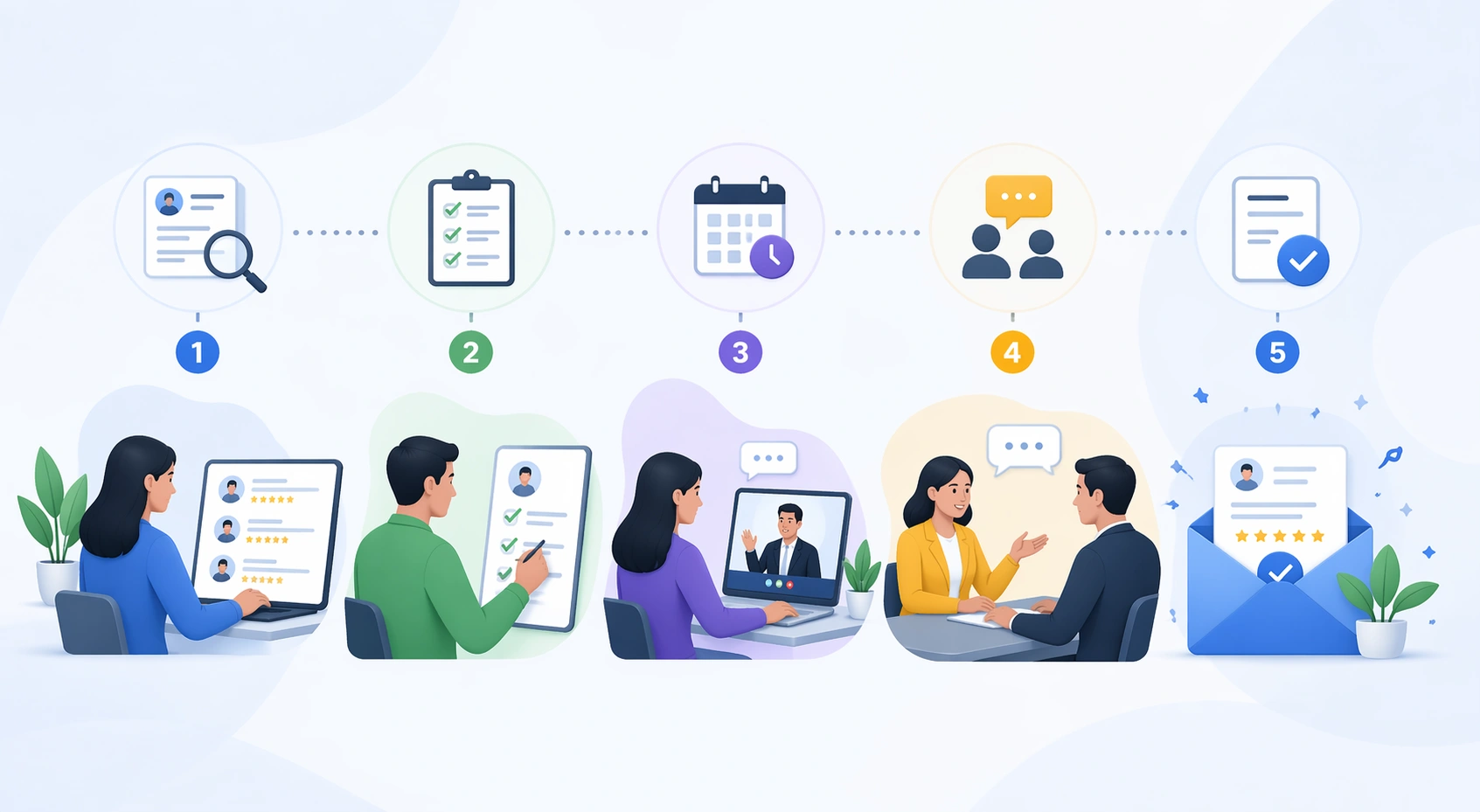
The right interview process steps do more than help an organization choose a candidate. They reduce hiring risk, improve consistency, and create a more defensible hiring workflow. Too many organizations treat the hiring process like a talent discovery exercise when the process should function as a structured system that screens out poor fits and validates strong ones. The failure to design and follow a consistent recruitment lifecycle produces costly mis-hires, wasted interviewer time, and high early turnover. A few casual conversations and a gut feeling is not a process. It is a gamble with a predictable payout.
The main interview process steps are role definition, candidate screening, structured interviews, qualification validation, offer, and onboarding. A strong hiring workflow uses documented criteria, consistent interview questions, scoring rubrics, and a 30-60-90 day onboarding plan to reduce bias and improve hiring outcomes.
Who This Guide Is For
This guide is for small businesses, nonprofits, municipalities, and growing organizations that need a more consistent hiring process. If interviews feel informal, hiring managers use different standards, or new hires keep failing within the first 90 days, the issue is usually the hiring workflow rather than the candidate pool.
Organizations that need hands-on support can use hiring process consulting to redesign screening, interview stages, scoring rubrics, candidate documentation, and onboarding handoffs.
What Is the Hiring Process?
The hiring process is the structured sequence of steps an organization follows to identify, evaluate, and select candidates for open positions. It involves screening applications, conducting interviews, validating qualifications, and making job offers. A well-designed hiring workflow reduces bias, improves decision consistency, and leads to better hiring outcomes.
The strongest hiring systems connect each stage of the recruitment lifecycle. Role definition informs the job posting. The job posting informs screening criteria. Screening criteria inform interview questions. Interview scores inform selection decisions. Selection decisions then flow into onboarding. When those pieces are disconnected, hiring becomes inconsistent, difficult to defend, and hard to improve.
Most hiring processes fail because they rely on unstructured interviews and subjective impressions rather than a repeatable, competency-based workflow designed to mitigate risk. The issue usually is not that organizations lack candidates. The issue is that organizations lack a consistent way to evaluate whether those candidates can perform the work.
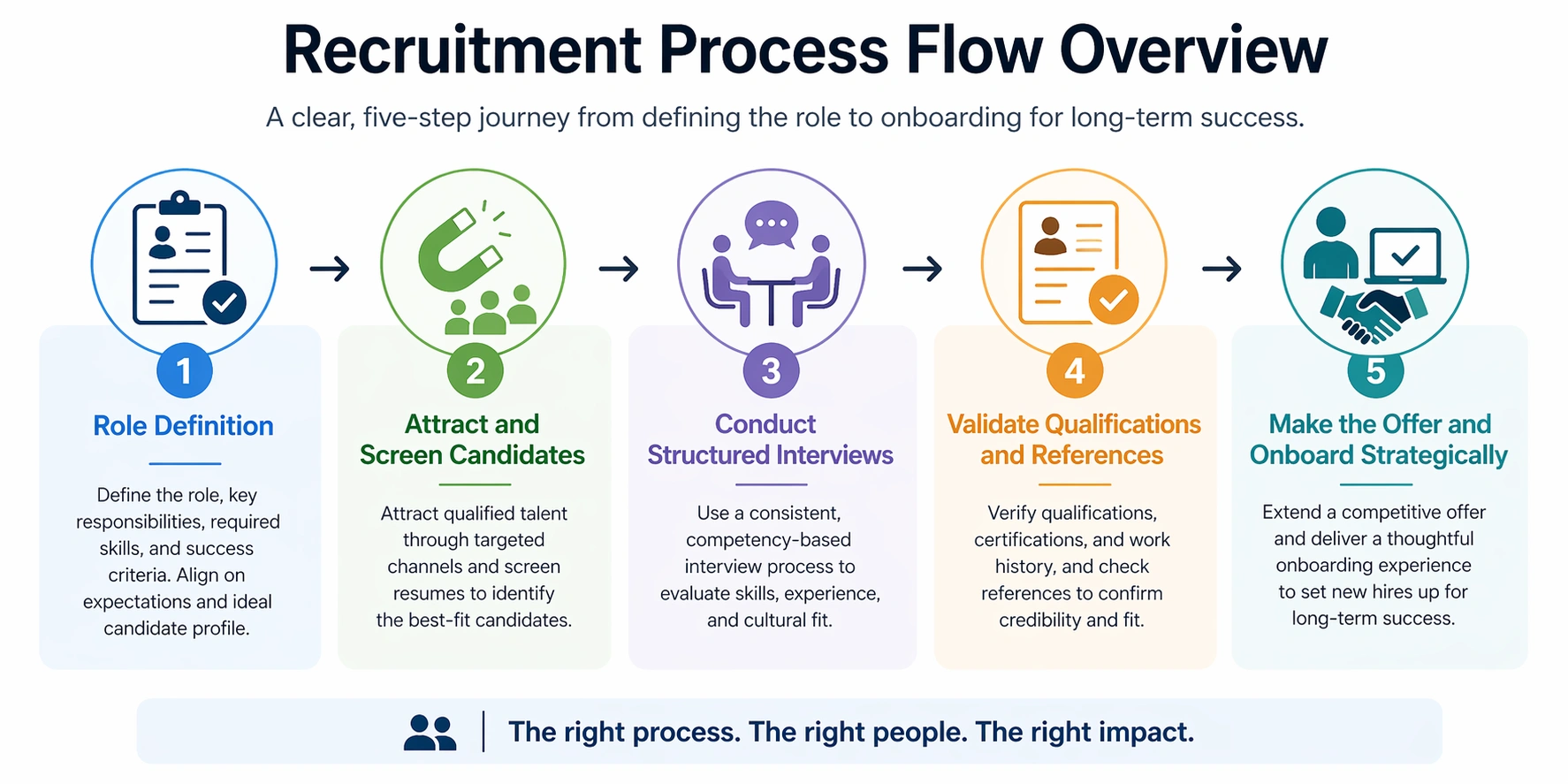
Recruitment Process Flow: From Role Definition to Offer
A recruitment process flow shows how candidates move through the hiring system from the moment a role is approved through the point when an offer is accepted and onboarding begins. The purpose of the flow is not to create unnecessary paperwork. The purpose is to make the process visible enough that leaders can identify bottlenecks, prevent inconsistent treatment, and improve the quality of hiring decisions.
A practical recruitment process flow should answer five questions: who owns each step, what criteria are being used, what documentation is required, when decisions must be made, and how candidates are moved forward or removed from consideration. Without those answers, hiring managers often fill in the blanks on their own. That is where inconsistency, bias, and compliance exposure begin.
Hiring Process Steps Every Organization Should Document
Hiring process steps should be documented before a position is posted. Documentation helps hiring managers apply the same standards across candidates and gives HR a clearer record of how decisions were made. A documented hiring workflow should define role approval, job posting requirements, screening standards, interview stages, scoring rubrics, reference checks, offer approval, and onboarding handoff.
The goal is not to make hiring slower. The goal is to make hiring more consistent. When each step has a clear owner, purpose, and documentation requirement, the organization can move faster without relying on guesswork.
The Five Steps of a Structured Hiring Process
Define the Role and Success Criteria
Before the first application lands, the hiring process must begin with a clear, competency-based definition of the role. This means understanding not just the job title and duties, but the specific behaviors, skills, and outcomes that define success. Vague or outdated job descriptions create confusion and attract unqualified candidates, wasting time for everyone involved.
Defining the role accurately also involves identifying the organizational context, reporting relationships, decision authority, and how the new hire's work will flow within the team. This foundational step sets the entire recruitment lifecycle on a path toward clarity and accountability. Without agreed-upon success criteria, the hiring team will lack consistency in evaluating candidates, leading to subjective decisions and increased mis-hire risk.
Attract and Screen Candidates
Once the role is defined, the next step is attracting candidates through targeted job postings and sourcing strategies aligned with the hiring goals. The screening process filters applicants based on minimum qualifications, experience, and alignment with the role's competencies.
Screening should be standardized and documented, leveraging applicant tracking systems where possible to ensure consistency. Relying on keyword searches or gut feeling at this stage leads to overlooking qualified candidates or advancing unsuitable ones. Screening calls or brief initial interviews can verify resume information and assess basic alignment before investing time in deeper rounds.
Conduct Structured Interviews
This is where most organizations fail by relying on unstructured conversations that favor charisma over competence. Structured interviews use predetermined questions tied directly to key competencies and measurable scoring criteria. This approach improves consistency, reduces bias, and gives the organization a clearer record of why one candidate was selected over another.
Each interviewer should be trained on the scoring system and the competencies being evaluated. Multiple interviewers with complementary perspectives improve the reliability of the assessment. Behavioral questions designed to elicit specific examples of past performance are more useful than vague questions that invite rehearsed answers. All interviews should be documented carefully to support transparency and defensibility.
Unstructured interviews increase legal exposure when hiring decisions are challenged. A documented scoring system is one of the strongest practical defenses against claims of inconsistent or discriminatory selection.
Validate Qualifications and References
After interviews, validating candidate qualifications through reference checks, background screening, and skills testing ensures the information provided is accurate and reliable. This step is often overlooked or rushed, but it is critical for risk reduction.
Reference checks should be structured and focused on verifying competencies and behavioral patterns relevant to the role, not just dates of employment. Background checks must comply with legal requirements and organizational policies. Skills assessments or work samples provide objective data points that complement interview impressions, particularly for technical, supervisory, or specialized roles.
Make the Offer and Onboard Strategically
Extending a job offer is not the end of the hiring process. It is the transition into onboarding, which is equally critical for retention. The offer should be clear, timely, and backed by documentation that protects the organization, including an offer letter that specifies title, compensation, start date, reporting relationship, and employment status where applicable.
Onboarding is the period during which the new hire aligns expectations, learns the culture, and integrates into the role. Poor onboarding negates the hiring investment and produces early turnover. A strategic onboarding plan includes role-specific training tied to the success criteria defined in step one, introductions to key stakeholders, and structured check-ins at 30, 60, and 90 days.
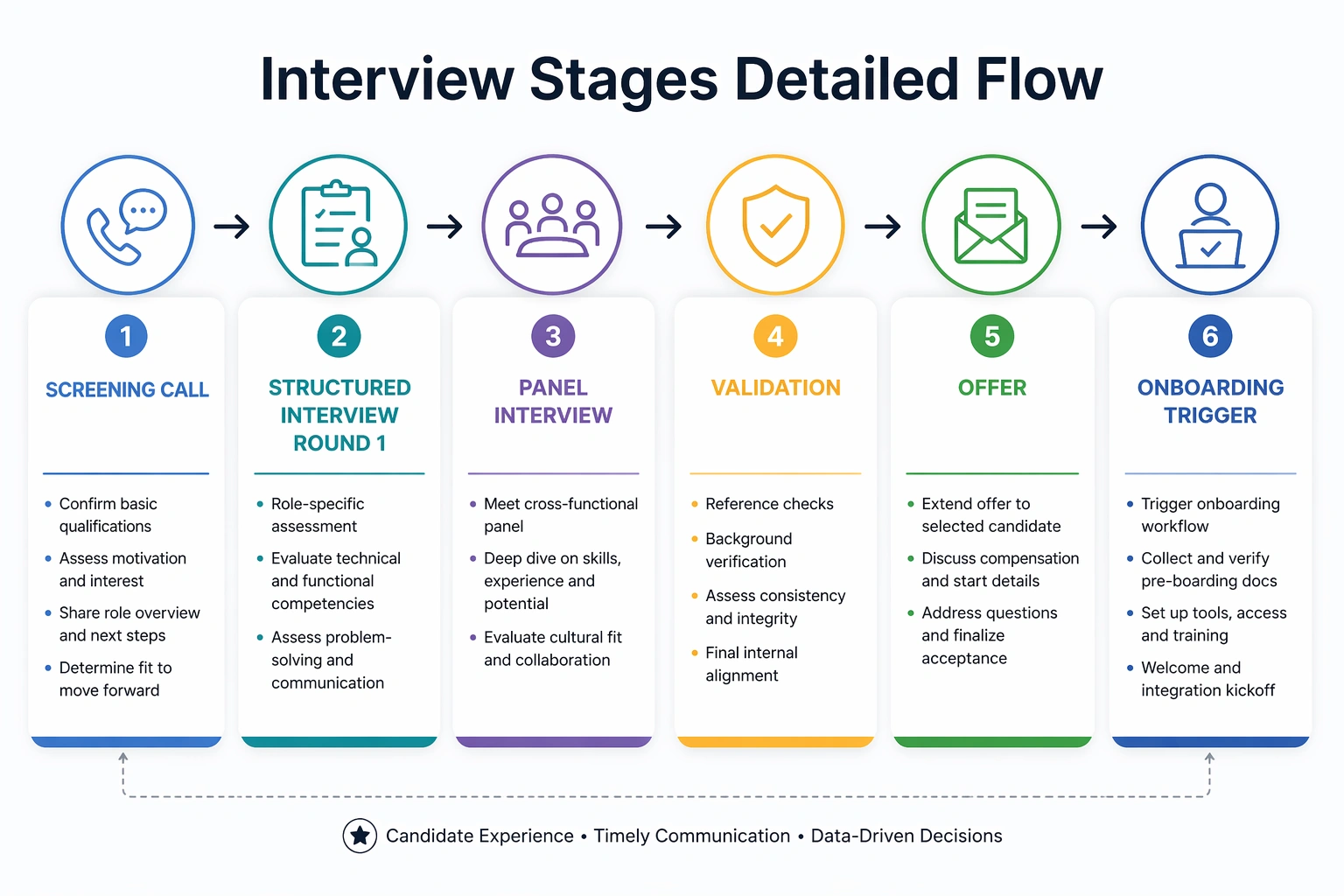
Interview Stages Explained
Interview stages should not exist because an organization has always used them. Each stage should have a clear purpose. A screening call verifies baseline fit and availability. A first structured interview evaluates core role competencies. A panel interview adds perspective from stakeholders who understand the work. A final conversation confirms expectations, compensation alignment, and practical fit before the offer is issued.
The most common mistake is repeating the same interview in different rooms with different people. That creates interviewer fatigue and candidate frustration without producing better data. Each interview stage should evaluate a different part of the hiring decision.
How to Build a Repeatable Hiring Workflow
A repeatable hiring workflow defines what happens before, during, and after each candidate interaction. The workflow should include requisition approval, intake meetings, job posting standards, screening criteria, interview scheduling, scoring rubrics, panel debriefs, reference checks, offer approvals, and onboarding handoff.
The workflow should also define decision rights. Hiring delays often happen because no one knows who has authority to move a candidate forward, reject a candidate, approve compensation, or issue the offer. A hiring workflow fails when every step requires informal permission from someone who was never clearly named as the decision owner.
Where Interviewing Fits in the Recruitment Lifecycle
Interviewing is only one part of the recruitment lifecycle. Recruiting begins before candidates apply and continues after the offer is accepted. The full lifecycle includes workforce planning, role definition, sourcing, screening, interviewing, validation, offer management, onboarding, and post-hire evaluation.
Treating interviews as the entire hiring process creates a narrow and reactive system. Strong organizations use interview data as one part of a broader talent decision. The final question is not simply whether the candidate interviewed well. The better question is whether the full process produced enough evidence to support a confident, consistent, and defensible hiring decision.
Purpose: Define responsibilities and outcomes
Owner: Hiring Manager / HR
Documentation: Job description, intake notes
Risk Reduced: Misaligned expectations
Purpose: Filter qualified candidates
Owner: HR / Recruiter
Documentation: Screening checklist
Risk Reduced: Inconsistent selection
Purpose: Evaluate competencies
Owner: Hiring Manager / Panel
Documentation: Scorecards, interview notes
Risk Reduced: Bias and subjectivity
Purpose: Confirm qualifications
Owner: HR
Documentation: References, assessments
Risk Reduced: Resume inflation
Purpose: Finalize hire and ramp-up
Owner: HR / Hiring Manager
Documentation: Offer letter, onboarding plan
Risk Reduced: Early turnover
Common Hiring Process Mistakes
Most hiring failures are not random. They usually come from process gaps that were visible before the person was hired. When organizations skip role clarity, allow inconsistent interviews, or fail to document selection criteria, the hiring decision becomes harder to defend and harder to improve.
- Starting interviews before defining the role's success criteria
- Letting each hiring manager use a different screening standard
- Asking inconsistent interview questions across candidates
- Relying on personality, confidence, or likability instead of evidence
- Failing to document interview scores and selection rationale
- Repeating the same interview stage without gathering new information
- Skipping structured reference checks
- Treating onboarding as separate from the hiring process
- Measuring success only by time-to-fill instead of quality-of-hire
Checklist: High-Quality Hiring Process
- Define clear role competencies and success criteria before recruiting begins
- Require complete intake information before opening any requisition
- Use standardized screening checklists aligned with role requirements
- Train all interviewers on the scoring system before the first interview
- Conduct structured, competency-based interviews with documented scoring
- Use panel interviews with trained evaluators for final-round candidates
- Perform structured reference checks tied to role competencies
- Complete background screening in compliance with applicable law and organizational policy
- Issue a written offer letter with clear terms before relying on verbal acceptance
- Launch a formal 30-60-90 day onboarding plan on day one
- Measure hiring quality by 90-day retention and performance, not just time-to-fill
For organizations ready to move beyond surface-level hiring tactics, the goal is engineering a recruitment lifecycle that reliably produces quality hires under pressure. Explore our Hiring Process Consulting services for hands-on redesign support. For the onboarding system that follows, see HR Onboarding Best Practices. For related documentation practices, see Employee Documentation Best Practices for Legal Defense.
Frequently Asked Questions
The five key stages are defining the role and success criteria, attracting and screening candidates, conducting structured interviews, validating qualifications through references and background checks, and making the offer followed by a formal onboarding plan.
Structured interviews reduce bias by using consistent questions and scoring tied to job competencies, increasing both the predictability of candidate success and legal defensibility if a selection decision is challenged. Unstructured interviews primarily measure how well a candidate performs in an unstructured interview, which is not the same as how well the candidate will perform in the role.
Track 90-day retention rates, early job performance against the success criteria defined in step one, and hiring manager satisfaction with new hire readiness. Time-to-fill measures process speed, not process quality. An organization can fill roles very quickly and still have a broken hiring process.
Onboarding is the final stage of the hiring process, not a separate HR event. It converts a good hire into a productive, retained employee. An organization that executes the first four stages well but neglects onboarding typically sees the hiring investment erode through early turnover in the 60-to-90-day window.
Use structured interviews with standardized questions and documented scoring criteria. Train interviewers on the specific competencies being assessed and the scoring rubric before any interviews begin. Diversify interview panels and debrief immediately after each interview. Bias reduction is an ongoing process, not a one-time training event.
The first step in the interview process is defining the role and success criteria. Before screening or interviewing candidates, the organization should document the competencies, responsibilities, reporting relationship, and measurable outcomes tied to the position.
Most hiring processes need two to four interview stages depending on role complexity. A typical process includes a screening call, a structured hiring manager interview, a panel or stakeholder interview, and a final confirmation conversation before the offer.
A recruitment process flow usually describes how candidates move from sourcing through offer. A hiring workflow is broader because it also defines internal ownership, decision authority, documentation requirements, interview scoring, approval points, and onboarding handoffs.
Related HR Questions, Answered
Direct answers from our HR FAQ library for Texas employers: