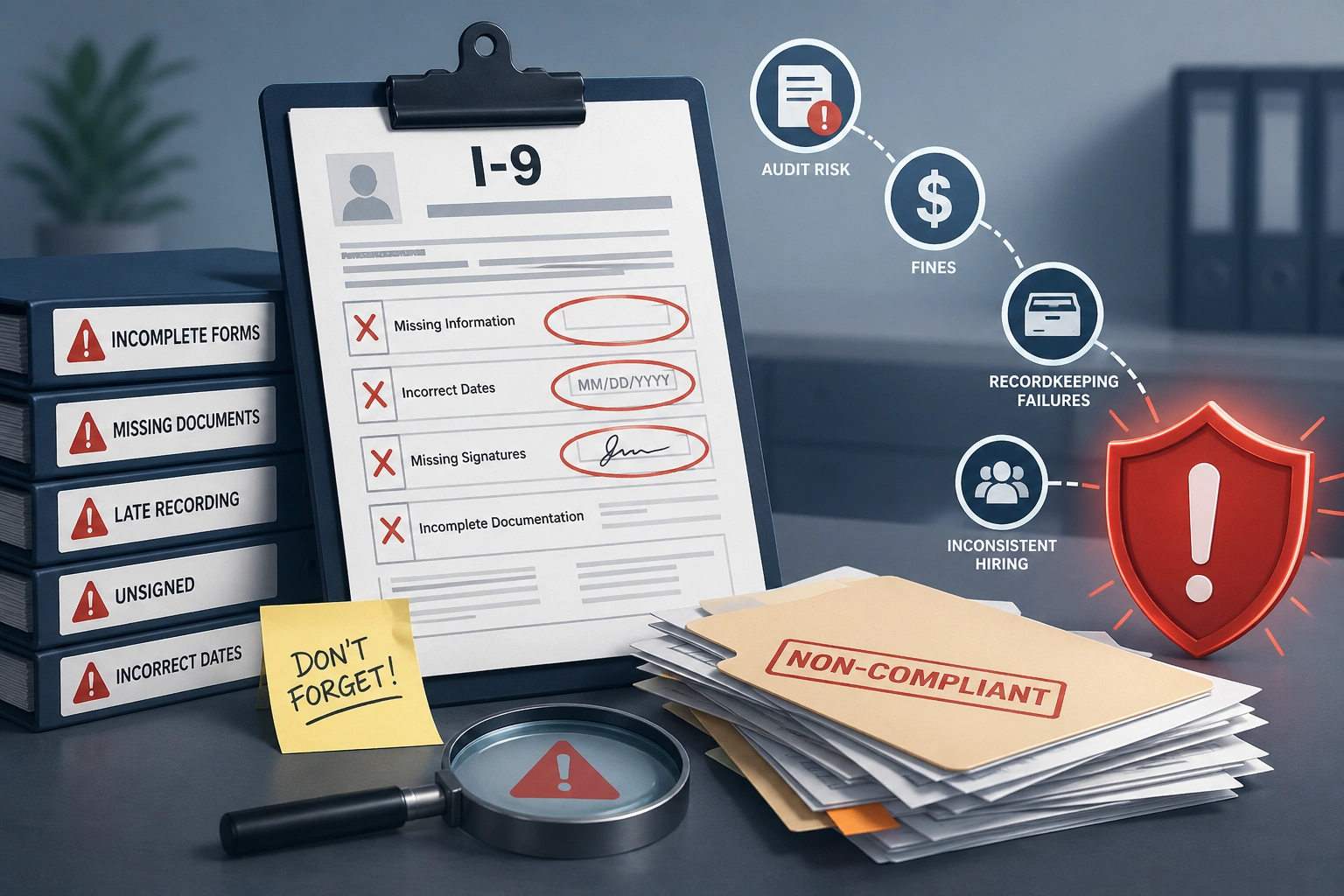
Most I-9 compliance mistakes do not happen because employers are trying to avoid the law. They happen because the hiring process relies on memory, inconsistent handoffs, untrained supervisors, outdated forms, and no audit rhythm. That is the dangerous part. The mistake looks small until an inspection turns one missing field into a pattern of noncompliance.
The most common I-9 form mistakes include missing Section 1 information, late Section 2 completion, accepting incorrect documents, failing to reverify temporary work authorization, using outdated forms, storing I-9s improperly, and failing to conduct internal audits. These errors create legal and financial exposure even when the employee is authorized to work.
What Is I-9 Compliance?
Form I-9 compliance is the employer’s process for verifying the identity and employment authorization of each new employee hired in the United States. The employee completes Section 1. The employer or authorized representative completes Section 2 after reviewing acceptable documents. Employers must retain the form and make it available during an authorized inspection.
The form itself is simple. The system around the form is where employers fail. Hiring managers rush. HR assumes the manager completed the task. The manager assumes HR completed the task. No one checks until the audit notice arrives.
Core I-9 Timing Rules
- Section 1: The employee completes Section 1 no later than the first day of employment for pay.
- Section 2: The employer completes Section 2 within three business days after the employee’s first day of employment.
- Retention: Employers retain Form I-9 for three years after hire or one year after termination, whichever date is later.
Primary compliance references: USCIS Form I-9, 8 CFR Part 274a, and ICE Form I-9 Inspection Guidance.
Why I-9 Form Mistakes Matter
I-9 mistakes are not harmless clerical errors. They create inspection exposure, penalty risk, and evidence that the organization lacks basic HR compliance infrastructure. The issue becomes larger when the same error appears across multiple employees, locations, departments, or time periods.
That is why I-9 compliance belongs inside a broader HR compliance consulting strategy rather than a one-time file cleanup. If the process keeps producing bad forms, the organization does not have a form problem. It has a workflow problem.
The Real Problem
I-9 risk usually comes from inconsistent execution. One manager completes the form correctly. Another misses the deadline. A third accepts the wrong document. The organization then calls the issue “human error” instead of admitting the system was never designed to produce consistent compliance.
Common I-9 Form Mistakes Employers Make
1. Missing or Incomplete Section 1 Information
Section 1 must be completed by the employee no later than the first day of employment for pay. Common mistakes include missing signatures, missing dates, incorrect citizenship or immigration status selections, blank required fields, and incomplete preparer or translator information when assistance was used.
Employers should review Section 1 for completeness without telling employees which status to select or which documents to present. The employer’s role is process control, not document steering.
2. Completing Section 2 Late
Section 2 must be completed within three business days after the employee’s first day of employment. Late completion is one of the easiest I-9 mistakes to prevent and one of the clearest signs that the hiring workflow has no control point.
If the start date is Monday, the employer should not be discovering the missing Section 2 two weeks later while cleaning up onboarding paperwork.
3. Accepting the Wrong Combination of Documents
Employees may present one document from List A or one document from List B plus one document from List C. A common employer mistake is accepting an improper combination, asking for more documents than required, accepting expired documents when not permitted, or recording document information in the wrong area.
Over-documentation is not safer. It can create discrimination risk. The employer should verify documents that reasonably appear genuine and relate to the employee, but the employer should not demand specific documents unless the law requires a specific process.
4. Using an Outdated Version of Form I-9
USCIS updates Form I-9 periodically. Employers using old onboarding packets often continue circulating outdated versions without realizing it. That is a preventable compliance failure.
Any organization using paper packets, saved PDF folders, shared drives, or old onboarding checklists should assign one HR owner to verify the current I-9 version at least quarterly.
5. Missing Employer Business Information
Section 2 requires employer information and certification. Missing the employer name, address, representative signature, title, or date creates avoidable exposure. These mistakes usually happen when managers complete I-9s without training or when HR reviews forms only after onboarding is already complete.
6. Backdating Late or Missing Forms
Backdating is not a correction. It is a new problem.
If an I-9 is late, complete the form using the actual date of completion and document the reason for the late completion. A clean correction trail is far better than a false timeline. Employers should never erase, conceal, or rewrite history to make a compliance problem look better than it is.
7. Correcting Errors Improperly
Improper corrections can make a fix look suspicious. Employers should not use white-out, erase entries, or obscure the original information. A better correction process is to draw a line through the incorrect entry, enter the correct information, initial the correction, and date the correction.
When errors are widespread, conduct a structured HR audit rather than fixing forms casually as they are discovered.
8. Missing Reverification Deadlines
Employees with temporary work authorization may require reverification. Employers often miss this requirement because no one tracks expiration dates after onboarding.
That is not a paperwork failure. That is a calendar failure. The fix is a controlled tracking system with a named owner, scheduled reminders, and a defined escalation process.
9. Keeping I-9s Too Long or Destroying Them Too Early
Employers must retain Form I-9 for three years after the date of hire or one year after employment ends, whichever is later. Keeping forms forever creates unnecessary audit exposure. Destroying forms too early creates compliance exposure.
A retention schedule should be built into the offboarding workflow, not left to someone’s memory.
10. Storing I-9 Forms in Personnel Files
Storing I-9s in personnel files makes inspections harder and exposes unrelated personnel information during document review. Best practice is to keep I-9 records separate from general personnel files, whether stored electronically or physically.
For broader recordkeeping structure, review employee documentation best practices for legal defense.
11. Mishandling Remote Verification
Remote work changed hiring workflows, but it did not eliminate employer accountability. Employers using authorized representatives or remote verification procedures need a defined process, not a casual email asking someone to “look at the documents.”
Remote verification should include instructions, quality review, deadline tracking, and documentation standards.
12. Never Conducting Internal I-9 Audits
The worst I-9 mistake is assuming no news means no risk. Without internal review, mistakes accumulate quietly across years of hiring.
A basic audit should check whether each active employee has an I-9, whether terminated employee forms are retained or destroyed according to the retention rule, whether Section 1 and Section 2 are complete, whether reverification was handled properly, and whether errors were corrected correctly.
I-9 Mistake Table: Risk and Fix
Common I-9 Mistakes and Practical Fixes
| Mistake | Risk | Practical Fix |
|---|---|---|
| Late Section 2 completion | Clear timing violation | Add I-9 completion to the first-week onboarding control checklist |
| Missing signatures or dates | Incomplete form | Require HR review before onboarding file closure |
| Wrong document combination | Verification error | Train authorized reviewers on List A, List B, and List C rules |
| No reverification tracking | Expired work authorization risk | Use a centralized tracking log with deadline alerts |
| Improper storage | Audit inefficiency and broader record exposure | Store I-9s separately from personnel files |
| No internal audit | Errors compound over time | Conduct scheduled I-9 reviews at least annually |
How to Fix I-9 Compliance Mistakes
Identify the Scope of the Problem
Do not fix one form and assume the issue is resolved. Pull a sample across departments, job types, hiring managers, and hire dates. Determine whether the error is isolated or systemic.
Correct Errors Transparently
Use a correction method that preserves the original entry. Date and initial corrections. Never backdate. If a form was completed late, document the actual completion date and the reason for the delay.
Assign One Process Owner
I-9 compliance should not float between HR, payroll, supervisors, and department heads. Assign one accountable owner and define who is authorized to review documents.
Build Controls Into Hiring
Make I-9 completion a required onboarding gate. The process should not depend on someone remembering after the employee has already started work.
Audit the Process Regularly
Internal I-9 audits should be scheduled, documented, and repeated. The goal is not cosmetic cleanup. The goal is to prove the system now produces compliant records consistently.
Internal I-9 Audit Checklist
Use this checklist before an external audit forces the issue.
- Confirm every active employee has a completed Form I-9.
- Verify Section 1 was completed no later than the first day of employment for pay.
- Verify Section 2 was completed within three business days after the first day of employment.
- Check employee signatures, employer signatures, dates, and required fields.
- Confirm acceptable document information is entered correctly.
- Review whether any employee requires reverification.
- Confirm reverification dates are tracked in a centralized system.
- Separate I-9 records from general personnel files.
- Apply the retention rule to terminated employee records.
- Correct errors transparently and document the correction process.
- Train anyone authorized to complete Section 2.
- Update onboarding checklists to prevent the same errors from returning.
Audit Rule
If the same I-9 mistake appears more than once, do not treat it as a typo. Treat it as a process defect.
I-9 Compliance Mistakes in Small Businesses
Small businesses often carry higher I-9 risk because hiring processes are informal. One person handles recruiting, payroll, onboarding, benefits, and compliance. That arrangement works until volume increases or the organization crosses a regulatory threshold that makes informal HR practices too fragile.
For growing employers, I-9 compliance should be part of a larger HR infrastructure build. The same system that controls I-9 completion should also control onboarding, document retention, policy acknowledgment, and required notices. For support with broader HR infrastructure, review small business HR consulting in Texas.
I-9 Risk in Municipalities and Nonprofits
Municipalities and nonprofits often face a different version of the same problem: limited staff, decentralized departments, and supervisors who were never trained to manage employment compliance. A public works department, library, utility crew, administrative office, and seasonal program may all touch hiring differently.
That variation is where I-9 mistakes grow. Public sector and nonprofit employers need standardized hiring controls that survive turnover, department differences, budget constraints, and leadership changes.
Related support: public sector HR consulting and nonprofit HR consulting in Texas.
When Outside HR Compliance Help Makes Sense
Outside help makes sense when I-9 records are scattered, errors appear across multiple files, managers complete forms inconsistently, reverification is not tracked, or leadership is unsure whether the organization could respond confidently to an inspection.
Faulkner HR Solutions supports Texas employers through HR compliance audits, I-9 process reviews, documentation cleanup, onboarding workflow improvement, and compliance infrastructure development. The goal is not more paperwork. The goal is a system that produces defensible records under pressure.
For a broader compliance review, start with HR audit consulting. For ongoing compliance support, review HR compliance consulting in Texas. For hiring workflow cleanup, review hiring process consulting.
Frequently Asked Questions
The most common I-9 form mistakes include missing employee information, late Section 2 completion, missing signatures, incorrect document entries, failure to reverify temporary work authorization, and poor retention practices.
The employer or authorized representative must complete Section 2 within three business days after the employee’s first day of employment.
Yes. Employers can correct many I-9 errors, but corrections should preserve the original entry, include the corrected information, and be initialed and dated. Employers should not backdate or conceal errors.
Best practice is to store I-9 forms separately from personnel files. Separate storage makes audits cleaner and reduces unnecessary exposure of unrelated employee records.
Employers must retain Form I-9 for three years after the date of hire or one year after employment ends, whichever date is later.
At minimum, employers should review I-9 records annually and after major hiring changes, HR staff turnover, mergers, system changes, or growth into new locations.