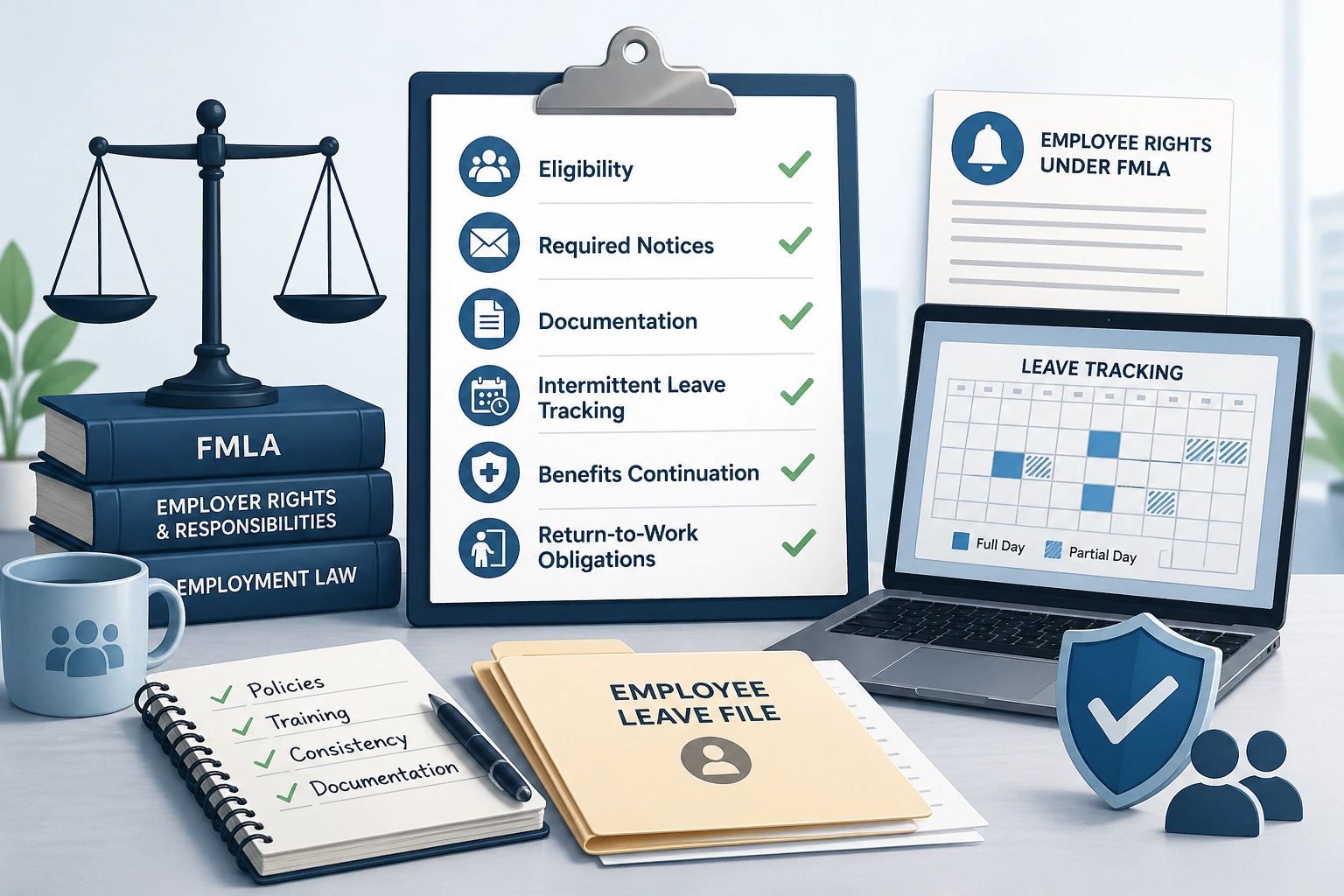
Most employers do not fail FMLA compliance because they ignore the law. They fail because their process cannot execute the law consistently. The handbook says one thing. The supervisor says another. The spreadsheet misses a deadline. The employee asks for leave in plain language, and nobody recognizes that the request may trigger FMLA. That is how exposure starts.
FMLA compliance requirements are not just legal requirements. They are operational controls. Covered employers need a system for recognizing leave triggers, determining eligibility, sending notices, collecting certifications, tracking leave, preserving benefits, managing intermittent absences, documenting communications, and restoring employees correctly. If any part of that process depends on memory or supervisor improvisation, the organization has a compliance weakness.
FMLA compliance requirements require covered employers to provide eligible employees with job-protected leave, continue group health benefits, provide required FMLA notices, track leave accurately, maintain documentation, prevent interference or retaliation, and restore employees to the same or an equivalent position after leave.
What Is FMLA?
The Family and Medical Leave Act is a federal law that provides eligible employees of covered employers with unpaid, job-protected leave for qualifying family and medical reasons. The law also requires continuation of group health benefits under the same conditions that would have applied if the employee had not taken leave.
In practical employer terms, FMLA is a protected leave framework. It controls eligibility, notice obligations, documentation, job restoration, benefits continuation, and the way employers respond when an employee needs leave for a qualifying reason.
The mistake is treating FMLA as a single HR form. FMLA is a sequence of controlled steps. When those steps are not mapped, assigned, tracked, and audited, compliance becomes luck.
Which Employers Must Comply With FMLA?
FMLA applies to covered employers. Covered employers generally include private-sector employers with 50 or more employees, public agencies, and public or private elementary and secondary schools.
For private-sector employers, the 50-employee threshold is the point where informal leave practices become much more dangerous. Growing businesses often reach this threshold before they have the HR infrastructure to manage it. That is the compliance cliff: the law changes before the internal system catches up.
For public agencies, including many municipalities, FMLA coverage can apply regardless of size. That makes public-sector HR especially vulnerable when supervisors have not been trained to recognize FMLA triggers or route leave requests through a controlled process.
Private employers should begin building FMLA infrastructure before hitting 50 employees.
Who Is Eligible for FMLA Leave?
An employee is generally eligible for FMLA leave when the employee meets three requirements:
- The employee has worked for the employer for at least 12 months.
- The employee has worked at least 1,250 hours during the 12 months before leave begins.
- The employee works at a location where the employer has at least 50 employees within 75 miles.
The 12 months of employment do not always need to be consecutive. The 1,250-hour requirement is based on hours of service during the 12 months immediately before the leave begins. Employers should not guess. Eligibility should be verified using payroll and employment records.
The operational problem is simple: if eligibility review is informal, the employer may approve leave incorrectly, deny leave incorrectly, or fail to provide required notices on time. Every eligibility review should follow the same checklist.
| Eligibility Requirement | Employer Review Question | Common Process Failure |
|---|---|---|
| 12 months of employment | Has the employee worked for the employer for at least 12 months? | HR relies on hire date alone and fails to review breaks in service or prior employment history. |
| 1,250 hours worked | Has the employee worked at least 1,250 hours in the 12 months before leave begins? | Supervisors estimate eligibility instead of verifying payroll records. |
| 50 employees within 75 miles | Does the employee work at a covered worksite? | Multi-location employers fail to evaluate the 75-mile rule correctly. |
What Reasons Qualify for FMLA Leave?
Eligible employees may use FMLA leave for qualifying family and medical reasons. Common qualifying reasons include:
- The employee’s own serious health condition.
- Care for a spouse, child, or parent with a serious health condition.
- Birth of a child and bonding with the child.
- Placement of a child for adoption or foster care.
- Qualifying military exigency leave.
- Military caregiver leave for a covered servicemember.
Most employers recognize obvious requests. The hard cases are indirect. An employee does not have to say “FMLA” to trigger employer obligations. A statement such as “I need time off for surgery,” “my doctor says I need ongoing treatment,” or “I need to care for my parent after hospitalization” may be enough to put the employer on notice that FMLA could apply.
That is why supervisor training matters. Supervisors do not need to become FMLA experts. They need to recognize possible triggers and send the issue to HR immediately.
Core FMLA Compliance Requirements for Employers
FMLA compliance requirements can be organized into eight practical employer obligations. Each requirement needs a defined owner, timeline, documentation standard, and audit method.
1. Provide Job-Protected Leave
Covered employers must provide eligible employees with up to 12 workweeks of job-protected FMLA leave in a 12-month period for most qualifying reasons. Military caregiver leave may provide up to 26 workweeks in a single 12-month period.
2. Continue Group Health Benefits
Employers must maintain group health benefits during FMLA leave under the same terms that would have applied if the employee had continued working. This means the employer must avoid treating protected leave as a reason to reduce or terminate coverage improperly.
3. Provide Required FMLA Notices
Employers must provide required FMLA notices at the correct time. Notice failures are one of the most common preventable compliance gaps because they are easy to miss when no tracking system exists.
4. Manage Medical Certification Properly
Employers may request appropriate certification when allowed. The process must be consistent. Employers should avoid over-requesting medical details, accepting incomplete records without follow-up, or allowing supervisors to collect medical information directly.
5. Track Leave Accurately
Employers must track FMLA usage accurately, especially for intermittent leave. A weak tracking process can result in over-designation, under-designation, inconsistent enforcement, and disputes over remaining leave balances.
6. Prevent Interference and Retaliation
Employers cannot interfere with an employee’s FMLA rights or retaliate against an employee for using protected leave. This includes subtle forms of retaliation such as negative scheduling changes, punitive attendance points, hostility from supervisors, or performance action tied to protected absences.
7. Restore the Employee Correctly
At the end of FMLA leave, the employee must generally be restored to the same or an equivalent position. Equivalent means substantially similar pay, benefits, working conditions, schedule, status, and responsibilities.
8. Maintain Complete Records
Employers should maintain leave requests, notices, certifications, communications, leave calculations, benefit records, return-to-work documents, and any related employment decisions. Documentation protects decisions. Missing documentation weakens them.
Required FMLA Notices Employers Must Provide
FMLA notice requirements are where many employers lose control. The law creates specific notice obligations. The employer process must make those obligations automatic.
| Notice | Purpose | Employer Risk if Missed |
|---|---|---|
| General Notice | Informs employees of FMLA rights through posting and policy communication. | Employees may argue they were not informed of their rights. |
| Eligibility Notice | Tells the employee whether the employee is eligible for FMLA leave. | Late or inconsistent eligibility communication can create disputes. |
| Rights and Responsibilities Notice | Explains employee obligations, certification requirements, substitution of paid leave, and related responsibilities. | The employee may not know what documentation or steps are required. |
| Designation Notice | Informs the employee whether leave is approved and designated as FMLA-protected. | The employer may lose control over how leave is counted and documented. |
The eligibility notice generally must be provided within five business days after the employer learns that leave may be for an FMLA-qualifying reason. That deadline should be built into the leave workflow with a tracking alert, not left to someone’s inbox.
FMLA Documentation Requirements
FMLA documentation is not paperwork for paperwork’s sake. It is the evidence trail that shows the employer handled leave correctly.
Employers should maintain documentation covering:
- The original leave request or triggering communication.
- Eligibility determination.
- Rights and responsibilities notice.
- Medical certification or qualifying documentation.
- Designation notice.
- Leave start date, leave type, and leave schedule.
- Intermittent leave usage and remaining balance.
- Benefit continuation and premium payment communication.
- Return-to-work status and fitness-for-duty requirements when applicable.
- Supervisor communications related to scheduling, coverage, and protected absences.
Medical documentation should be stored separately from general personnel records. Access should be limited. Supervisors should not keep medical details in desk files, email chains, or informal notes.
For a deeper documentation framework, review Employee Documentation Best Practices for Legal Defense.
Intermittent FMLA Leave Requirements
Intermittent FMLA leave is where weak systems show themselves quickly. An employee may need leave in separate blocks of time due to a qualifying reason rather than one continuous absence. That requires more precise tracking, stronger supervisor communication, and clear attendance coding.
Employers should define how intermittent leave will be requested, recorded, coded, reviewed, and reconciled. A supervisor should know whether an absence is protected before discipline, attendance points, or scheduling consequences are applied.
Do not let intermittent FMLA live only in a supervisor’s calendar.
At minimum, intermittent FMLA tracking should include the date of each absence, amount of leave used, reason category, balance remaining, documentation status, and whether the absence was properly designated.
Return-to-Work and Job Restoration Requirements
FMLA compliance does not end when the employee returns. The return-to-work process carries its own risk.
The employee generally must be restored to the same job or an equivalent job. Equivalent means more than “similar enough.” The role must be substantially equivalent in pay, benefits, shift, location, schedule, status, responsibility, and working conditions.
Common return-to-work mistakes include:
- Changing the employee’s schedule because the absence was inconvenient.
- Reducing responsibilities without a documented legitimate reason.
- Assigning the employee to a less desirable role after leave.
- Counting protected FMLA absences against the employee in attendance discipline.
- Failing to evaluate ADA accommodation obligations after FMLA ends.
The FMLA return-to-work process should connect with ADA, workers’ compensation, fitness-for-duty, and performance management workflows. These systems should not operate in separate silos.
FMLA, ADA, Workers’ Compensation, and Paid Leave Overlap
One of the biggest compliance mistakes employers make is treating FMLA as isolated. FMLA often overlaps with the ADA, workers’ compensation, short-term disability, paid sick leave, PTO, and internal leave policies.
For example, an employee may exhaust FMLA but still need ADA accommodation review. Another employee may have a workplace injury that triggers workers’ compensation and also qualifies for FMLA. A third employee may use PTO concurrently with FMLA depending on policy and applicable rules.
The employer needs a leave coordination process that answers four questions:
- What laws or policies may apply?
- Which protections are running at the same time?
- What notices and documentation are required?
- Who owns the next decision point?
If those questions are not answered consistently, the employer is not managing leave. The employer is reacting to leave.
Common FMLA Compliance Mistakes
Most FMLA compliance mistakes are preventable. They usually happen because the organization relies on judgment where the process should provide control.
Mistake 1: Treating FMLA as a Policy Instead of a Workflow
A policy tells people what should happen. A workflow makes sure it happens. Employers need intake forms, notice templates, deadline tracking, certification review, designation steps, leave balance tracking, and return-to-work controls.
Mistake 2: Letting Supervisors Interpret FMLA
Supervisors should not decide whether FMLA applies. They should recognize potential triggers and escalate immediately. That boundary protects the organization and the supervisor.
Mistake 3: Missing Notice Deadlines
Notice deadlines are not optional. If the employer misses the eligibility or designation process, the employer creates avoidable disputes over whether leave was properly handled.
Mistake 4: Applying Certification Rules Inconsistently
One employee is required to provide documentation. Another is not. One certification is challenged. Another incomplete certification is accepted. That inconsistency becomes evidence.
Mistake 5: Failing to Track Intermittent Leave
Intermittent leave requires discipline. Each absence must be coded correctly, deducted accurately, and reviewed consistently.
Mistake 6: Allowing Retaliation Through Attendance or Scheduling Decisions
Retaliation is not always dramatic. Sometimes it looks like an attendance point, a colder schedule, a denied opportunity, or a supervisor comment that should never have been said out loud.
Mistake 7: Mishandling Return-to-Work
The return-to-work step needs the same discipline as the leave approval step. Job restoration, fitness-for-duty, accommodation review, and supervisor communication should be mapped in advance.
FMLA Compliance Checklist for Employers
Use this checklist to evaluate whether your FMLA process is built to hold under pressure.
- Confirm whether the organization is a covered employer.
- Verify employee eligibility using service, hours, and worksite criteria.
- Train supervisors to recognize potential FMLA triggers.
- Centralize leave intake through HR or a designated leave owner.
- Provide the eligibility notice within the required timeframe.
- Provide the rights and responsibilities notice.
- Request and review certification consistently when applicable.
- Issue the designation notice when leave is approved or denied.
- Track continuous and intermittent FMLA leave accurately.
- Continue group health benefits correctly during leave.
- Maintain medical documentation separately from personnel files.
- Protect employees from interference, retaliation, and attendance penalties tied to protected leave.
- Coordinate FMLA with ADA, workers’ compensation, PTO, and disability benefits when applicable.
- Restore employees to the same or an equivalent position after leave.
- Audit FMLA files periodically for missing notices, incomplete certifications, and tracking errors.
A Practical FMLA Compliance Process Framework
Employers do not need a complicated system. They need a controlled one. The following framework keeps the process clear enough for small HR teams, municipalities, nonprofits, and growing businesses.
Recognize the Trigger
Train supervisors to recognize language that may indicate an FMLA-qualifying reason. Employees do not need to use the phrase “FMLA.” The process should begin when the employer has enough information to know leave may qualify.
Verify Eligibility
Use a standard checklist to verify 12 months of service, 1,250 hours worked, and the applicable worksite coverage rule. Do not estimate eligibility based on memory.
Send Required Notices
Provide eligibility, rights and responsibilities, and designation notices using standard templates. Track the date each notice is issued.
Track and Manage the Leave
Track leave usage, certification status, benefits continuation, supervisor scheduling communication, and remaining leave balances. Intermittent leave requires special attention.
Restore, Review, and Audit
Coordinate return-to-work, confirm job restoration, evaluate ADA overlap if needed, and audit the file for documentation completeness.
FMLA Compliance for Texas Employers
Texas employers covered by FMLA must comply with federal FMLA requirements. For Texas municipalities, nonprofits, and growing businesses, the practical issue is usually not whether FMLA exists. The issue is whether the employer has a consistent system for applying it.
Texas employers should pay particular attention to:
- Public-sector coverage and municipal leave practices.
- ADA accommodation review after FMLA exhaustion.
- Workers’ compensation overlap.
- Supervisor communication in small departments where absences are highly visible.
- Documentation discipline in organizations without dedicated leave administrators.
- Policy alignment between handbooks, payroll practices, and actual leave administration.
For broader Texas compliance support, review HR compliance consulting in Texas and HR compliance services in Texas.
When to Audit Your FMLA Process
Employers should audit FMLA administration before a complaint, termination dispute, or agency inquiry forces the issue. The best time to find a missing notice is before the file becomes evidence.
An FMLA process audit should review:
- Whether FMLA triggers are recognized consistently.
- Whether eligibility determinations are documented.
- Whether notices are timely and complete.
- Whether certifications are handled consistently.
- Whether intermittent leave balances are accurate.
- Whether supervisors understand what they can and cannot say.
- Whether return-to-work decisions are documented and defensible.
- Whether FMLA, ADA, workers’ compensation, and paid leave are coordinated properly.
For a broader audit structure, see HR audit consulting. If the issue is part of a larger HR workflow breakdown, review HR process improvement.
When Outside FMLA Compliance Support Makes Sense
Outside support makes sense when FMLA cases are handled differently by department, supervisors are unsure what to escalate, documentation is incomplete, intermittent leave tracking is messy, or leadership only discovers leave problems after an employee relations issue escalates.
Faulkner HR Solutions helps Texas organizations build FMLA compliance infrastructure that can actually be used by real people under real workplace pressure. That includes workflow audits, leave process mapping, supervisor routing guides, documentation standards, policy alignment, and implementation support.
The goal is not more HR paperwork. The goal is a leave process that protects employees, protects the organization, and does not depend on one exhausted person remembering every deadline.
Schedule a no-obligation strategy call or call 210.446.8730 to review your FMLA process and identify where compliance risk is building.
Frequently Asked Questions
FMLA compliance requirements require covered employers to provide eligible employees with job-protected leave, continue group health benefits, provide required notices, track leave accurately, maintain documentation, prevent interference or retaliation, and restore employees to the same or an equivalent position after leave.
Covered employers generally include private-sector employers with 50 or more employees, public agencies, and public or private elementary and secondary schools. Private employers approaching 50 employees should build FMLA infrastructure before the threshold creates compliance obligations.
No. An employee does not need to use the phrase “FMLA.” If the employer has enough information to know leave may be for a qualifying reason, the employer should begin the FMLA review process.
Employers must provide a general FMLA notice, eligibility notice, rights and responsibilities notice, and designation notice. These notices should be built into a standard leave workflow with date tracking.
The biggest mistake is treating FMLA as a handbook policy instead of a controlled workflow. Most failures happen when intake, notice deadlines, certification, intermittent tracking, supervisor communication, and return-to-work steps are handled inconsistently.
Texas employers covered by federal FMLA must comply with federal FMLA requirements. Employers should also coordinate FMLA with ADA, workers’ compensation, wage and hour, attendance, benefits, and internal leave policies.