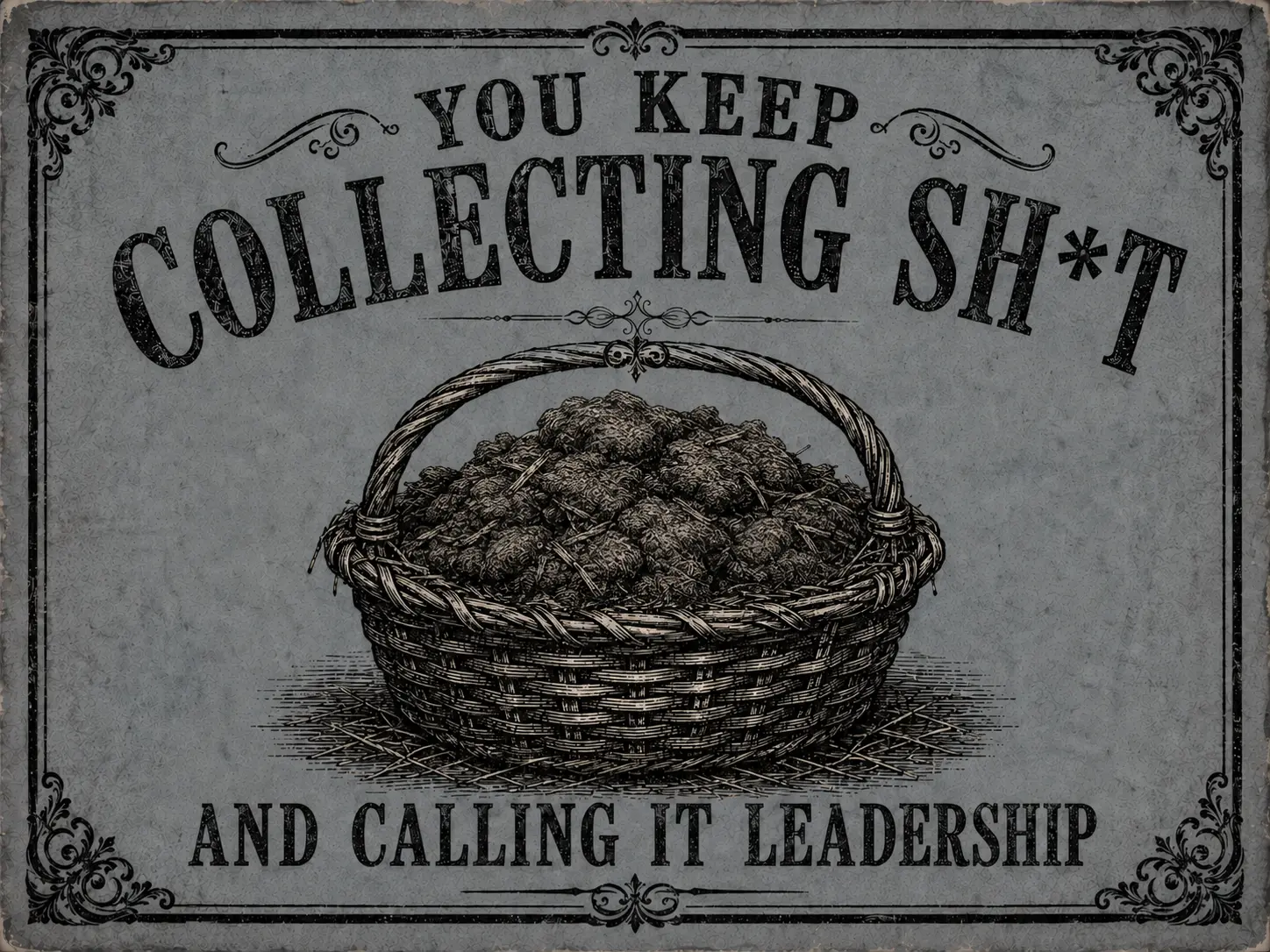
One of my favorite stories to tell when I am put on the spot for leadership advice is the tale of The Stupid Chicken Farmer. Ajahn Brahm, a British-born Buddhist monk, introduces our poultry protagonist and his smarter chicken-farmer neighbor. He describes how the farmer walks into the chicken shed, grabs the manure instead of the eggs, brings it into the house, and then complains about the smell. What a stupid chicken farmer you are, said his wife and kids. You bring us shit and leave the eggs in the shed.
I love this story because the mistake is so obvious. You do not need special training to see what went wrong. The farmer did not just have a rough day; he missed what was valuable right in front of him by taking the easiest thing to grab, bringing it where it did not belong, and then acting surprised when it made everything smell bad and everyone angry.
The reason this story sticks with me is that I have seen leaders do something similar (not literally grabbing shit, well, we hope not anyway) after things go wrong at work. When a problem comes up on the job, instead of taking time to understand what is really going on, leaders often grab the most obvious or emotional part and focus on that. They collect stories about the bad employee, the weak supervisor, the toxic department, and the broken culture, and start mythologizing the workforce failures into something much larger than they are. People are lazy and not driven enough to want to be accountable anymore. These are the narratives leaders bring into their meetings, performance reviews, and executive discussions, and they even shape how they see themselves as leaders. This, in turn, stifles progress in figuring out the real issue and just shows everyone the problem they are carrying.
Before the naysayers start clearing their throats, let me drag the elephant into the middle of the room and say out loud that I’m not arguing that your experiences are not real. Dysfunction can result from more than just your organization’s design. Sometimes it really is just as simple as the person you put in the role. So, no, I’m not asking that you go around pretending that the mess in your business is imaginary. I am, however, positioning myself to argue that your interpretation of the mess may not always be the whole story, and if you stop at the most emotionally satisfying explanation every time, I guarantee you that you will miss the thing your organization actually needs to fix.
Hunting the Good Stuff Is Not Enough
As a junior soldier in the military, I remember that once every quarter or so, or whenever the First Sergeant or LT realized we were out of compliance with our annual training, we would gather at the Division Headquarters and participate in MRT. MRT stands for Master Resilience Training, and it teaches soldiers to 'hunt the good stuff.' While junior soldiers only have COB and the weekend's plans in mind, the overall construction of the training didn’t stick, but the central idea was that we don’t let negative experiences cloud the experiences that can shape and mold us. Think: trying to see what is still useful and what can make you stronger, instead of just focusing on what went wrong. And while that philosophy helped me develop a novel understanding of the topic, Ajahn Brahm’s story works better for leadership because it is more honest, viscerally and waaay less polished. In real organizations, people do not just miss the good; they often hold onto the bad because it gives them something to blame. It gives them a person to point at, a villain, and a reason to stop searching for real answers.
Blame is such a tempting seductress for leaders. Its lace dress (or axe-wielding, plaid-wearing lumberjack vibes) masks emotional security and closure behind quick decisions and personal culpability. It gives leaders the right to say, 'We had a performance issue, and we addressed it,' and while that might sound like an appropriate response, it also undermines by avoiding the harder work of figuring out the real problem. As leaders, it is essential for us to understand that process is not equal to proof, and that a seamless execution of employee discipline can give you a clean file in exchange for solving the wrong problem.
This is the point in the article where, reflectively, I ask you to hold a mirror up to yourself and evaluate the current state of your organization, and the processes and procedures you allow to run through it to create value streams. This question right here amplifies the room's temperature, and the personal stasis of professional comfort starts to curdle and spoil with the heat. In repeated patterned processes where you can admit to yourselves, out loud, that process is not proof, the issue unhinges from employee accountability and starts crawling back to how you designed the workflow, formulated the metrics around your interpretation of success, tailored custom training systems, and positioned every people-oriented leadership decision impacting your operations. Again, we don’t hold harmless the employee as an innocent bystander, but in the same breath, we don’t afford you that opportunity either.
What They Picked Up Instead
Anyone who has actually run an operation, and I mean actually boots on the ground operating the helm of a business’ profitability and success, not described it in a board deck or simulated it on the PS5, knows there is a difference between operating capacity and maximum capacity, even if nobody ever made them say the words out loud. Maximum capacity is the magic number that everyone strives for. It’s the unicorn occurrence that businesses optimize for when every variable lines up and behaves itself accordingly. You’ll have instances where nobody calls out sick, no client cancels, compliance doesn't drag, the referral stream keeps flowing, and not a single human being in the building does the inconvenient thing of acting like a human being and operating sub-optimally. The more unglamorous number is the one where most businesses actually perform work. Operating capacity is the system's ability to sustain over time without quietly setting fire to the people doing the work, the quality of what they produce, or the rules that make any of it legitimate in the first place.
That distinction should have meant something to a behavioral health agency I know of before it decided, the way struggling organizations so often do, to take a profitability problem and rename it a clinician discipline problem.
And look, I can completely empathize with the business leaders in those seats and how they made the difficult decisions that put them there. I’m not playing armchair quarterback with 20/20 hindsight vision. Two consecutive quarters in the red and a board that wants that trend to shift the opposite way. There is nothing strange about a CEO, board, or stressed-out finance director staring at accounts payable, hungry vendors, payroll pressure, and thin margins and saying the organization needs more profitability, more billable hours, and better productivity.
I’m the last person who is going to stand here and tell you that payroll is a charity and that your business will run on goodwill and ambition. The failure was not that leadership cared about margins or the bottom line, but that leadership looked at the capacity it desperately needed and not what the operation could reasonably produce.
So the pressure from these metrics rolled downhill and landed on the lowest-standing members. Every service-providing role from peer support specialists to qualified mental health professionals, benefit coordinators, and licensed therapists was handed a strict billable-hour target. That target was stapled to every employee's performance reviews and monthly counseling statement with the starched message attached, saying hit the number, or the discipline starts.
From the comfort of a conference room, I'm sure this felt like a level of accountability, wore the cologne of grown-up management: clear expectations paired with even clearer consequences and a documented paper trail of monthly and quarterly verbal conversations to prove everybody did their job.
And you can argue that the solution smelled sweet in the room, but it could not cover the odor of bad math of holding the target up against the clinic’s actual operating capacity to see whether it could survive contact with reality.
As much as I had hoped my consulting entrance would have started before this story, I can save you the suspense and say I was called in for cleanup; however, here’s the vignette I use and teach from. The case begins with one of the clinicians starting to fall behind on their projected monthly productivity, and the supervisor responded exactly the way the system had trained them to respond. And I’m not sure what bothers me the most: the more damning issue that the process worked so consistently inside a broken system, or that everyone mistook that consistency for competence.
As you would have expected, out came the verbal warning, then the written warning, then the performance improvement plan with the target, the timeline, the consequence all spelled out. When the clinician still couldn't reach the required hours, the agency terminated them, and leadership got the tidy little trophy it had been reaching for the whole time: a clean file, a documented process, and that warm narcotic comfort of believing it had identified and solved a performance problem.
The termination may have been internally justified in an at-will state, but the bigger picture revealed a compliance issue that was severely impacting the quality of care and the organization's operational risk management. Client census had already dropped because patients began experiencing merry-go-round appointments with service providers focused on meeting their metrics rather than clients' needs, and referring partners were hesitant to send new referrals due to negative word of mouth.
With that level of competition and scarcity in the market for current client census, I don’t even want to think about how many hours were, or may have been, billed to clients and their insurance who were not physically there.
As an HR/OD consultant entering this engagement, I was not fully versed in the Texas Administrative Code that regulated how many hours could be billed for certain diagnoses, but I knew, full stop, there was no negotiating with the statute. I knew, even more so, that required administrative meetings devoured six hours of every clinician's week, and that documentation, supervision, care coordination, and all of case consultation still had to happen, because behavioral health is a human discipline and it does not run on AI-optimized spreadsheets that guesstimate productive performance based on selective facts.
In that system, the organization designed a spring-loaded landmine that the clinician stepped directly onto, boxing them into a situation between practicing ethically and hitting a number the math had already ruled out as implausible. To make the employer's number, they would have had to over-bill, or stretch services past the point where they were still clinically appropriate, or simply conjure work out of thin air that did not exist and bill for that. To serve their clients legally and ethically, the way they were licensed and sworn to, they had to miss the number.
Then comes the part that should make any leadership team paying attention want to search for a better solution to systems that are driving the insanity of their practice. The agency fired that clinician and hired someone with more experience, only to find themselves in the same spot three months later. You’d think that a more-experienced replacement sitting on a performance improvement plan for the very same damn reason was an invocation for changing internal procedure or at least questioning the root causes that are limiting performance.
This is the moment leadership should have felt the floor shift. Because you cannot discipline your way out of a structural impossibility, and I wish more leaders would tattoo that right across their foreheads, or at least buy a poster like that or something. Sure, you can write it up. You can build the file thick enough to lean on. You can terminate the employee and hire somebody stronger and smarter and more experienced and more desperate to prove they belong, and you can do it again after that one breaks too. You can even call someone like me afterward when the EEO mess starts forming around the edges, because that is usually when people decide they need help. But if the number refuses to match the operating reality, then I don’t know what you think you're actually doing outside of just feeding people, one at a time, into a machine you couldn't be bothered to calibrate.
The lesson had been practically lying out in the open and exposed, just waiting for somebody to bend down and pick up the right thing instead of the easy thing. It needed to decide whether the profitability problem actually lived in staffing, or referrals, or scheduling, or service mix, or payer strategy, or administrative bloat, or, God forbid, in the leadership decisions themselves. Instead, it reached down and picked up the lightest, most portable thing within arm's reach: the story of the employee who failed.
That is the basket, and let's be honest about what's filling it. It’s shit because a shitty employee gives leadership something to hold up and point at, something with a face on it, and something to say stinks. The egg, the thing actually worth carrying, was the operational truth buried underneath all that mess. And once you let yourself see that, really see it, the rest of the story gets very hard to keep defending with a straight face.
Pick Up the Egg
This is where I dust off my soapbox and start my declarations because I have split feelings about what I am writing. Firstly, I feel a sense of relative shame as leaders because we all flood the halls of conferences with the chatter and gamut of podcasts we listen to and the books we read, touting the latest claims about how we want accountability, honesty, and transparency in our workplaces, only to tuck tail and forget everything we learned and revert back to our ways of comfort when returning to the office. We speak of responsibility and integrity and want to create environments where our employees own their results and managers run their departments, but if we haven’t teetered on the edge of discomfort in this article yet, accountability is all-encompassing and evaluates the whole system rather than pretending that one person caused the entire failure.
Secondly, and more selfishly, I understand the economics of avoidance and when leaders refuse to fix the system, their first problem usually isn’t that they are avoiding the cost, but rather they are moving to the more expensive part of the calendars of consultants like me who can make more money from that version of your problem. That may be good business for me, but that is a huge pie in the face for you, your leadership, and your organization.
After reflecting on our allegory, our very stupid chicken farmer seems much less foolish for bringing manure into the house, because contemporary organizations do the same thing every day by holding onto resentment, stories, disciplinary files, frustration, complaints about culture, and proof that someone let them down.
Meanwhile, they leave behind what could actually improve the business and ignore the real, compelling signs that the metric was wrong in the first place. Real accountability is shown by whether you can stay with the problem long enough to learn from it, make changes, and let go of what no longer helps the organization. Sometimes that means disciplining an employee or letting a supervisor go, and sometimes it means admitting the organization created a situation no reasonable person could succeed in. A mature leader has to be willing to see the whole picture, not just the part that makes them feel better.
That is the difference between just carrying the problem and actually doing the work. Carrying the problem lets you stay angry. Doing the work means building something better. The manure explains why people are frustrated, but the egg shows what needs to change. If leaders keep ignoring the egg because they are too busy pointing out the mess, they should not be surprised when the same failure happens again, just with a different name.